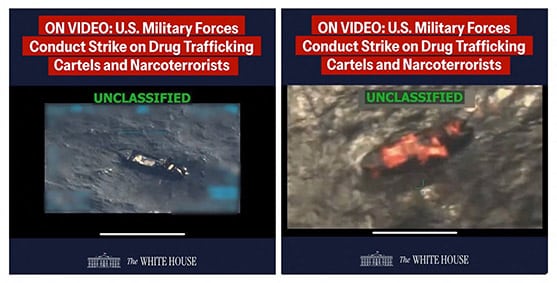
Onscreen, the small and visibly speedy boat plows its way through the waves, while a glowing green title at the top of the frame reads “unclassified.”
Seconds later, the image — and the vessel with it — explode in a brilliant flash.
In Oval Office remarks Sept. 2, President Donald J. Trump informed the American people the U.S. military carried out the strike seen in the video.
“We just — over the last few minutes — literally shot out a boat, a drug-carrying boat; a lot of drugs on that boat,” he said.
The Trump administration noted the action killed 11 people it alleged were “narco-terrorist” members of the Venezuelan Tren de Aragua gang, and that the vessel was in international waters.
Since a new front in America’s ongoing battle against drug smuggling has apparently opened — there have been two additional U.S. attacks on Venezuelan boats, the latest on Sept. 19, and a total of at least 17 related deaths — Catholics may be wondering: Are we at war? And if so, where do such enforcement actions fall on the spectrum of the church’s “just war” criteria?
Addressing the United Nations General Assembly in New York City on Sept. 23, Trump said the U.S. is “using the supreme power of the United States military to destroy Venezuelan terrorists and trafficking networks led by (Venezuela President) Nicolás Maduro.”
Amid reports of top White House aides urging Maduro’s ouster, and 6,500 U.S. military personnel operating in the region, the Venezuelan leader announced the country’s government is preparing a series of constitutional decrees to defend itself in case of an “attack” from U.S. forces.
An end to drug smuggling and “the war on drugs” — a term popularized by the media after a June 1971 press conference at which then-President Richard Nixon declared drug abuse “public enemy No. 1” — is obviously a desirable good.
“We all want that,” Msgr. Stuart Swetland, president of Donnelly College in Kansas City, Kan., and a U.S. Naval Academy graduate and Navy veteran, told OSV News. “But that starts with us dealing with demand, rather than supply. Both have to be addressed.”
The National Center for Drug Abuse Statistics reports over half (51.2 percent) of people 12 and older have used illicit drugs at least once, while the 2024 federal budget for drug control was nearly $44.5 billion. The U.S. Bureau of Economic Analysis estimates roughly $29.9 billion in illegal drugs entered the United States in 2017.
“You can’t just use any means to reach that good end of a drug-free America,” Msgr. Swetland continued. “The Catechism (of the Catholic Church) is pretty clear: All citizens and all governments are obliged to work for the avoidance of war — which means war should be a last resort, after other reasonable means have been exhausted.”
“The war against drugs,” he clarified, “is not a war in the sense of a military conflict; it is a police action. And it should be treated like a police action — which means that we don’t preemptively kill people; rather, we attempt to arrest people and to give them proper trials and procedures.”
The Catechism of the Catholic Church states the basic conditions of just war criteria: “At one and the same time, the damage inflicted by the aggressor on the nation or community of nations must be lasting, grave, and certain; all other means of putting an end to it must have been shown to be impractical or ineffective; there must be serious prospects of success; the use of arms must not produce evils and disorders graver than the evil to be eliminated.”
“It misses three aspects of the just war requirement,” explained Msgr. Swetland. “Rightful authority, because it’s Congress who declares war. (President Trump) does not have an authorization of force to intervene in the drug war this way. It’s not last resort, and is disproportionate. You could even add it’s indiscriminate in a sense; it doesn’t discriminate against civilian to combatants.”
Colombian President Gustavo Petro — also addressing the U.N. — called for an investigation.
“Criminal proceedings must be opened against those officials, who are from the U.S., even if it includes the highest-ranking official who gave the order: President Trump,” Petro said. If the boats were, in fact, carrying drugs as alleged, the Columbian president argued their passengers “were not drug traffickers; they were simply poor young people from Latin America who had no other option.”
“It’s illegal because of not having proper authorization,” said Msgr. Swetland. “The president of the United States is bound to protect and defend the Constitution of the United States, and the War Powers Act. Neither the War Powers Act of ’73 nor the Constitution gives him this authority.”
However, The New York Times reported Sept. 19 that “draft legislation is circulating at the White House and on Capitol Hill that would hand President Trump sweeping power to wage war against drug cartels he deems to be ‘terrorists,’ as well as against any nation he says has harbored or aided them, according to people familiar with the matter.”
Msgr. Swetland’s own military experience provides an example of how force can be exercised.
“The military sometimes is used as part of the police action to interdict the drug trade. When I was in the Navy in the 1980s — during President (Ronald) Reagan’s war on drugs — we were given a list of ships or plane numbers to be looking for,” he recalled. “And the ship I was on — the USS Kidd, before I was on it — did intervene, stopping a suspected drug running boat.”
“But,” he added, “they did it the way it’s supposed to be done — they used minimum force; they shot across the bow; that brought the ship to bear; they turned the ship over to the Coast Guard. It was a police action — not blow it up first, and ask questions later.”
David Cochran, a professor of politics at Loras College in Dubuque, Iowa, and author of “The Catholic Case Against War: A Brief Guide,” agreed.
“I think there’s two reasons these kinds of attacks violate the traditional understanding of just war theory in the Catholic tradition,” Cochran told OSV News. “The first is we’re not actually at war with Venezuela — so the use of military power (is) outside of an ongoing war. In fact, the attacks could be an act of military aggression itself — that violates the just war theory.”
“This idea — that when countries, even if the government might know about it, or citizens of countries, even if the government knows about it, is smuggling drugs that may reach the U.S. — I don’t think rises to the just cause to go to war against that country,” he observed, “or that it represents orthodox Catholic just war teaching.”
Cochran also noted drug smugglers are not armed combatants in the traditional sense.
“If you suspect drug smugglers, or people committing a crime, it’s not permitted to use military force to summarily execute them. And the whole reason is because military force is so lethal,” he shared.
“The Catholic tradition is very strict about only attacking armed combatants during armed conflict,” he said.
That’s not, of course, to say nothing can be done.
“The Catholic tradition wouldn’t deny that countries have a right to prevent smuggling of drugs into their territory,” commented Cochran. “But it doesn’t give you a blank check to use military power.”
Judy Coode — communications director of Pax Christi USA — said the Catholic peace movement organization is “appalled.”
“These attacks have been executions without any due process. We oppose these violent, destructive actions which grossly undermine the rule of law and diplomacy,” she shared in a statement to OSV News.
“Citizens of the United States must make it clear to members of Congress and the Executive Branch that they do not support their tax dollars being used for extrajudicial executions, a grave violation of human dignity,” Coode added.
Cochran noted that, historically, combatting drug smuggling is a complex and seemingly never-ending issue, due to America’s continual illicit drug use.
“We’ve been fighting a war on drugs for a long time and it’s very difficult to keep drugs out of a country as large as the United States, with such a demand for drugs by Americans who want to use them,” he said. “You can blow up lots and lots and lots of boats and kill lots and lots and lots of people — and it’s almost certainly not going to stop the drug problem in the United States.”
Read More World News
Copyright © 2025 OSV News
