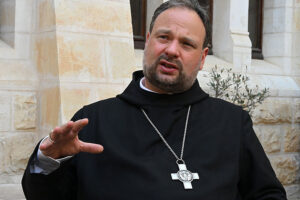
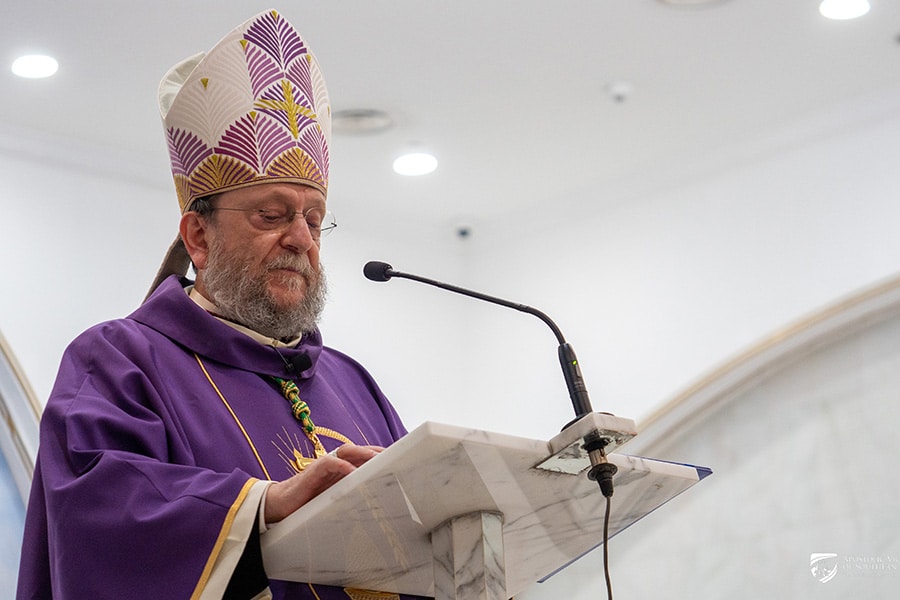
Amid the escalating chaos of another war in the Middle East, Benedictine Father Nikodemus Schnabel said the abbey where he resides has become an “island of hope in an ocean of suffering” where even people of different faiths have found refuge.
In a telephone interview with OSV News March 6, Father Schnabel, abbot of Dormition Abbey on Mount Zion in the heart of Jerusalem and of Tabgha, the community’s priory on the northwest shore of the Sea of Galilee, said that among those who took shelter as sirens blared in the holy city was a group of Muslim, Christian and Jewish students.
As uncertainty and fear loomed, seeing a group of young students whose religions are constantly pitted against each other sitting together was a “wonderful” sight.
On March 4, “the whole afternoon there was one alarm after another. We were in the shelter with Jews, Christians and Muslims. It sounds strange but it was wonderful,” Father Schnabel told OSV News.
Among the group, he noted, there was a curiosity about how different religious traditions “deal with a situation like that.”
“If we as a human family had this attitude of curiosity — the desire to understand others, the tradition of others — it would be wonderful,” he said. “Instead, in our times, we (think we) have the answers already. We think we already know the others.”
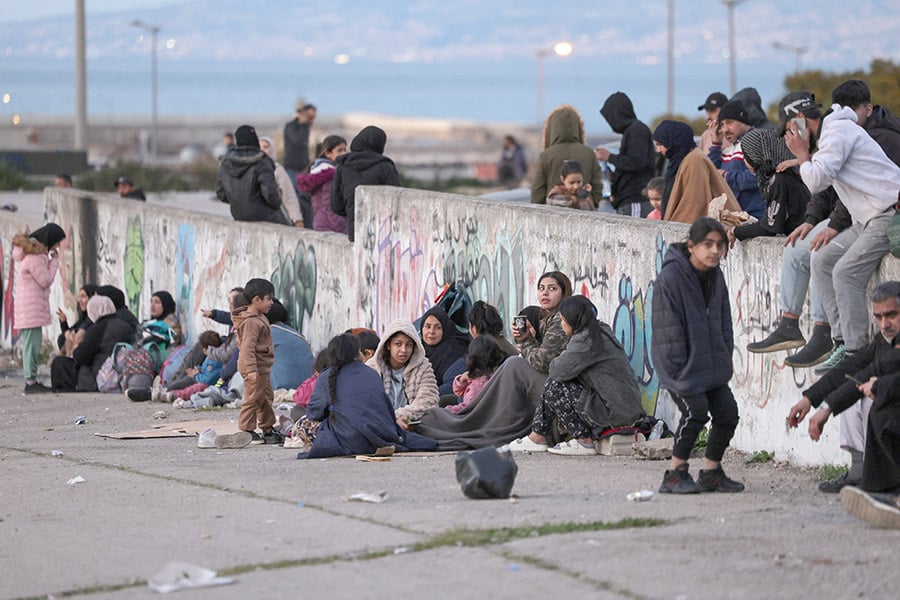
Father Schnabel told OSV News that instead of arguments or fear, those gathered shared concerns for people suffering across the region.
“There was, unanimously, really the feeling that all people are suffering,” he said, adding that the group also shared stories about frightened children and families affected by the conflict, reinforcing what he described as a deeper sense of solidarity.
“None of us said, ‘Oh, my life, my life,'” he recalled. “Instead, people were thinking about others.”
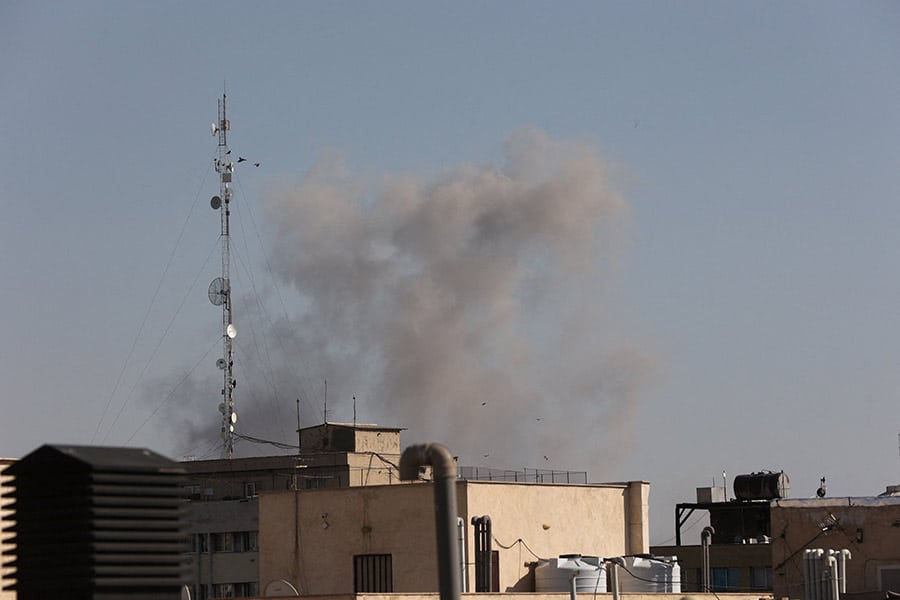
With the war entering its seventh day, Israel and the U.S. continued their strikes on Tehran, while the Israeli military also carried out an attack in southern Beirut against Hezbollah, who have joined in the fighting, NPR reported March 6.
Following the death of its supreme leader, 86-year-old Ayatollah Ali Khamenei, Iran has launched retaliatory strikes against U.S. bases and assets in the Gulf states, as well as strikes against Israel.
Father Schnabel told OSV News that while sirens and alarms were constant since the start of the war, in Jerusalem, “the situation has become more and more calm” with fewer sirens.
Nevertheless, the Benedictine abbot lamented that the current security restrictions have brought unusual restrictions in Jerusalem, with Israeli police closing religious sites, including the Dormition Abbey, to the public.
“The police came and closed our monastery to the public,” Father Schnabel said. “It was really a thing because it was never (closed) in the last weeks and months.”
While such closures have not been common in the past, he underlined that Christian, Jewish and Muslim holy places were also closed to the public, affecting sites such as the Church of the Holy Sepulchre, the Western Wall and the Temple Mount compound.
Despite the restrictions, he said, the Benedictine community continued its liturgical life.
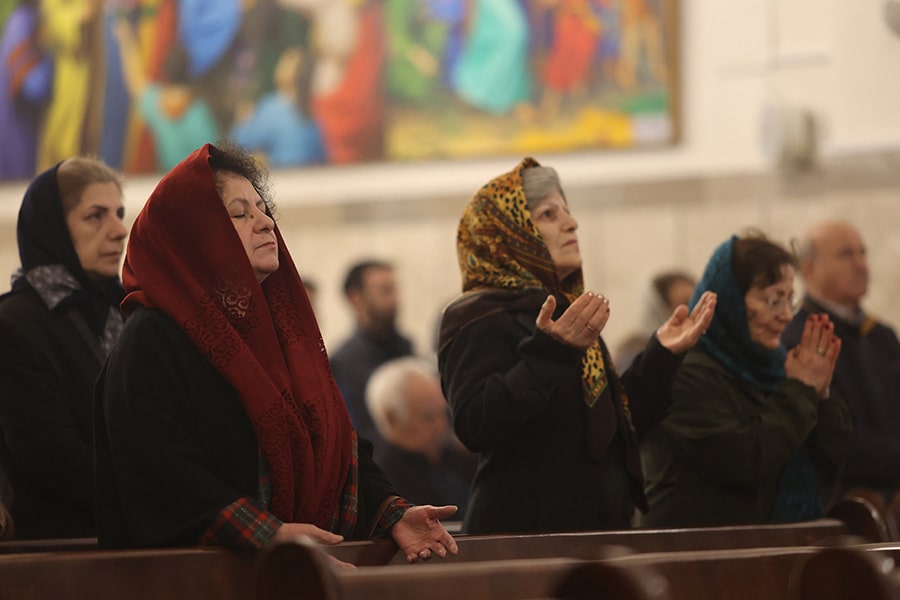
“Sometimes people misunderstand that our church is closed, so there is no prayer,” Father Schnabel said. “No. Of course, we have all our prayer times and we have daily Eucharist.”
At the start of the war, several pilgrim groups, including one from France, had taken shelter at the monastery. However, the abbot confirmed that all pilgrims have left the country.
Father Schnabel said he still welcomes individual pilgrims and that now that pilgrim groups have canceled their pilgrimages, Dormition Abbey remains open for those who wish to stay and pray.
“Our house is open and if you want, you can celebrate Easter with us. For me, it’s no problem. We have the rooms, we have food, we have drinks. No problem. So I tell every guest, ‘Don’t be worried. Stay as long as it is good for you.’ That’s our policy.”
For Father Schnabel, the presence of visitors — especially the group of Christian, Muslim and Jewish students who sheltered at the monastery — served as a powerful reminder for all looking at the conflict from the outside that the situation is far from “black and white.”
“We, as the Catholic Church here in this Holy Land, have members who are Palestinians, Arab-speaking (Christians) who have been here for centuries, who are under pressure from the settlers, from the political sphere. We have a small group of Hebrew-speaking Catholics, very often who have husbands or wives who are Jewish; Palestinian (Christians) who have Muslim neighbors,” he explained.
“We have Catholics (treated) as modern slaves from the Philippines, India and Sri Lanka,” the Benedictine abbot continued. “And of course, we have also Catholics like me: monks, nuns who run schools, who run hospitals, who run pilgrimage places. And of course, we have the pilgrims. So, we are everywhere.”
He also noted the Christian presence in Gaza, which he said was “another reality that nobody is talking about.”
“People ask me what my position is, my political position. I say I’m neither pro-Israel nor pro-Palestine. I’m pro-human because in the end, we are all human beings,” Father Schnabel told OSV News.
“Why should I cheer if a Jew is killed or a Muslim killed, or a Christian killed, or an atheist? In fact, we are losing together as mankind,” he added. “For me, there is one fear. Of course, losing life in the world is one. But I also have a bigger fear: of losing our humanity.”
Read More Conflict in the Middle East

Copyright © 2026 OSV News
