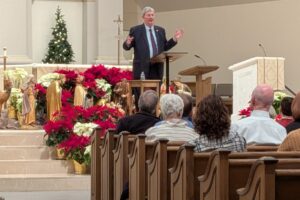
CLARKSVILLE — As speculation swirls around Pope Leo XIV’s young pontificate, George Weigel is urging Catholics to hit pause.
Speaking to a crowd of about 300 Jan. 9 at St. Louis in Clarksville, part of a pastorate with St. Francis of Assisi in Fulton, Weigel urged Catholics to resist snap judgments about the new pope and instead understand the complex moment he has inherited.
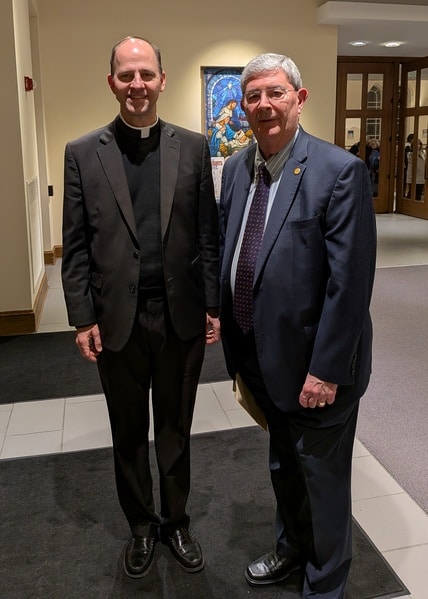
The Baltimore native and distinguished senior fellow at the Ethics and Public Policy Center delivered the pastorate’s featured distinguished speaker lecture, titled “Pope Leo and the Church Today: Challenges and Opportunities.”
“The first thing I want to do tonight is to calm things down,” Weigel told the audience. “Let’s all take a deep breath and try to understand the challenges faced by this man and … how we might support him.”
Weigel said the election of Robert Francis Prevost as the first pope from the United States should not have been a surprise “if you were paying attention.” Though born in Chicago, Pope Leo’s identity is deeply international, shaped by a decade of missionary work in Peru and leadership within the Augustinian order. Latin Americans, Weigel noted, often regard him as “one of their own,” and his fluency in several languages reinforces his reputation as an international figure rather than a narrowly American pope.
“He has an American sense of administrative competence,” Weigel said. “He is a very good listener.”
That competence will be tested, Weigel said, because Pope Leo inherited “a lot of problems, the extent of which he probably did not fully realize.” Chief among them is the Vatican’s financial situation, which Weigel described as being in “bad shape,” marked by a lack of transparency, outdated budgeting practices and significant unfunded pension liabilities. Financial reform, he said, is essential not only for internal accountability but also for maintaining credibility with Catholics who support the Church’s mission.
Another major challenge lies in the Church in Germany, which Weigel described as deeply divided from much of the global Church. Many German Catholic leaders, he said, are “not on the same page as the rest,” pursuing theological and pastoral directions that create serious tension within worldwide Catholicism.
Weigel, who wrote the definitive biography of St. John Paul II, also addressed the topic of synodality, the consultative and collaborative approach to Church governance emphasized in recent years by Pope Francis. While acknowledging the value of listening and dialogue, he expressed skepticism about prolonged synodal processes that fail to lead to concrete action.
“There has been an enormous investment of time and energy,” Weigel said, but without a corresponding movement toward evangelization. He warned against confusing endless consultation with mission and urged the Church to shift from discussion to proclamation.
That call, Weigel said, aligns closely with Pope Leo’s priorities. Evangelization remains central to the pope’s vision, and every Catholic is called to be a missionary disciple.
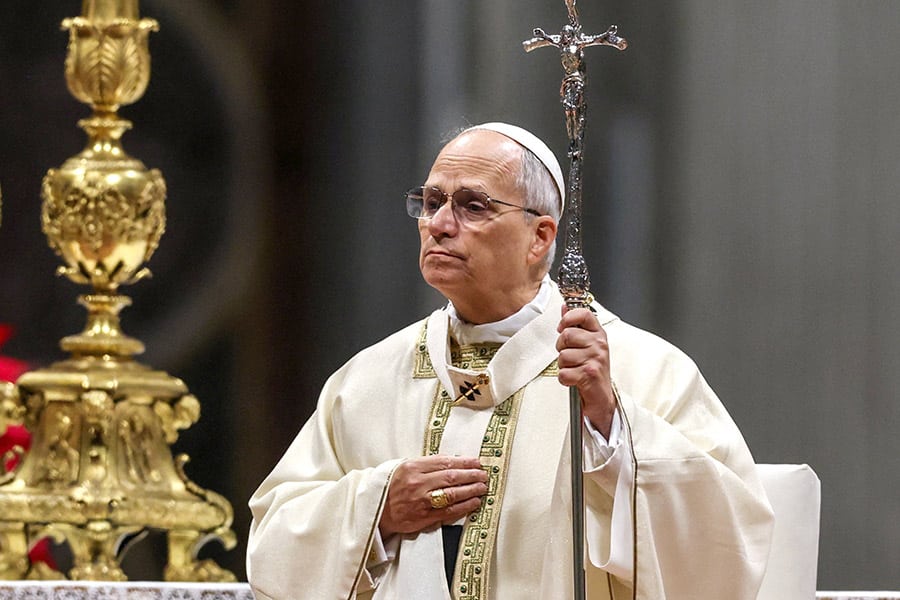
“He has a clear view of what the kingdom is all about,” Weigel said, adding that “every place is mission territory.”
Weigel pointed to thriving Catholic campus ministries in the United States as signs of hope for renewal. These communities, he said, succeed because they offer the full richness of Catholic life – sacraments, doctrine and pastoral care – without watering down the faith. Such clarity fosters genuine conversion and sustained spiritual growth among young adults.
Weigel praised Pope Leo’s emphasis on Christ rather than on himself or on institutional concerns. This Christocentric focus, he said, reflects the vision of the Second Vatican Council and offers a promising path toward restoring the Church’s spiritual vitality.
Internationally, Pope Leo faces complex diplomatic and ecumenical challenges, including strained relations with the Russian Orthodox Church and the Vatican’s controversial agreement with China regarding bishop appointments. Weigel cautioned that accommodating oppressive regimes risks compromising the Church’s witness and future missionary credibility.
Despite the challenges, Weigel expressed optimism about Pope Leo’s leadership, describing him as a prayerful, integrated man who respects established procedures and governs calmly.
Attendees welcomed the opportunity to hear Weigel’s perspective.
“We’ve read him for a long time,” said Jeff Forsyth, a parishioner at Church of the Resurrection in Ellicott City. “He has a very deep understanding of the Catholic Church both nationally and internationally.”
“I’m so glad I came,” said Virginia Matthias of St. Louis Parish. “I like having this kind of thing in our church. A lot of people came, and it was very good.”
Weigel concluded by encouraging Catholics to focus less on Vatican intrigue and media speculation and more on the life of faith at the local level – in parishes, families and communities – where, he said, the real work of the Church continues every day.
Email Katie V. Jones at kjones@CatholicReview.org
To view the entire talk, click play below:
Read More Local News
Copyright © 2026 Catholic Review Media
