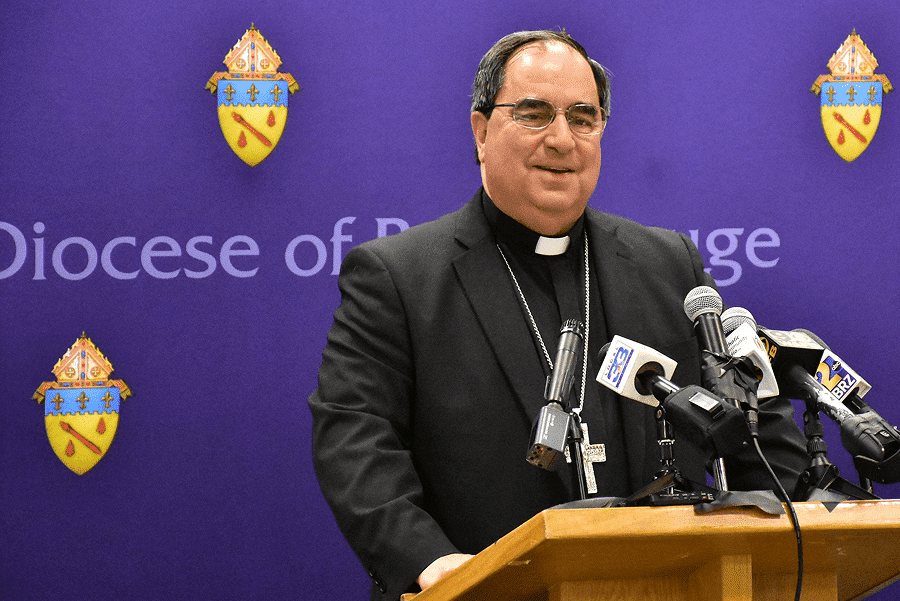
(OSV News) — Amid immigration detention sweeps in Louisiana — part of an ongoing nationwide campaign by the Trump administration — Bishop Michael G. Duca of Baton Rouge has issued a dispensation from the obligation to attend Mass for those concerned for their safety.
The dispensation, announced in a Dec. 4 statement posted to the diocese’s website, applies to Sundays and holy days of obligation, and remains “valid until the individual Catholic determines it is safe to attend Mass again or this dispensation is revoked or amended.”
He said that “those who choose to stay at home should gather as a family and spend time in prayer to keep the Lord’s Day holy.
“Reading the daily Mass readings, praying the rosary, or reciting a novena for intercessory protection are all suitable alternative spiritual practices for those accepting this dispensation,” he instructed.
Bishop Alberto Rojas of San Bernardino, California, issued a similar dispensation on July 8, and the Diocese of Nashville provided guidance in May on Mass obligations during immigration raids.
Bishop Duca said his decision — which comes just weeks after the U.S. Conference of Catholic Bishops’ Nov. 12 special pastoral message on immigration — was issued “with a heavy heart” and “in this time of uncertainty.”
He pointed to “the recent publicized arrival of Immigration and Customs Enforcement (ICE) officers into south Louisiana and greater Baton Rouge,” noting that “many of the faithful genuinely fear immigration enforcement action.”
On Dec. 3, the Department of Homeland Security announced “Operation Catahoula Crunch” — named for a dog breed native to Louisiana — which the agency said targeted “criminal illegal aliens roaming free thanks to sanctuary policies that force local authorities to ignore” ICE arrest detainers.
While state officials — including Louisiana Gov. Jeff Landry — have endorsed the Trump administration’s crackdown on immigration, New Orleans has since 2016 prohibited its officers from aiding federal immigration law enforcement, except in limited cases, and is a sanctuary city.
Baton Rouge’s police department, in contrast, is currently in discussions with federal officials to participate in ICE’s 287(g) program, referencing a section of the Immigration and Nationality Act that authorizes ICE to delegate certain enforcement actions — such as identification and arrest — to state and local law enforcement, who work under ICE oversight.
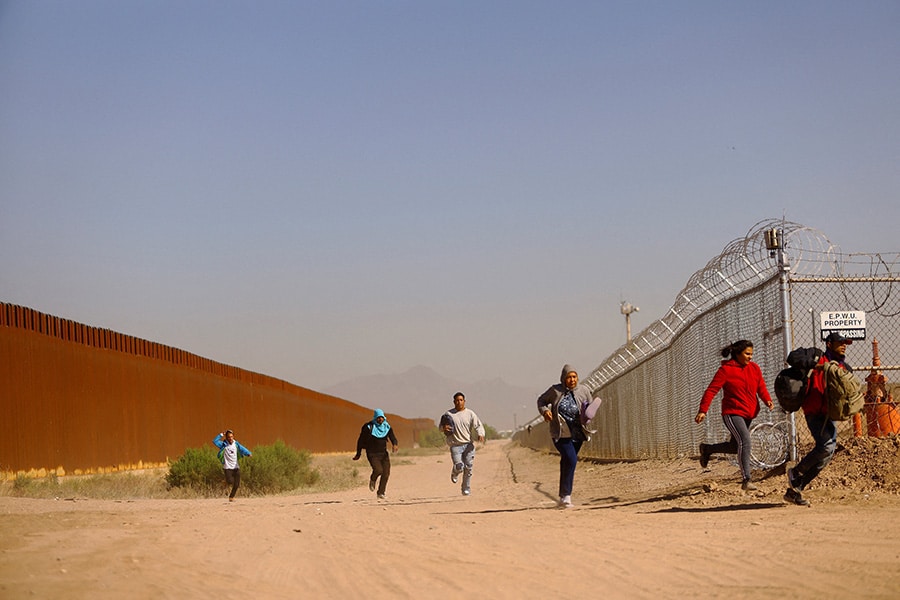
Immigration advocates in Louisiana have reported detentions of U.S. citizens in the sweeps, and have accused ICE officials of racial profiling.
In the New Orleans suburb of Marrero, security footage showed a 23-year-old woman, identified by NBC News as Jacelynn Guzman, a U.S.-born citizen, being pursued Dec. 4 by masked immigration agents as she ran to her home. Guzman told the outlet she had repeatedly told them she was a U.S. citizen. The agents stopped at the property line, as Guzman’s stepfather ordered them away.
DHS later said that “U.S. Border Patrol was conducting a targeted immigration enforcement operation against a criminal illegal alien previously charged with felony theft and convicted of illegal possession of stolen property,” and “encountered a female matching the description of the target.”
The agents “determined the individual in question was not the target,” and all “departed the area” without making any arrests, said DHS.
In his message mentioning the fear people have of immigration enforcement actions, Bishop Duca said, “These expulsions are affecting not only our Catholic Hispanic brothers and sisters but also refugees and immigrants of all denominations from other nations who form the rich tapestry of our local communities.
“These are our neighbors, coworkers, and parishioners,” said the bishop.
As of Nov. 16, well over 65,000 individuals are in ICE custody, with 73.6% of those detained having no criminal conviction, and many of those with convictions were responsible for minor offenses such as traffic violations, according to Syracuse University’s Transactional Records Access Clearinghouse.
Pew Research Center has reported that close to half of the nation’s Latinos (47%) report feeling less safe in their neighborhoods due to the Trump administration’s deportation campaigns.
Latinos’ daily routines have been impacted, said Pew survey respondents, with 19% recently changing their everyday activities over concerns of being asked to prove their legal status, and 11% reporting they now more often carry documentation proving their citizenship of immigration status.
In addition, some Latinos “are engaging in certain activities less often in recent months,” reporting to Pew that they’re avoiding local community or cultural events (10%), speaking a language other than English (9%), family and friend gatherings (9%), grocery shopping (8%) and religious services (7%).
“National security and the protection of human dignity are not incompatible,” said Bishop Duca. “We must advocate for a just solution to this difficult situation in our country.”
Catholic social teaching on immigration balances three interrelated principles — the right of persons to migrate in order to sustain their lives and those of their families, the right of a country to regulate its borders and control immigration, and a nation’s duty to regulate its borders with justice and mercy.
The Catechism of the Catholic Church instructs that “more prosperous nations are obliged, to the extent they are able, to welcome the foreigner in search of the security and the means of livelihood which he cannot find in his country of origin” (Catechism, 2241).
In his Dec. 4 statement, Bishop Duca urged the faithful to “pray for those immediately affected, especially during this Advent season — a time in which we should be anticipating the joy of Christmas, surrounded by our family in celebration, instead of the experience of anxiety and fear.
He quoted Pope Leo XIV’s apostolic exhortation “Dilexi Te” (“I Have Loved You”): “God has a special place in his heart for those who are discriminated against and oppressed, and he asks us, his Church, to make a decisive and radical choice in favor of the weakest. “
“Through our prayers and actions, may those who are suffering know that Jesus’ words are addressed personally to each of them,” said Bishop Duca.
Read More Immigration and Migration
Copyright © 2025 OSV News
