Early in her career, Brigitte Bardot, the French cinematic icon who died Dec. 28 at 91, had a unique ability to make American Catholics come to their feet. But not in a good way. Instead, in 1958, they were often carrying picket signs outside movie theaters while her film “And God Created Woman” played inside.
Bardot made nearly 50 movies between 1952 and 1973, when she announced that she would make no more and turned to the cause of animal rights. Seven of those, all from the 1950s, received the C (Condemned) classification from the National Legion of Decency.
Despite all that, Bardot — born in 1934 and raised by conservative Catholic parents who wanted her to become a ballet dancer — never once, in the ensuing decades, criticized the church. Indeed, in an interview near the end of her life, she observed that, although she was no longer a practicing Catholic, “Faith is within me, no more and no less than before.”
Seven C’s from the Legion of Decency was a lot for one actor. Most had to do with Bardot’s early portrayals that found some pretense for her to be clad only in a towel. (“Suggestive costuming” was a frequent complaint.)
The C classification for “Love is My Profession,” (released in America in 1959) which has a seduction scene crass even by contemporary standards, was well-earned, though. The Legion’s summary blasted the film for its “unrelieved emphasis on sensuality of a highly gross nature,” making it, overall, “an open flouting of Judeo-Christian standards of common decency.”
Bardot’s “Mademoiselle Striptease,” released in France in 1957, was much tamer, its title notwithstanding. The film is about the writer of a scandalous novel who is nearly put in a convent. She enters an amateur striptease contest, and that sequence was demure enough to earn a lengthy photo spread in Life magazine. But a C it was nonetheless.
The film that established Bardot’s reputation, “And God Created Woman,” directed by her then-husband Roger Vadim and premiering in Europe in 1956, led to an unusually long and varied reaction from the Legion.
At the time, the U.S. distribution of most foreign films was based on bookings by individual theaters. As a result, the movie played around the country for the entirety of 1958 and into the following year, sometimes in repeat engagements. So demonstrations against it had to be organized locally and sporadically.
From its beginning in the mid-1930s, the Legion’s organizers believed that films had the power to influence behavior and either bolster or degrade public morality — especially respect for marriage.
The plot of “And God Created Woman” has to do with a developer’s plan to build a hotel-casino in Saint-Tropez. To do so, he needs to pay off a small shipyard to get it to relocate. But Bardot’s sexuality dominates everything.
She plays Juliette, a wayward 18-year-old orphan. In her opening scene, she is face down in profile and nude, sunning herself.
When she stands up, she’s behind a sheet on a laundry line, but the implication is clear. She has been having an affair with the developer, and when she later marries Michel (Jean-Louis Trintignant), the brother of the man she really loves, she tells him how much she enjoys sex. Later in the film, Juliette is in a clingy wet dress by the ocean.
The scene with the most impact, then and now, has Juliette, barefoot and on a tabletop, wearing a black leotard, energetically dancing the mambo. She is perspiring — something never seen on female stars at the time.
Juliette is clearly enjoying herself. While the scene is thought of today as representing female empowerment, at the time, the public just saw it as titillating.
That scene alone made Bardot’s subsequent career. It also launched Catholic outrage beginning in December 1957, when the film arrived in America and the Legion called it “an open violation of Christian and traditional morality” as its “theme and treatment dwells without relief upon suggestiveness in costuming, dialogue and situations.”
Yet the Legion’s effectiveness was on the wane. It could inspire picket lines, and one theater in Pittsburgh tried to placate the faithful by suspending showings during Holy Week. But the Legion failed to make a dent in the film’s American box office haul, which ultimately amounted to some $4 million.
Msgr. Thomas Little, executive secretary of the Legion, accused Bardot’s pictures up to that point of contributing to a “moral breakdown” in movies. After that, life moved on.
In 1958, the Legion classified Bardot’s “The Bride is Much Too Beautiful” as Fair (Objectionable in Part) because of “suggestive costuming.” In 1960, however, it classified her “Babette Goes to War” as suitable for adults and adolescents – the equivalent of an A-II classification today. Family fare.
Bardot’s animal-rights activism led her to form her own foundation in 1986. She supported the abolition of whale hunting and campaigned against all forms of animal cruelty, including medical testing. She sold many of her possessions to finance the cause.
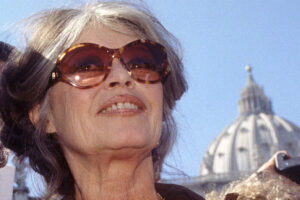
This led to a remarkable scene. On Sept. 27, 1995, Bardot not only attended the weekly general audience of St. John Paul II as a representative of the International Fund for Animal Welfare, she also got to chat briefly with the pope.
She settled in Saint-Tropez and, as she aged, became more irascible, running afoul of strict French laws on hate speech. She was fined five times for “incitement to racial hatred” for remarks and public postings she had made about Muslims and immigrants.
In September 2024, Bardot gave a remarkable interview to Clémence Nava of Aleteia in which she discussed her Catholic background. Some of what she said could be called typical for a pre-Vatican II generation.
“I feel that Mass has lost some of its mystery, a certain warmth of soul. When I was a child, I attended church with my parents every Sunday. I remember the sense of mystery that emanated from that magnificent place.”
“The priest celebrated with his back to us, in Latin. It’s such a pity that this was modernized. Celebrating Mass facing the congregation feels to me like a theatrical performance. I would describe myself as a traditionalist. I’d like to see Catholic worship regain greater respect and importance.”
And having met one pope, she expressed disappointment with another. “I wrote to the pope twice, happy to learn that he was taking the name Francis and convinced that he would do something for animals. I never received a reply.”
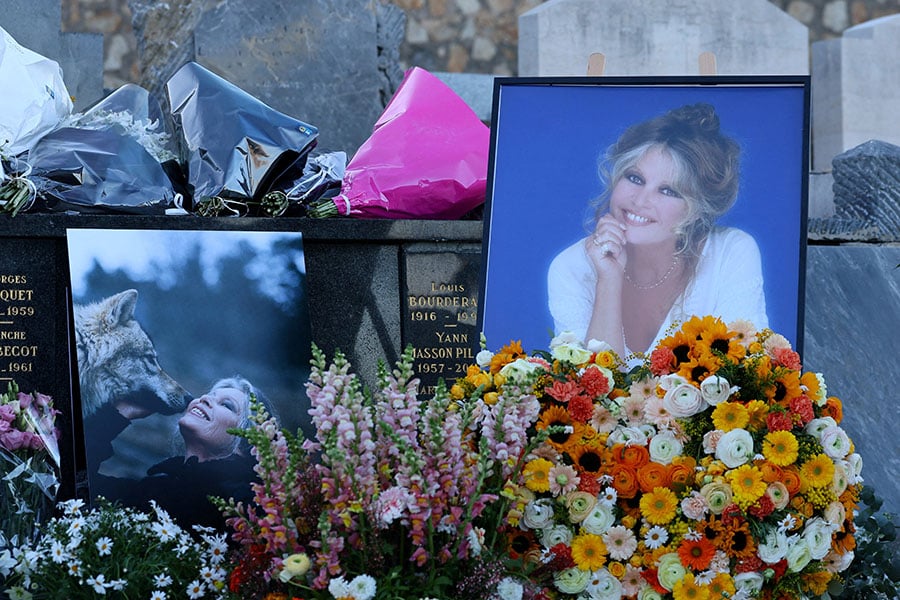
Bardot is survived by her fourth husband, Bernard d’Ormale, and a son. At her Jan. 7 funeral Mass at Notre-Dame-de-l’Assomption Church in Saint-Tropez, Father Jean-Paul Gouarin’s homily omitted Bardot’s fame completely.
“I do not know how many among us believe in eternal life,” he said. “Many believe that it is finished. Well, no. And that is precisely what must motivate us, what must invite us to fulfill ourselves.”
He added, “I only know the word of Christ, who tells us: ‘I go to prepare a place for you,’ and we are here to pray that Brigitte has a place. The essential thing is that she has her place. The essential thing is that she is there.”
Read More Movie & TV Reviews




Copyright © 2026 OSV News
