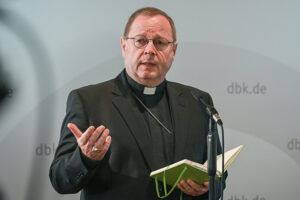
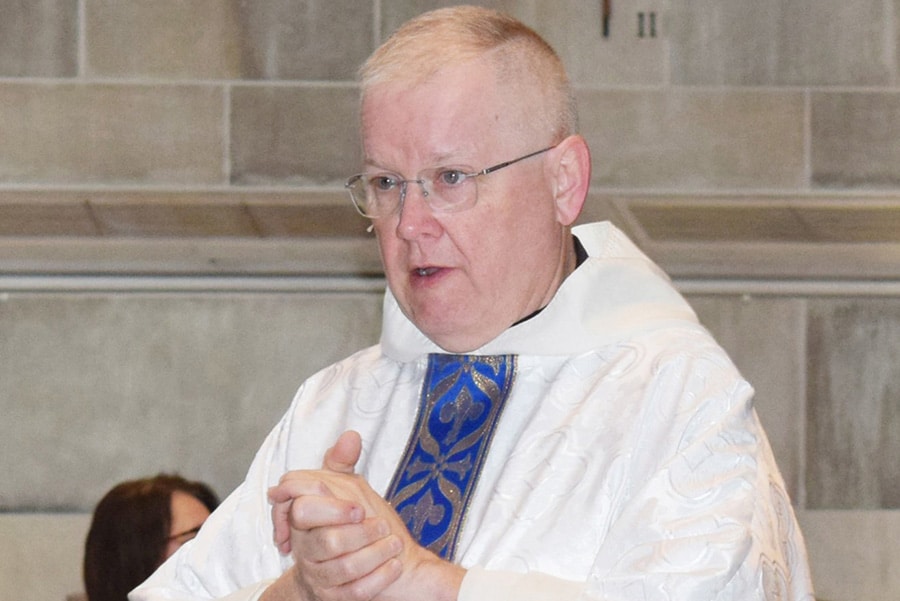
Bishop Georg Bätzing of Limburg, president of the German bishops’ conference, who spearheaded the controversial Synodal Way during his six-year term, announced that he will not seek reelection when the bishops meet for the spring assembly in February.
The Diocese of Limburg published excerpts of Bishop Bätzing’s letter to the German bishops’ conference Jan. 19, saying that he reached the decision “after consultation and mature reflection.”
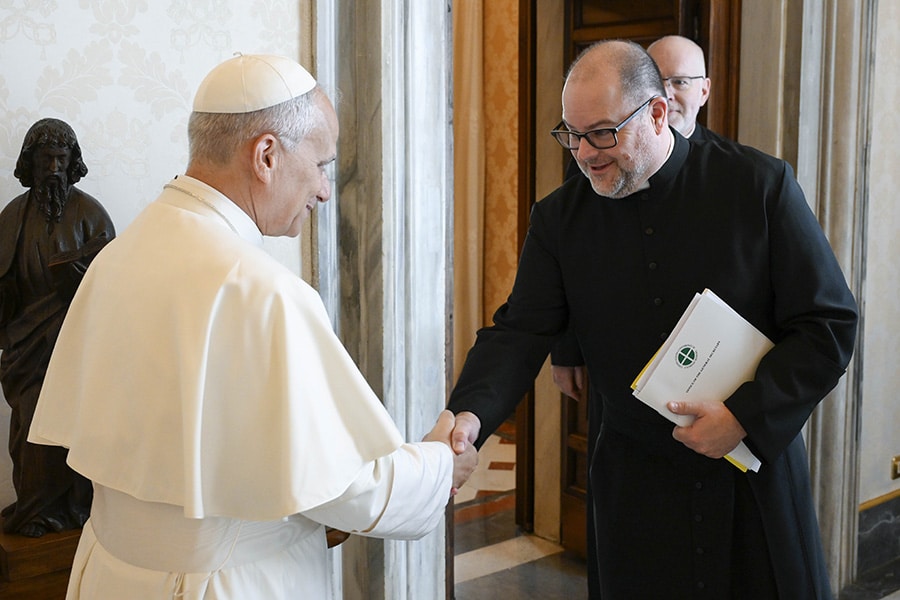
According to the Vatican, Bishop Bätzing met with Pope Leo XIV in September. The meeting was held several months after the German bishop was criticized for comments he made about a debate regarding abortion in Germany, which, although technically illegal, permits abortions up to 12 weeks without punishment.
Asked to weigh in on the debate involving a candidate for the constitutional court’s support of abortion legislation, the bishop said the current abortion law represented a “wise balance.”
“Why abandon the clear compromise that exists on the issue of abortion and thus risk a possible social divide?” he asked in an interview with Augsburger Allgemeine.
In his statement, Bishop Bätzing said it was “a great honor and joy to perform this service in truly demanding times” and thanked those “who have supported me in the past six years in an appreciative and constructively critical manner.”
“It has been six intensive years in which we bishops, together with many others from the People of God, were able to move things forward and realize a viable future form for the Church in our country,” he wrote. “Now it is time to place this task, which is important for the work of the Bishops’ Conference, into other hands. And I am certain that things will continue well.”
Bishop Bätzing also prayed for “cooperation within the conference, continued courage for open dialogue, for constructive debate, and the willingness to reach out to one another — so that together we may bear witness to the joy of faith to the faithful in our country and many more.”
The German bishops’ conference confirmed Bishop Bätzing’s statement and said the election of a new president will take place during the Feb. 23-26 spring plenary assembly in Würzburg.
During his tenure, Bishop Bätzing spearheaded the Synodal Way. Launched in 2019, the reform process began in response to the 2018 MHG study, a comprehensive investigation into clergy sexual abuse in Germany from 1946-2014.
The study, which was commissioned by the German bishops’ conference, revealed that 1,670 clerics sexually abused 3,677 minors during that period of time. The public outcry prompted bishops to discuss a path of reform.
The Synodal Way was established as a two-year reform process, but it was extended due to the COVID-19 pandemic and concluded in 2023.
However, its push for revising established church teachings on homosexuality, women’s ordination and priestly celibacy prompted concerns by bishops around the world that it would set a dangerous precedent that would ultimately break German Catholics away from the universal Church.
In 2022, in an open letter signed by more than 70 bishops from four continents — 49 bishops from the U.S., four from Canada, 19 Africans, one Italian and one Australian — the prelates raised concerns that the Synodal Way was relying more on “sociological analysis and contemporary political, including gender, ideologies” than on Scripture and tradition, and being too focused on “power” and “autonomy.”
Bishop Bätzing expressed surprise and responded by saying that the Church needed to speak openly about abuse of power in the Church and that the “euphemistic dressing up, as you try to do in your letter, does not really help.”
That same year, the Vatican issued a rare statement, saying that “the ‘Synodal Way’ in Germany does not have the power to compel the bishops and the faithful to adopt new ways of governance and new approaches to doctrine and morals.”
In a joint statement with Irme Stetter-Karp, president of the Central Committee of German Catholics, known as ZdK, Bishop Bätzing said the statement was a “source of astonishment” and that it was “not a good example of communication within the Church.”
Among those most concerned by the direction the Synodal Way was taking was Pope Francis, who had criticized the path the German bishops were taking.
In a 2023 interview with The Associated Press, the late pontiff said Germany’s synodal process was being led by the “elite” and warned that it was guided by ideological principles rather than the Holy Spirit.
“When ideology gets involved in church processes, the Holy Spirit goes home, because ideology overcomes the Holy Spirit,” he said.
The pope’s interview with AP prompted Bishop Bätzing to go on the defensive and openly criticize Pope Francis.
In an interview with the German newspaper Die Welt just days after the AP interview of the pontiff, Bishop Bätzing said he viewed the pope’s way of leading the Church “through interviews to be extremely questionable.”
Given its contentious relationship with Rome over the past six years, it will be now up to the German bishops’ conference to choose a president who will either continue the reforms spearheaded by Bishop Bätzing or one with a more diplomatic approach than his predecessor.
Read More Bishops

Copyright © 2026 OSV News
