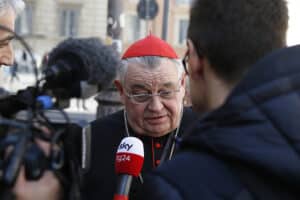
Cardinal Dominik Duka, whose life was defined by communist persecution, was remembered by the master of his Dominican order as one that “played a key role in restoring Dominican life in Czechoslovakia and later in the Czech Republic.” Cardinal Duka died Nov. 4 at age 82.
Father Gerard Francisco Timoner III, the master of the Order of Preachers, remembered the late cardinal’s courage to persevere in faith amid communist persecution.
When “his state authorization to exercise priestly ministry was revoked, forcing him to take a civilian job at the Škoda Works in Plzen,” in 1975, he “continued his pastoral and formation work in secret, training young Dominicans, organizing underground theological studies, and maintaining contact with Dominicans abroad.”
For this, the master said, Cardinal Duka was arrested in 1981 and convicted of “obstructing state supervision of churches.” He spent 15 months in the Plzen-Bory prison, “where he prayed with fellow inmates and strengthened them in their faith.”
Cardinal Duka was born in Hradec Králové in the Czech region of Bohemia in 1943. His father fought as an aviator in the Allied Czechoslovak Army in exile in Britain, and later was jailed by the communist regime in 1948. The future outspoken leader of the church was raised by his mother.
“He was denied further education by the communist regime and therefore worked as a mechanical locksmith,” the master of Dominican order said in his Nov. 4 statement.
Duka then witnessed firsthand the communist persecutions of the church, seeing nuns expelled from their convent in Hradec Králové. His vocation was born during a May devotion to the Blessed Virgin Mary, when the presiding priest gave a catechesis on a priest who had left the ministry. “That catechesis gave me an entirely different idea, to choose a vocation to the priesthood,” he explained.
Following his military service, he was accepted in 1965 to study theology at the Theological Faculty in Litomerice.
In 1968, Jaroslav entered the Order of Preachers and took the name Dominik in honor of the order’s founder. He was ordained a priest in 1970.
As in other communist states, Czechoslovakia’s government suppressed religion and went after the Catholic Church as the cradle of real freedom. In 1975, the state revoked then-Father Duka’s official license to minister as a priest. Duka thus worked in a Škoda automobile factory but continued to clandestinely minister the sacraments and was a novice master — illicitly celebrating Mass and publishing uncensored books.
During his subsequent 1981 imprisonment, then-Father Duka “prayed with fellow inmates and strengthened them in their faith,” Father Timoner said. There, he shared a cell with the future Czech president Václav Havel, one of the best-known dissident intellectuals behind the Iron Curtain.
Havel and Cardinal Duka would remain friends for decades; the cardinal presided over the funeral Mass of the former president in St. Vitus Cathedral in 2012.
Like many other Catholics behind the Iron Curtain, the young Dominican felt inspired by the witness of the Polish-born pontiff, St. John Paul II. Earlier in 2025, he told Vatican News that “such a pope appears once every thousand years.”
Cardinal Duka explained that when in prison he and Havel regularly spoke about the pope, whom they admired for having given explicit and public support to the repressed members of the Czechoslovak Charter 77 movement in 1981. The landmark declaration calling on Czechoslovakia’s communist rulers to honor their commitment to human rights under the 1975 Helsinki Accords was to become the dissident movement’s most significant protest against the regime.
In 1998, John Paul chose the dissident priest to lead the Diocese of Hradec Králové. In 2010, Pope Benedict XVI appointed then-Bishop Dukah to be the archbishop of Prague — an office he exercised until 2022 — and two years later made him a cardinal.
“Throughout his 27 years of episcopal ministry, he remained deeply connected to the Order and supported it in many ways,” Father Timoner said in his letter. Two major issues he tackled during those years were the restitution of church property seized by the communist regime and growing secularism in one of the world’s least religious societies.
During his episcopacy, Cardinal Duka became known as an outspoken doctrinal and social conservative, sometimes provoking controversy with his statements. Following the promulgation of “Amoris Laetitia,” which according to many interpretations cautiously allowed divorced and civilly remarried Catholics to receive holy Communion in some cases, the Czech cardinal submitted a “dubia,” Latin for “question,” to Pope Francis.
Cardinal Duka forbade a Prague parish from holding LGBTQ-related events, and participated in Prague’s March for Life. He cautioned against immigrants who did not respect their host countries’ values. After the murder of the American conservative podcaster and activist Charlie Kirk earlier this year, Cardinal Duka celebrated a requiem Mass for him.
Although in the 2021 census only 12% of Czechs identified as Christians, Jakub Medek, a Poland-based Czech journalist for Radio TOK FM and the host of the Czechostacja podcast, told OSV News that “in such a secular country as the Czech Republic, Cardinal Duka, even after retiring, was for many Czechs a significant part of the political elites” and that he remained “if not a moral authority than at least an important figure whose opinion mattered.”
Read More Obituaries
Copyright © 2025 OSV News
