
If you’re like me, you were impressed by the athletes of the Milan-Cortina Olympics. In them we witnessed both the rewards of hard work and the traumatizing effects of extreme expectation.
It’s hard to believe that most of these athletes were just teens and young adults.
As I watched them, I was brought back to the recent gathering of the Fellowship of Catholic University Students (FOCUS), SEEK26, in which I participated.
During the SEEK conference, I was struck by the pressures and anxieties experienced by young people today, and by the number of times the speakers tried to convince them to believe in God’s personal, unconditional love.

I started to wonder why this message was being repeated with such insistence. It seemed a little cheesy. Doesn’t God’s love go without saying?
Then I read the letter our superior general had just sent to all the Little Sisters around the world, establishing a spiritual orientation for us for 2026. In it, she proposed we spend a year of joyful confidence in God’s Providence, and she asked, “Do we truly believe in God’s Love for us?”
There was that question again!
Whether a freshman in college or a consecrated person with a life-long commitment to God through religious vows, this question is central to our lives!
So, I asked myself, why is it that so many of us find it so hard to believe in God’s love?
I decided to do a survey on this question, asking fellow Sisters, together with some friends and colleagues – anyone on my phone’s contact list – about why believing in God’s love is so difficult.
The responses I received fell broadly into three categories.
Some of those I surveyed suggested that the memory or shame of past sins deters many people from believing in God’s love. I’ll call these folks the St. Peters among us, for when Jesus called St. Peter to follow him, he immediately recoiled, protesting, “Depart from me, for I am a sinful man!”
Another group seems to be victims of the prejudices and negative judgments of others, which crush their sense of self-worth. Even if unfounded, these negative messages coming from outside ourselves can drown out the truth that God’s love is personal and unconditional.
Those who suffer from prejudices and negative judgments remind me of the Samaritan woman at the well in St John’s Gospel. Painfully
ware of her inferior social status in the eyes of the Jewish majority, she shies away from Jesus. “How can you, a Jew, ask me, a Samaritan woman, for a drink?”
The third set of responses suggested that some people find it difficult to believe simply because they have never seen God or experienced his love firsthand. “How can I believe in someone or something I can’t even see?” they ask.
These folks are like “doubting” Thomas, who, after the resurrection protested, “Unless I see the nail marks in his hands and put my hand into his side, I will not believe.”
The results of my survey – unscientific as it was – gave me much food for thought. There are so many St. Peters, doubting Thomases and women at the well, including ourselves.
What can we do to convince us that God really loves us, regardless of our sins and faults?
I believe that the simplest, most direct way to overcome our doubts about God’s personal and unconditional love is to prayerfully turn to the Cross.
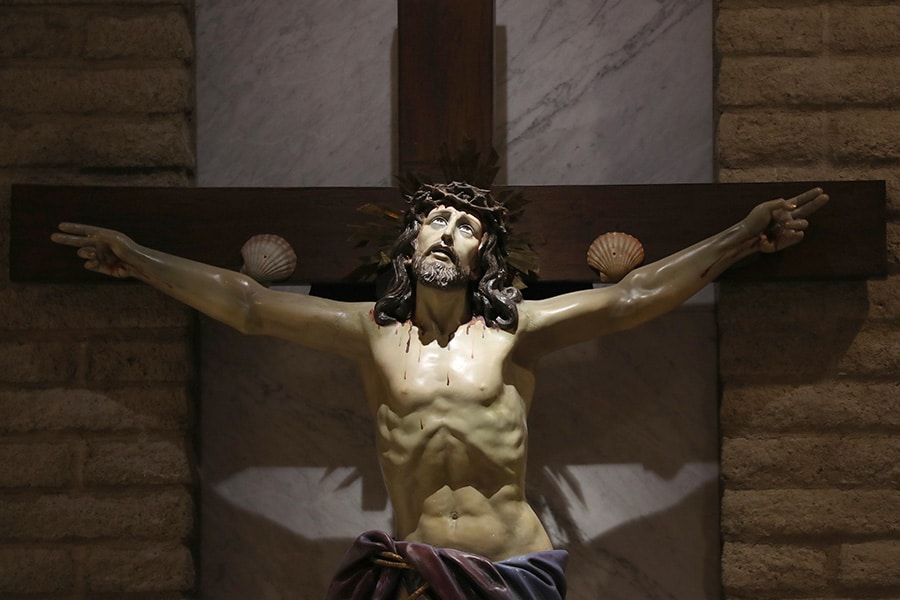
The image of Christ on the Cross – whether it be a very large crucifix hanging in a grand cathedral or a simple one at the end of our rosary – speaks volumes about God’s love.
From the Cross Jesus calls out to all the St. Peters among us, urging them to let go of their sins and accept his forgiveness. Just as he said to the good thief, he says to them, “You will be with me in Paradise.”
To those who distance themselves from God because others have convinced them that they are not worthy of love, Jesus stretches out his arms and says, “I love you so much that I would have died for you even if you were the only person on earth.”
And to those who say they will not believe without seeing, Jesus holds out his wounded hands and says, “See my hands and my side, these wounds were really for you.”
During this Lent, I pray that we will all turn to the Cross and find there the undeniable proof of God’s personal, unconditional love. Then, through our kindness and love, may we convince others that they too are worthy of God’s love.
Read More Commentary


Copyright © 2026 Catholic Review Media
