
DUNDALK – Three months after a lightning strike sparked a devastating fire at St. Rita Church in Dundalk, parishioners are weighing in on the future of the heavily damaged building as part of a discernment process that will help Archbishop William E. Lori decide how to move forward.
The conversation comes amid a broader period of transition following the merger of four local parishes – St. Rita, St. Luke in Edgemere, Sacred Heart of Mary in Graceland Park and Our Lady of Hope in Dundalk – into a single faith community under the Archdiocese of Baltimore’s “Seek the City to Come” pastoral planning initiative.
The new parish is seated at Our Lady of Hope, with St. Rita Church serving as an additional worship site.
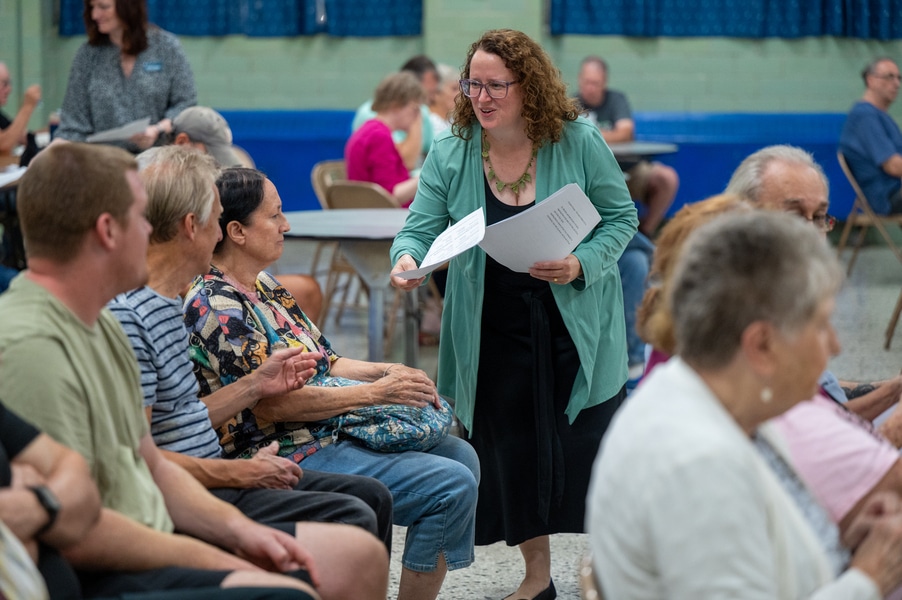
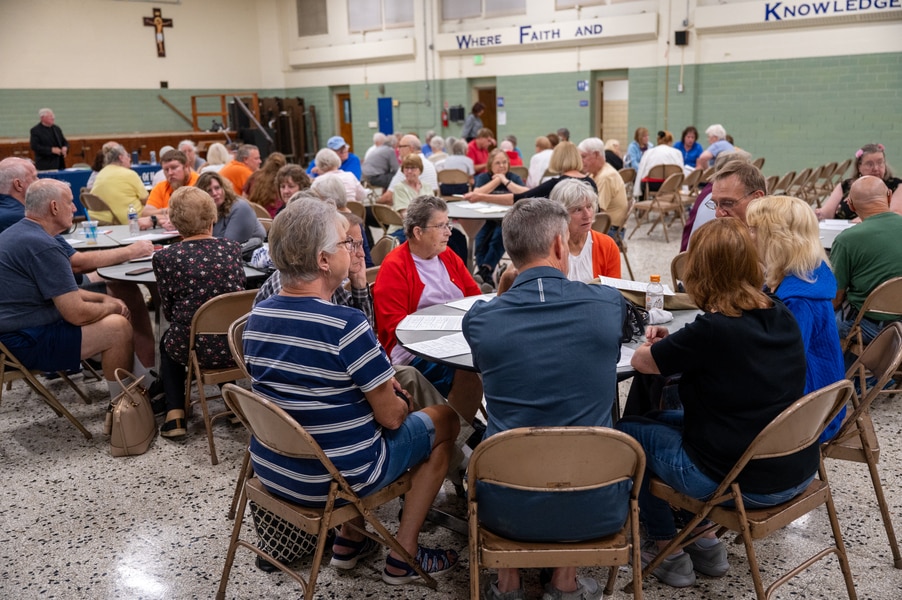
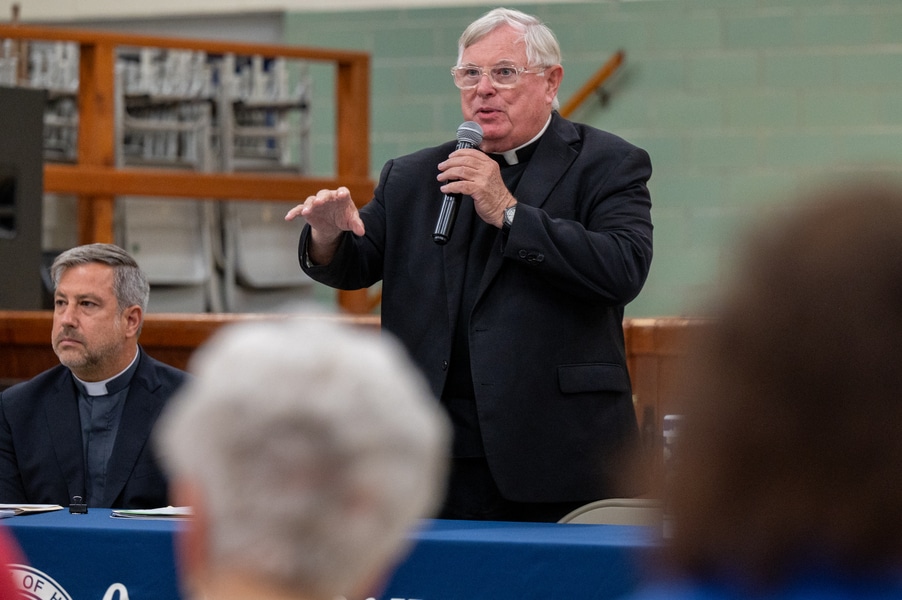
During an Oct. 6 meeting at Our Lady of Hope-St. Luke School, which drew 122 attendees, archdiocesan representatives outlined three options developed in collaboration with parish leaders and committees:
Option One: Restore St. Rita Church to its pre-fire condition.
Option Two: Clean and sell the church property.
Option Three: Demolish the building and sell the property.
Regardless of what option is chosen, the parish will receive $1.1 million from insurance – the amount in damages assessed by adjustors.
Archdiocesan leaders noted that one idea under consideration is the possible construction of a new church on the campus of Our Lady of Hope, whose current church building is in need of significant repair.
“Whatever decision is made – rehabbing, new construction, etc. – the new parish will use the payment from the insurer to that end,” Deacon Andrew Lacovara, delegate to the Urban Vicariate, told the Catholic Review.
Julie St. Croix, director of the Office of Parish Renewal in the archdiocese’s Institute for Evangelization, emphasized during the meeting that no decisions have been made. Parishioner input, she said, will help guide the process.
“The fire was very unexpected, catastrophic and not the way we planned things to go,” she said, “but we need to keep in mind that the goal here always is to build this new parish together. And there is a potential to build something new – something that everybody will feel a part of.”
St. Croix noted that since the merger Dec. 1, 2024, Mass attendance at Our Lady of Hope parish has been averaging 800 a week – about 100 less than the amount of people attending the four churches as they existed prior to the merger.
Since the merger, attendance at the Our Lady of Hope worship site increased by about 250, with attendance at the St. Rita worship site decreasing by about 50.
Following the fire, the 10 a.m. Mass at St. Rita was relocated to Our Lady of Hope and has been attracting about 200 people, including worshippers from St. Rita and possibly some from other former parishes – only slightly lower than the number attending prior to the fire, St. Croix said.
In a fact sheet, the archdiocese noted that the former parish of St. Rita has $556,046 in savings, the proceeds from the sale of its school and convent. The campus at St. Rita is anticipated to have more than $375,000 in deferred maintenance costs, independent of repair costs necessitated by the fire.
The campus incurs more than $38,000 a year in utilities, insurance and grounds expenses. The former St. Rita Parish also has $840,642 in debt to the archdiocese, including $75,964 in health care insurance and $211,975 in property and casualty insurance premiums paid by the archdiocese.
In addition, the former St. Rita parish has $534,624 in unpaid cathedraticum (a parish tax paid to the archdiocese) and $18,079 in unpaid school assessments.
Deacon Lacovara noted that the archbishop is willing to defer the collection of $500,000 for the moment, which leaves $340,642 to be reconciled with any sale of property.
Financial projections show that restoring St. Rita Church would net the parish about $143,000, while cleaning and selling or demolishing and selling the property would each yield roughly $1.1 million.
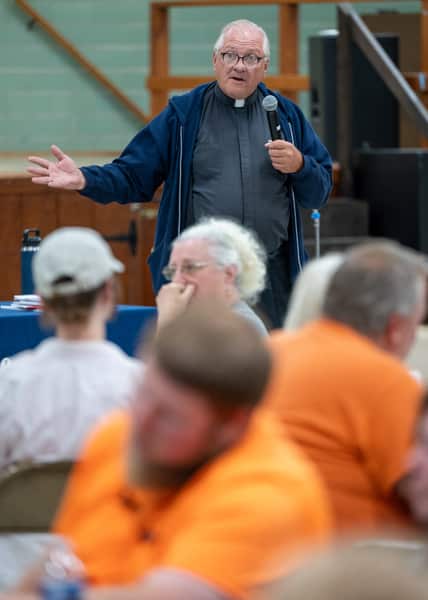
Father Kevin Mueller, pastor of Our Lady of Hope, emphasized that parish leaders have been discerning what to do with the church at Our Lady of Hope long before the fire at St. Rita. The building, erected in 1970, has numerous issues, including problems with its ceiling, a lack of meeting space and nonfunctioning air conditioning.
The pastor noted that the air conditioning system dates to 1941 and was purchased used from a military base. During this past summer, Masses have been celebrated in the school hall at Our Lady of Hope-St. Luke School.
Our Lady of Hope hired an architect to develop a master plan for improving the building prior to the fire, Father Mueller said. Enacting that plan would have cost $11 million – not much less than the cost of erecting a new building, he said.
“It’s like if you have a car and it’s not running,” Father Mueller said. “You get a new one or you have to fix it. And it turns out that (the cost of) fixing it isn’t much different than getting the new one.”
The pastor noted that the building of a possible new church, if that is the direction the parish pursues, is a long way into the future and there are no capital campaigns currently in the works.
“I want you to know that the idea of a new church (at Our Lady of Hope) has nothing to do with the St. Rita situation,” he said.
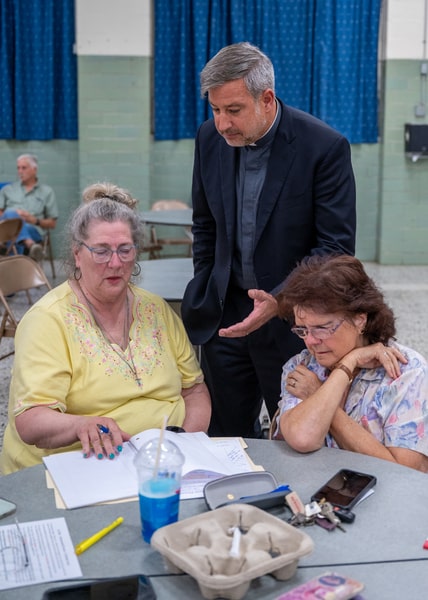
During the Oct. 6 meeting, parishioners were invited to give their opinions. Most seemed split between restoring St. Rita Church to its former condition and demolishing it and building a new church at Our Lady of Hope.
Those in favor of restoring the building said there is a need for a Catholic presence in a troubled area of Dundalk. Some said it is difficult for elderly people to get to Our Lady of Hope, with others noting that St. Rita is a beautiful building with a proud history. Others worried that crime might increase if there is not a Catholic church in the older section of Dundalk.
“We want revitalization in Dundalk,” one parishioner said. “You don’t do that by closing buildings. It’s too precious to let it go.”
If Jesus were to come to Dundalk today, another parishioner said, he would be in Old Dundalk, where the need is greatest.
“That’s where we need to be, too,” she said.
Those in favor of building a new church said it would be an opportunity for the four former parishes to come together more intentionally, possibly under a new parish name. Cherished items, such as altars, statues and other artifacts from the four former parishes, could be incorporated in the design of a new church, they said. The sale of buildings at other former parishes that are now part of Our Lady of Hope might also help in the construction of a new church, they said.
Peggy Shaffer, a longtime leader from St. Rita who served on the transition team implementing Seek the City at Our Lady of Hope, told the Catholic Review the community is slowly coming together, but it’s been a long process.
“No matter what option is chosen,” she said, “I do think there is an opportunity for the new parish to truly be a new parish, where, at some point, all of us become a faith family – not just a faith family of St. Rita, Sacred Heart of Mary, St. Luke or Our Lady of Hope,” she said.
Marybeth Mezewski, a parishioner of Our Lady of Hope and a member of the transition team, said it’s extremely important that voices be heard throughout the discernment process.
“It’s really important that we are heard and listened to and not just told what to do,” she said. “I think that’s something that’s key in this area.”
During the Oct. 6 meeting, Monsignor Jay O’Connor, Episcopal Vicar to the Eastern Vicariate, led the community in prayer.
Archbishop Lori is expected to make his decision within two months.
Email George Matysek at gmatysek@CatholicReview.org
Also see:
Two-alarm fire damages St. Rita Church
Hope rises from ashes for St. Rita parishioners
Read More Local News




Copyright © 2025 Catholic Review Media
