November, being the month of All Souls, is a time when many choirs (ecclesiastical and secular alike) perform music centered on the faithful departed.
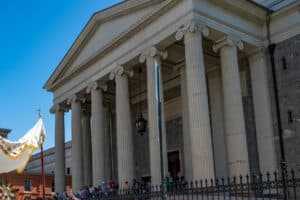
Local music lovers will have a chance to experience it when the Baltimore Basilica — America’s first cathedral — hosts Nov. 1 at 8 p.m. a one-night-only performance of Mahler’s Titan Symphony and Duruflé’s Requiem.
The Western choral canon teems with repertoire for November, with composers from a wide variety of traditions and time periods having set the psalms, funeral hymns and other traditional texts about death and eternity, and, of course, the texts and chants of the Requiem Mass.
Even as the church’s financial investment in composers and musicians dwindled in the 19th century, European concert halls nonetheless resounded with Requiem settings by non-liturgical composers; works that still receive regular attention, such as the settings by Berlioz and Verdi, were well-known at this time, in addition to works by composers such as Liszt and Brahms (with their Totentanz and Ein Deutches Requiem, respectively) that, while not being Requiem Masses themselves, drew heavily from the traditional texts and tunes that continued to fascinate audiences.
The Dies Irae chant (the Sequence of the Requiem Mass), in particular, was a source of fascination for these musicians, with its somber tones and the intense imagery of its text. Despite the success of these concert requiems, the tradition of liturgical requiems did not end with Mozart, with all of its legend and mystique: composers such as Anton Bruckner and Gabriel Fauré continued to set the requiem to be played in the context of the Mass, a tradition which Maurice Duruflé himself continued with his setting in 1947.
Written in the spirit of Pope St. Pius X’s 1903 moto proprio Tra le sollecitudini(a document which called upon all Catholic composers to center all of their liturgical works around church’s patrimony of Gregorian chant), Duruflé’s Requiem, op. 9, sets each of the movements of the Requiem Mass (save for the aforementioned Dies Irae) and weaves the immediately recognizable chant tunes into the fabric of the piece: Mass-goers will recognize, in particular, the Sanctus and Agnus Dei chants in the work, chants which are included in the Roman Missal and still frequently sung today in Catholic parishes.
Mahler’s Symphony No. 1 in D Major, “Titan,” of 1888, has no discernible relationship to Duruflé, nor does it have any explicit connection to the month of All Souls. Musically speaking, both composers were masters of the art of orchestration: both works are chamber reductions of full symphonic works (Duruflé’s having been rendered by the composer himself), a process facilitated by the deftly crafted textures of the original versions. For Gustav Mahler, however, orchestration was not only a matter of timbre and clarity — it was a way of grappling with life’s deepest questions.
Gustav Mahler (the second of 14 children, only 6 of which survived infancy) was constantly preoccupied with death and eternity, and themes of that are interspersed throughout all of his work. As a child, he and his siblings would put on play funerals, and the funeral march became a genre of which he was greatly enamored: indeed, the third movement of this symphony contains a funeral march (darkly ironic though it may be with its use of the popular tune “Frère Jacques”). The whole symphony captures a vast range of emotions: the first movement captures the joyous yet saddened heart of a young man in unrequited love, giving way to a comical take on the Viennese waltz in the second and a sardonic funeral march in the third, to the stormy beginning, luscious middle, and triumphant end of the fourth movement.
Both works pair to make for an unforgettable program in a space marked by deep history, spiritual significance, and an unmatched acoustic.
To purchase tickets to the performance at the Basilica, visit americasfirstcathedral.org/2526. Children 12 and under are free. Discounts are available for students and religious.
Read More Commentary



Copyright © 2025 Catholic Review Media
