
To be a Catholic in America has never been easy. In the years after World War II, as decades of outright discrimination and even persecution faded away, Catholics were left with the unsettling reality that neither major political party has ever been truly aligned with the fullness of the Church’s moral and social teaching.
And today, as the United States and, indeed, the world are being shaken by seismic shifts in American domestic politics and U.S. foreign policy, we find ourselves asking how to bring our faith to bear in a public square increasingly hostile to its teachings.
The Church has always acknowledged that there is no single perfect political system. The genius of the Constitution of the United States, however, long lay in its federalist structure, which implicitly enshrined what Catholic social teaching would come to call “subsidiarity”: the principle that authority flows from the basic building block of society — the family — outward, and that the authority proper to any given governmental structure (the family, the municipality, the state) should never be usurped by a level of government “higher” than it.
The shootings of Renee Good and Alex Pretti by federal immigration enforcement officers will be debated on social media and by the talking heads of the 24-hour news channels ad infinitum. What should not be debated, however, is the principle that the enforcement of federal laws should not undermine lawful state and local authority, nor should any action of law enforcement — local, state or federal — put people at risk unnecessarily.
In escalating an already tense situation and deliberately undermining the authority of state and local governments, the Trump administration’s response to Good’s death was a violation of subsidiarity that did not further the common good, as the shooting of Pretti 17 days later proved.
Similarly, while no structure of international laws and institutions will ever ensure lasting peace on earth, the Church has supported the development of international organizations such as the United Nations and NATO as natural outgrowths of the Church’s longstanding just war theory and her call to foster international cooperation to further the progress of all peoples.
Actual and proposed unilateral military actions by the Trump administration — in Venezuela, in Iran, in Greenland, and perhaps in Mexico and Cuba and Colombia and even Canada — have no just war basis, but reflect the administration’s view that, as presidential adviser Stephen Miller told CNN Jan. 5, “we live in a world … that is governed by strength, that is governed by force, that is governed by power.”
Such “diplomacy based on force,” Pope Leo XIV noted in his Jan. 9 address to the Vatican diplomatic corps, “gravely threatens the rule of law, which is the foundation of all peaceful civil coexistence.”
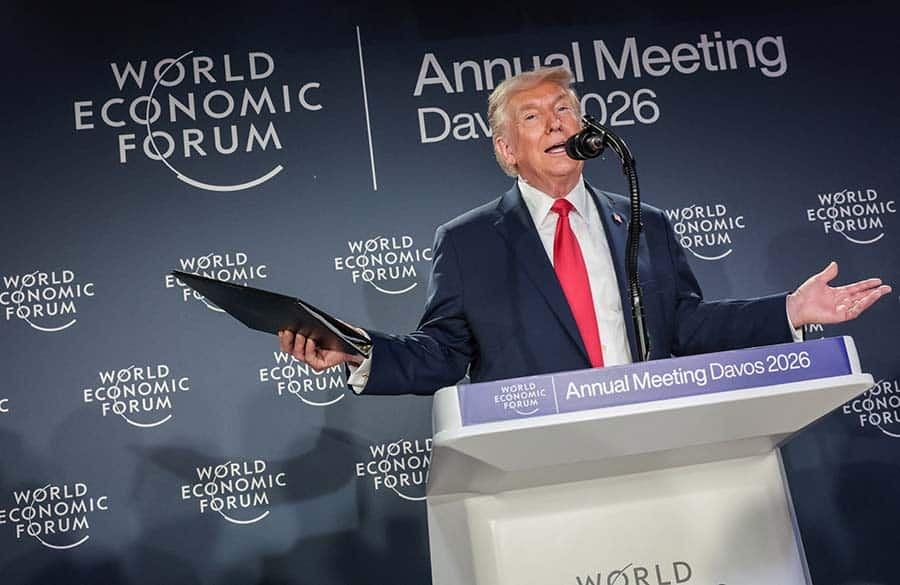
While President Trump, in his address to the World Economic Forum in Davos, Switzerland, on Jan. 21, said, “I don’t have to use force, I don’t want to use force, I won’t use force” to achieve U.S. hegemony over Greenland, the preceding two weeks of bellicose language threatened to destabilize what remains of the post-Cold War international order, shatter NATO, and destroy the sovereignty of any country that stands in the way of U.S. control of natural resources or of this administration’s expansive concept of national security and control of the Western Hemisphere.
The crisis du jour may have passed, but there is no reason to believe that President Trump and others in his administration will abjure further threats of unjust military action against perceived foes, resource-rich countries, or even our NATO allies. Indeed, in Davos, President Trump followed up his remarks on Greenland by listing a string of actions the military has carried out at his command, touting growing U.S. military might, and contrasting that might with the lack of preparedness of our European allies.
President Trump and others in his administration understand and successfully exploit the reality that social media and the 24-hour news cycle keep the American people distracted. But for Catholics, such distraction may come at a great cost, as we risk losing sight of the fundamental moral principles that flow from the Gospel of Jesus Christ.
These principles are the lens through which we should judge the actions, proposals, words and behaviors of all of our political leaders: that we cannot do evil that good may come of it; that every human being is made in the image and likeness of God and is loved by him; that everyone we encounter is our neighbor and has an inherent dignity that we must respect; and that no country is uniquely blessed, and none uniquely cursed, but that all people of all nations are called to reject those who tempt us to worship power and the things of this world, and to conform ourselves, personally and as a nation, to the Prince of Peace.
Read More Commentary


Copyright © 2026 OSV News
