
Is the Eucharist alive in your life? If not, would you like it to be?
The celebrations of the sacred Paschal Triduum are a great place to start.
Holy Thursday
The Paschal Triduum begins with the Mass of the Lord’s Supper on Holy Thursday launches the Paschal Triduum. “Paschal” derives from the Hebrew word pascha, to “pass over” or “pass through.” “Triduum” means “three days,” or at least 72 hours — from the evening Mass of the Lord’s Supper to vespers on Easter Sunday. Together, the Paschal Triduum’s liturgies present the three days of Jesus’ salvific work of reconnecting — or bridging — heaven and earth so that we, the baptized, might pass over to heaven with him.
The work of bridge-building is pontifical. A “pontifex” is one who builds a bridge. A priest in ancient, pre-Christian Rome was called a pontifex since he stood in the breach that separated gods from men and attempted to effect a reconciliation between them. But these priests (like many other pre-Christian priests) were only shadows and anticipations of the Pontifex Maximus — Christ — that greatest of all bridge builders to come. Holy Thursday commences Jesus’ great bridge-building project.
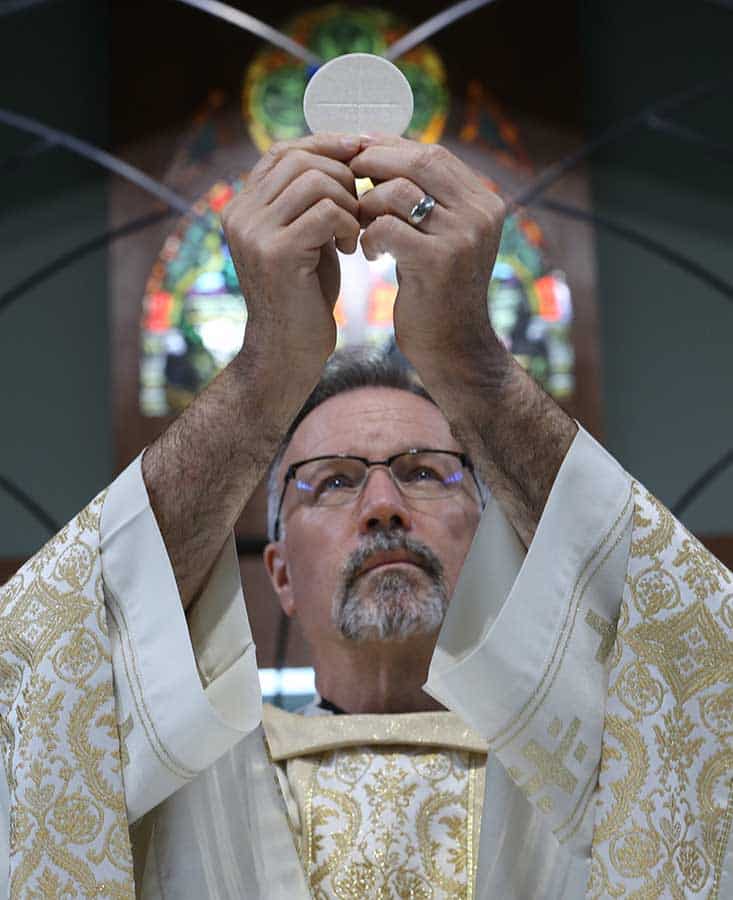
Normally, the chrism Mass is celebrated in dioceses around the world on this day. In addition to blessing the holy oils and consecrating the sacred chrism, this Mass gathers priests — both ordained and baptized — around the high priest par excellence, the diocesan bishop. Following his homily, the bishop asks all of the faithful to pray for their priests, but not before these men renew their own priestly promises. His invitation to do so describes Holy Thursday as “the anniversary of that day when Christ our Lord conferred his priesthood on his apostles and on us.”
Holy Thursday, as his words indicate, is an anniversary of the priesthood, for on this day in the Upper Room, the priesthood of the New Covenant — that of Jesus and of his apostles — was actualized.
But, if the priesthood is born on Holy Thursday, so is its “twin” — the Eucharist. Also called the “natalis calicis” or “birthday of the chalice,” Holy Thursday supplies the material that priests need in order to build bridges: the offering, oblation or sacrifice. Priests need sacrifices — and sacrifices need priests: You can’t have one without the other.
The first reading from the Mass of the Lord’s Supper recounts God’s instructions to Moses and the Israelites about that first Passover offering: Unleavened bread is eaten along with a year-old, unblemished lamb whose blood, marking the houses, ransoms their firstborn sons. Each ancient detail finds fulfillment in Christ: the true bread from heaven, the Lamb of God, the Father’s only begotten Son. When the Church celebrates Mass today — when it obeys Christ’s command to “do this in memory of me” — that same Son, the Lamb, lives under the appearances of bread and wine.
The Church offers us another Eucharistic insight about the sacrifice during its preparation of the gifts and altar at this evening Mass. First, in one of the only occasions when the Missal names (and prints) a particular song for the offertory procession, the Church puts on our singing lips the “Ubi Caritas”: “Where charity and love prevail.” The verses of this eighth-century hymn sing of the unity in love that should characterize Christian believers: “let us strive to keep our minds free of division; may there be an end to malice, strife and quarrels, and let Christ our God be dwelling here among us.” Our offering, then, is not merely to supply material for the Eucharistic Body of Christ, but it is meant to unify “in charity and love” the mystical body of Christ.
To emphasize the connection between Eucharist and Church, the offertory procession on this night allows “gifts for the poor (to) be presented with the bread and wine.” What’s more, on this “birthday of the chalice,” the Church suggests that “during Communion, the priest entrusts the Eucharist from the table of the altar to deacons or acolytes or other extraordinary ministers, so that afterwards it may be brought to the sick who are to receive holy Communion at home.” In short, the body of Christ that is the sacrament gives life to the body of Christ, which is also the Church.
What, then, does Holy Thursday teach us — and form within us — about the Blessed Sacrament? That the Eucharistic mystery gives life and purpose not only to the priesthood but to the entire Church and its members.
Friday of the Passion of the Lord
Good Friday also teaches Eucharistic lessons, albeit in a different way than Holy Thursday’s Mass of the Lord’s Supper — or any other Mass. In fact, there is no Mass at all to be found on Good Friday but, rather, a liturgy commemorating Christ’s passion and cross.
When we consider Christ’s cross as a tree, as the tradition does, then Eucharistic truths will bear fruit in our souls. In some fashion, the entire history of salvation tells a story of trees. In the beginning, at the center of Eden’s garden, stood a “tree of life” from which our first parents were welcome to eat from at their pleasure and, by it, come into closer union with God’s own divine life. At the end of time, in heaven, the Lord promises that he will give “the victor” the “right to eat from the tree of life that is in the garden of God” (Rv 2:7). Standing between these two “trees of life” rises the adorable cross of Christ, arms extended back to the beginning and forward to the end, embracing all things beneath its boughs.
Part of the beauty of Good Friday’s Tree of Life is found in its fruit. Jesus himself says as much: Every tree is known by its fruit (cf. Lk 6:44). The saints found much food for thought in such an image.
The eighth-century monk St. Theodore the Studite observes, “The fruit of this tree is not death but life, not darkness but light. This tree does not cast us out of paradise, but opens the way for our return. … A tree once caused our death, but now a tree brings life. Once deceived by a tree, we have now repelled the cunning serpent by a tree. What an astonishing transformation!” The cross of Christ, the true Tree of Life, reverses the world’s downward spiral to death and redirects it to the heights of heaven.
St. Albert the Great would say much the same in the 13th century: Christ “could not have commanded anything more beneficial, for (the Eucharist) is the fruit of the tree of life. Anyone who receives this sacrament with the devotion of sincere faith will never taste death.”
Ever since he first tasted the forbidden fruit, man has had a kind of supernatural eating disorder. Part of his healing will be a spiritual diet of supernatural substance: the body and blood of Christ, served up for us on the cross. Good Friday makes this dimension of the Eucharistic mystery palatable for us.
The Easter Vigil
Surely, there is no more remarkable celebration throughout the entire Church year than the Easter Vigil. The blackness of night, the magnificent illumination of the Easter fire, the grand procession into the church are just a prelude to the poetry of the Exsultet and the long recounting of salvation history in the many readings. But these words, too, lead to the evening’s main event: the initiation of souls into the full communion of the Church.
For some, baptism will be the doorway through which they pass into the Church. For others, a profession of faith and being confirmed by sacred chrism will mark their entry. For both, the first reception of the Eucharist will make their initiation complete.
We saw how Holy Thursday’s Mass of the Lord’s Supper included gifts for the poor along with the bread and wine for the Mass. While the instructions for the offertory procession at the Easter Vigil don’t speak of unique gifts, they do enlist the service of the Church’s newly baptized priests. (Recall that through baptism, all the faithful share in Christ’s priesthood.)
“It is desirable,” the rubric says, “that the bread and wine be brought forward by the newly baptized or, if they are children, by their parents or godparents.” Part of the insight behind this ritual action was seen above: Priests — even among the baptized — offer sacrifices, and sacrifices are given to God through the consecrated hands of priests. But a potentially obscure figure mentioned in the First Eucharistic Prayer — “Abel the Just” — gives us even greater awareness of what’s happening at this moment.
Cain and Abel, the sons of Adam and Eve, both offered gifts to God — Cain, the yield of his harvest, and Abel, a firstling from the flock (cf. Gn 4:4) — but only Abel’s was found acceptable. Why was this the case? We’ve seen before how God’s design favored the firstborn son as well as fruits of the springtime harvest — both of which Cain could claim. Yet there was something more meaningful in Abel’s offering — namely, his best.
Abel is called “the just.” Justice is a virtue that renders another his due. When it comes to what we owe God, there is nothing we can offer to commensurate his greatness and for the good things he has given us — which is everything! “How can I repay the Lord for all the great good done for me?” the psalmist asks (116:12). Answer: We can’t. But we can give our best, because our best is what God deserves as a matter of justice.
St. Cyprian explains: “When Cain and Abel first offered their sacrifices, God considered not so much the gifts as the spirit of the giver: God was pleased with Abel’s offering because he was pleased with his spirit. Thus, Abel the just man, the peacemaker, in his blameless sacrifice taught men that when they offer their gift at the altar they should approach as he did, in the fear of God, simplicity of heart, ruled by justice and peaceful harmony. Since this was the character of Abel’s offering, it was only right that he himself should afterward become a sacrifice.”
Abel thus stands as a model for the neophyte’s first Mass as a Catholic receiving first Communion. Abel also lives on as a reminder to each of us who has been to Mass many times and already received our first Communion. At every Mass, we are called to give to God our best, in simplicity of heart, joining our entire selves to Christ in the Eucharistic sacrifice.
Jesus’ Paschal sacrifice is made really, truly present before our praying eyes on the altar at every Mass. And even after Mass, his body, blood, soul and divinity remain in our midst in the tabernacle. The Triduum attunes us to this reality each year.
Read More Commentary
Copyright © 2026 OSV News
