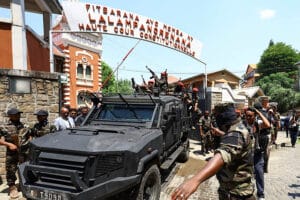
Catholic Church leaders in Madagascar have urged a return to dialogue after the Indian Ocean island’s president was forced into exile by an Oct. 14 military takeover.
“The political situation remains heated, so we can’t yet speak of any stability,” explained Father Seraphin Rafanomezantsoa, coordinating secretary of the Madagascar bishops’ conference.
“It’s highly debatable how far this new regime can organize the country and direct appointments. Although street demonstrations have calmed for the moment, the immediate course of events can’t be foreseen,” he said.
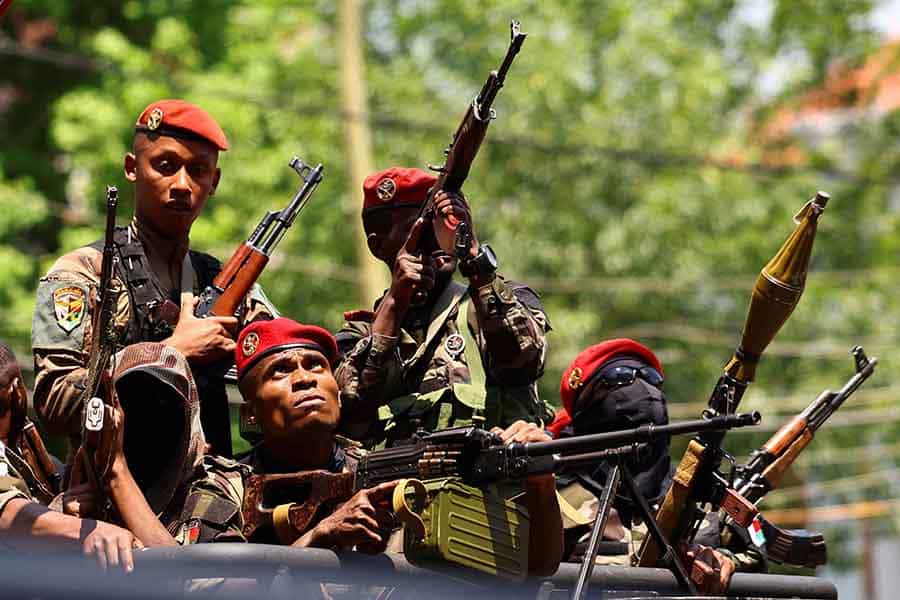
The priest spoke as Col. Michael Randrianirina, head of Madagascar’s elite CAPSAT military unit, was installed Oct. 17 as provisional head of state, replacing the ousted President Andry Rajoelina.
In an OSV News interview, Father Rafanomezantsoa said the bishops’ conference had no information as yet about Catholic injuries or damage to church properties during the disorder, which erupted in late September, adding that its members were now in their dioceses with “no immediate plans” for a joint statement.
“Although the protests were relatively calm here in the capital, Antananarivo, there were harsh confrontations with gendarmes and the military in other regions, where tensions between rulers and citizens have accumulated for years” Father Rafanomezantsoa told OSV News.
“The bishops are following the country’s plight closely with prayer, while acting as observers, ascertaining and analysing what’s happening after this latest precipitation of events.”
Speaking Oct. 14 outside Antananarivo’s presidential palace, Randrianirina announced he “seized power” and suspended the constitution after joining the side of mostly youthful protesters.
He added that his forces, who were greeted with applause and flag-waving, would rule alongside a civilian government, pending new elections after two years.
Meanwhile, Madagascar’s National Assembly voted to impeach Rajoelina, who took power in a 2009 popular uprising and was twice elected president in 2018 and 2023.
However, the assembly’s vote was rejected as illegal in a social media post by the 51-year-old president, a former businessman, who left the country Oct. 12 aboard a French military plane, according to Radio France International.
The United Nations said at least 22 people had been killed and dozens injured in clashes with security forces, during protests against long-running electricity and water outages and other dire conditions across the country, one of the world’s poorest, where around three-quarters of inhabitants live below the poverty line, according to World Bank data.
In a Sept. 26 appeal, the bishops’ conference described Madagascar as “truly suffering.”
“God intended our country to be an island in the middle of the Indian Ocean, like a canoe or a great ship. … If we fight internally, Madagascar will sink,” the bishops said.
“Madagascar does not deserve this, and we trust once again in the wisdom of the Malagasy people to communicate and speak out for those who are truly suffering. We must know how to distinguish between the opposition and the leaders,” they said.
Pope Leo XIV, who met bishops from Madagascar in the Vatican June 16, referred to “violent clashes” between the police and demonstrators at an Oct. 1 general audience, adding that he hoped “all forms of violence” would be avoided in an “ongoing pursuit of social harmony.”
Meanwhile, Madagascar’s Council of Churches, which is headed by Catholic Archbishop Jean De Dieu Raoelison of Antananarivo, and includes Anglican and Protestant leaders, warned Oct. 10 that violence could worsen, and said it was “already moving forward with mediation between the different parties.”
In his interview, Father Rafanomezantsoa said the Catholic bishops’ conference had backed the council’s “mediation offer” and would not be proposing any separate intervention.
“For now, we can only hope and pray for peace on behalf of all our country’s citizens, inviting all political actors to seek the common good over any personal political interests,” the conference’s coordinating secretary told OSV News.
“The Catholic Church will always call on everyone to see the country’s situation clearly and objectively, and to do everything to avoid abandoning it to disorder and humiliation.”
Catholics in the church’s five archdioceses and 21 dioceses, served by 2,000 priests and 5,000 women religious, account for around 30 percent of the 30 million inhabitants of Madagascar, which was visited by Pope Francis in June 2019 and is also home to smaller Muslim and animist communities.
The African Union said it had suspended Madagascar’s participation in the organization because of the Oct. 14 military coup, and warned Randrianirina’s armed forces to “refrain from further interference in political processes,” while the U.S. State Department also urged all sides “to pursue a peaceful solution in line with the constitutional order.”
In his OSV News interview, Father Rafanomezantsoa said his church, dating from early 16th-century missionaries, counted on continuing outside aid to ease the “great poverty and deprivation” afflicting Madagascar, with its “already very fragile” economy.
“Such a political and social crisis deepens impoverishment and diminishes everyone, and our bishops will be assessing public needs and seeing what can be done to help,” the conference’s coordinating secretary said.
“We’ll also be urging people to put hatred aside, look at the situation objectively and rebuild calm and peace in daily life — so that children can return to school and economic actors set to work re-dynamizing our economy.”
Read More World News
Copyright © 2025 OSV News
