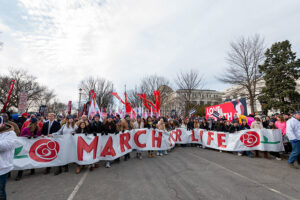
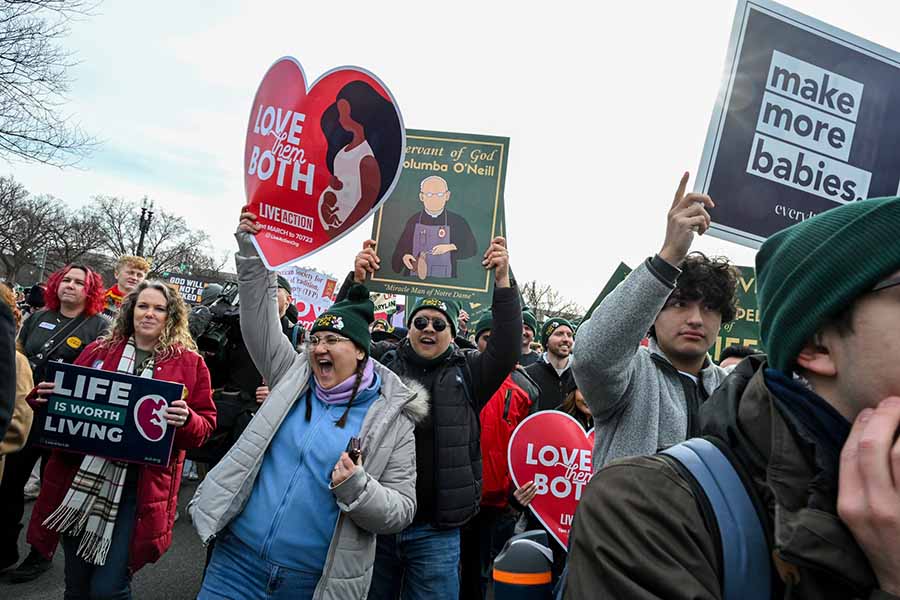
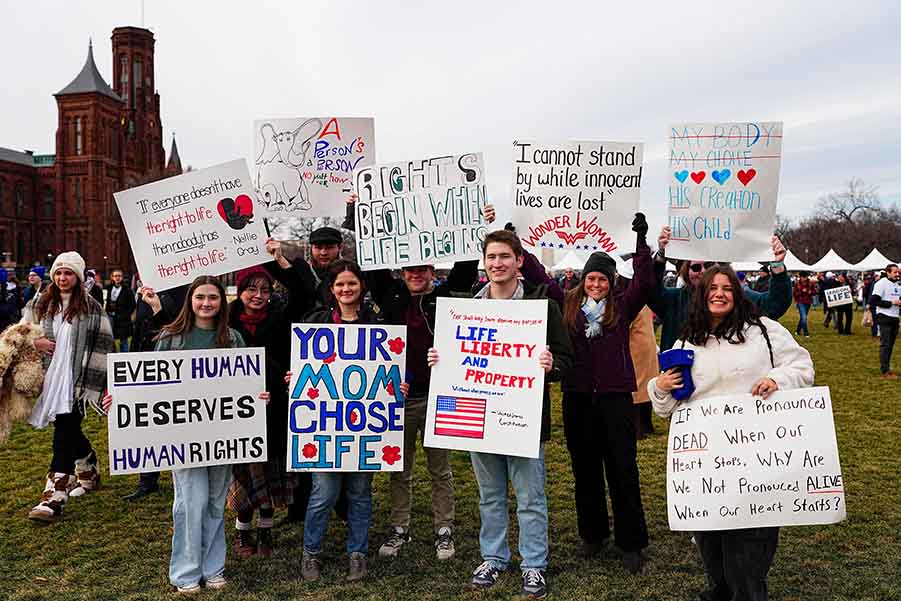
WASHINGTON (OSV News) — Tens of thousands of pro-life advocates descended on the March for Life demonstrating their strong motivation to give witness to the importance of protecting the right to life for the unborn. This year’s march stressed the theme “Life is a Gift,” but the event also showed visible cracks emerging in the movement’s political vision and frustration with the Trump administration.
For Catholics attending the march from all corners of the U.S., the motivations were as strong as ever.
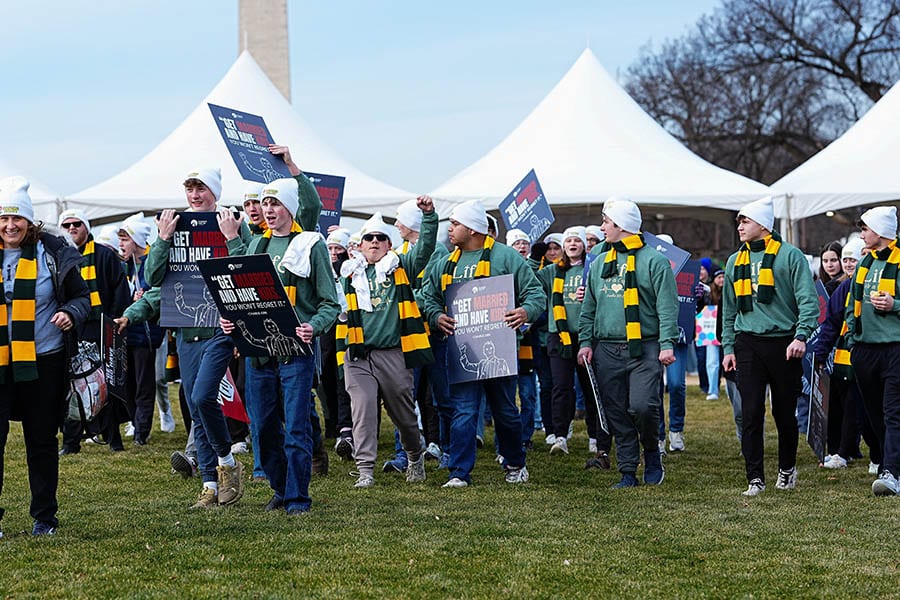
At St. Jude Parish in Waltham, Mass., the bus ride of 30 parishioners of all ages is “a real pilgrimage,” parochial vicar Jeremy St. Martin, who leads it, told OSV News. The bus left on Jan. 22, arriving 22 hours later — praying the Liturgy of the Hours along the way — at the Basilica of the National Shrine of the Immaculate Conception in Washington at 8 a.m. on Jan. 23, the day of the March for Life.
“We don’t stop for breakfast or anything. Everyone knows it’s a pilgrimage,” he said.
Hallie Millerbernd, a senior nursing student at the University of Mary in Bismarck, N.D., told OSV News this is her third March for Life. The multi-bus pilgrimage from there takes 60 nonstop hours, making it a real test of endurance.
She said the sight of “thousands of people of all ages carrying signs with different colored hats, singing songs and chanting” inspired her. “It also showed me that there was hope for change and that there was a large movement against abortion.”
Ruby Galatolo, who came to Washington from the Diocese of Orlando, Fla., said she has tried to come every year since her first march in 2010. The experience was a turning point in her life, seeing “so many young people here so happy and hopeful.”
Gatalolo said she “never imagined that I would see the day when Roe v. Wade would be overturned,” referring to the Supreme Court’s 2022 Dobbs v. Jackson Women’s Health Organization decision that returned the issue of abortion to lawmakers.
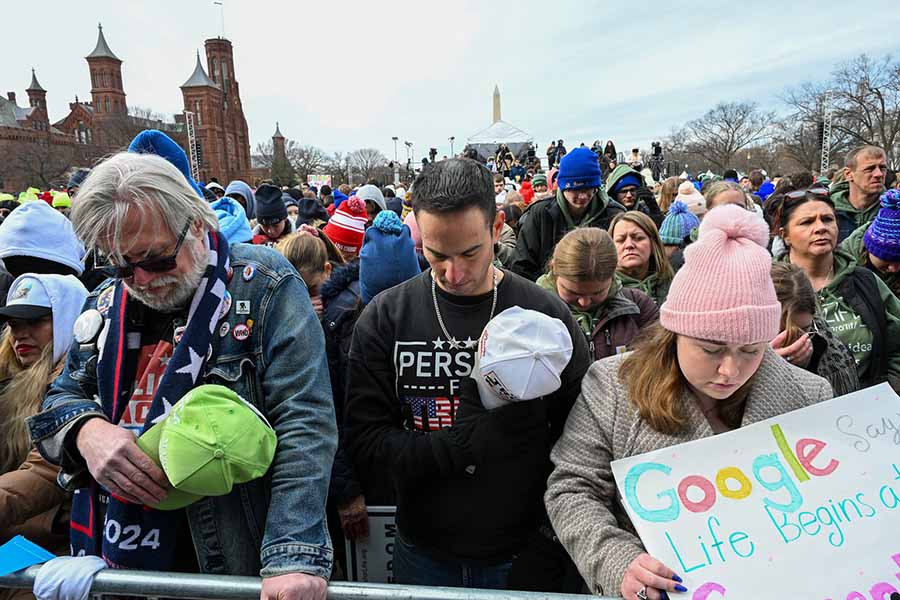
“Of course, there is still a long way to go,” she said, adding that she continues to hope that ultimately abortion would become a thing of the past.
The Catholic Church was also strongly represented in Jan. 22-23 vigil events held around the 53rd March for Life, with thousands attending the National Prayer Vigil for Life held at the national basilica in Washington, the Life Fest event put on by the Knights of Columbus and Sisters of Life in nearby Oxon Hill, Md., and the Life is VERY Good hosted by the Diocese of Arlington at the EagleBank Arena in Fairfax.
In his homily at the National Prayer Vigil for Life’s closing Mass Jan. 23, Cardinal Seán P. O’Malley, who, with the exception of the COVID limitations in 2021, has been to every March for Life since the first one in 1974, exhorted participants to “look for opportunities to be apostles of life building a civilization of love and ethic of care.”
“We’re here today to proclaim life is a gift. It’s a precious gift from a loving God,” said Cardinal O’Malley, archbishop emeritus of Boston. “Together we can protect and nurture that gift of life … The antidote to abortion is love, love manifest in community, compassion and solidarity.”
Sister of Life Faustina Maria Pia told OSV News that she hoped the young people at Life Fest — which featured musical performances, Eucharistic adoration, a Eucharistic procession, Mass, confession and testimonies — would realize the gift of their own life.
“Today is a day that we really want to make a strong impact on our nation, to witness to this beautiful sanctity of human life,” she said of the event. “There’s no more powerful way than to pray.”
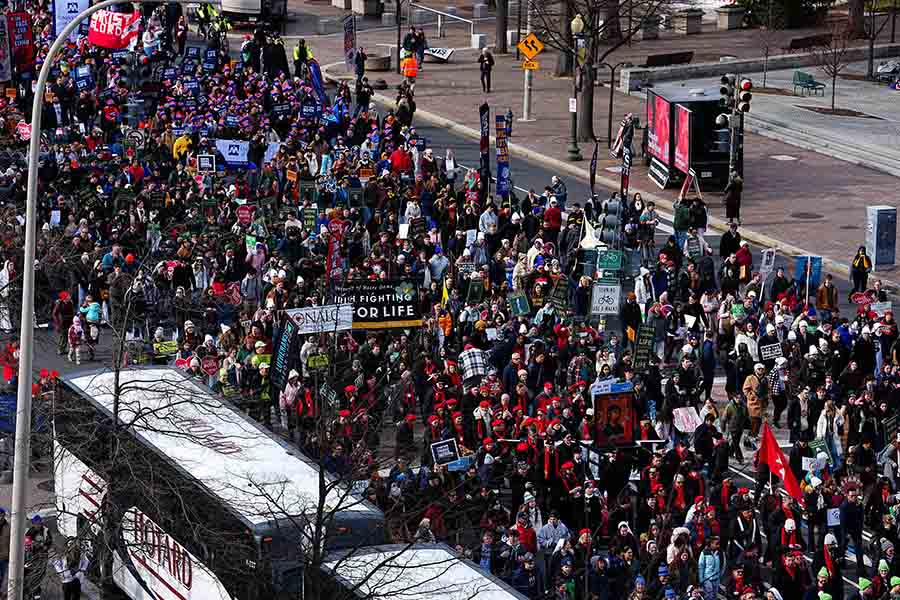
At the March for Life rally itself, March for Life president Jennie Bradley Lichter reminded the crowd that what has “saved so many lives and moved countless hearts” on the abortion issue over the years is the marchers’ “unfailing hope,” their “love for the littlest ones and for moms who need a hand,” their joy and “the sheer number of you who are here year after year.”
At the beginning of the rally, Lichter introduced the “Friends of Club 21” choir, a group of teens and young adults with Down syndrome, to sing the national anthem. She said the group embodied the theme of the march.
But this year’s March event showed that amid the cultural unity, there was political fraying within the pro-life movement itself.
Lichter herself introduced Vice President JD Vance, who spoke in person at the rally, while President Donald Trump gave a video message reminding attendees of his role in helping overturn Roe v. Wade — “the greatest victory in its history” — and thanking “every single one of you who’s out on this winter day, a beautiful day — but it’s winter, nevertheless — to stand up for the unborn.”
However, while Lichter praised the administration’s pro-life policies, it was Vance who brought up “the elephant in the room,” which he called “a fear” that “not enough progress has been made.”
Various pro-life advocates and groups had begun to raise criticism of the second Trump administration, following a string of pro-life disappointments, such as Trump’s recent comments to House Republicans telling them to be “flexible” on the Hyde Amendment, which prohibits public funding of elective abortions, in negotiations on health care subsidies.
Vance touted the administration’s past accomplishments, citing actions including expanded conscience protection for health care workers, and “policies that make family life possible,” such as “Trump accounts,” government-backed savings accounts for newborns under the “One Big Beautiful Bill Act.”
He also mentioned the recent announcement from him and his wife, Usha Vance, that they are expecting their fourth child, noting in his remarks last year, “I told you all one of the things I most wanted in the United States of America was more families and more babies.”
“So let the record show you have a vice president who practices what he preaches,” he said.
Vance’s speech was generally well received by the crowd, but some attendees chanted “Ban the abortion pill.” Several national pro-life groups have called on the Trump-Vance administration to roll back the Biden administration’s actions on mifepristone, a pill commonly but not exclusively used for early abortion, to the regulations in place during the previous Trump-Pence administration. But the administration has not delivered on this, while approving a new generic form of the pill.
Vance, however, argued that the pro-life movement was better off today than it was 10 years ago, when Trump was first elected, and there would be disagreements within the movement about how best to achieve their goals.
But, in the hours following Vance’s speech, Susan B. Anthony Pro-Life America, an organization that works to elect pro-life candidates to office, issued a statement rebuking his assertion by pointing out the comparison “reveals a harsh reality.”
“The clearest measure of whether the pro-life movement is winning or losing is the number of abortions occurring each year,” said Marjorie Dannenfelser, the group’s president. “According to the latest statistics, there are at least 1.1 million abortions occurring in America annually post-Roe. This compares to 874,000 abortions in 2016 — a 30 percent increase.”
“Because of the indispensable role President Trump played in the overturning of Roe, we have the opportunity to save lives and serve women,” she said. “But it is because of the inaction of the Trump-Vance administration on abortion drugs that this opportunity isn’t being realized — and abortions are going up, not down.”
The March for Life rally dais featured exclusively Republican political leaders, who touted their legislative accomplishments while criticizing Democratic lawmakers on abortion. No identifiable pro-life Democrats were among the rally’s featured speakers — a visible departure from March for Life rallies of previous years.
Among those accomplishments were two pieces of legislation that passed in the House of Representatives Jan. 21 and 22, and will be taken up by the Senate: The Pregnant Students’ Rights Act, which would require colleges and universities that participate in federal student aid programs to provide both prospective and current students with information on rights and resources for carrying a baby to term while enrolled, and The Supporting Pregnant and Parenting Women and Families Act. The latter bill would allow states to use low-income support funds for pregnancy centers that support protecting the life of the mother and her unborn child, and that offer services such as pregnancy testing, prenatal and pregnancy education, counseling, diapers, baby clothes and other material resources.
Pro-life Democrats, in partnership with Rehumanize International and the Consistent Life Network, did have their own event at the National Press Club in Washington before the March for Life, unfolding their own legislative vision called the “Legislating for Human Dignity” campaign. Among the policy proposals the group backs was the Supporting Healthy Moms and Babies Act, a bipartisan initiative with draft legislation introduced in both the House and Senate that would make birth free — eliminating cost-sharing for prenatal care, labor and delivery, and postpartum care.
Shortly before the final prayer and sending off the thousands gathered to march and advocate for life, Lichter said she had a message from an early alumnus of the March for Life who could not be with them due to an overseas work commitment: Pope Leo XIV.
She read the pope’s letter to the march’s participants, imparting his papal blessing and assuring them “of my spiritual closeness as you gather for this eloquent public witness to affirm that the protection of the right to life constitutes the indispensable foundation of every other human right.”
After the final prayer, marchers — armed with a variety of signs with pro-life slogans — exited the rally space on the National Mall to walk through Washington’s streets to the steps of the Supreme Court building.
Julie Asher, Lauretta Brown, Marietha Góngora V., Kurt Jensen, Kate Scanlon, Maria Wiering and Katie Yoder contributed to this report.
Read More Respect Life


Copyright © 2026 OSV News
