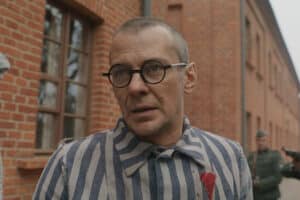
NEW YORK (OSV News) — When Pope St. John Paul II canonized Father Maximilian Kolbe, OFM Conv in 1982, he quoted John 15:13 — “Greater love has no man than this, that a man lay down his life for his friends”– and described Father Kolbe as “a man who was granted the grace of carrying out these words of the Redeemer in an absolutely literal manner.”
That was prisoner 16670 of the Nazi concentration camp in Auschwitz, Poland, and a compelling new film, “Triumph of the Heart” (Outsider Pictures) dramatizes the real-life story of St. Maximilian’s martyrdom.
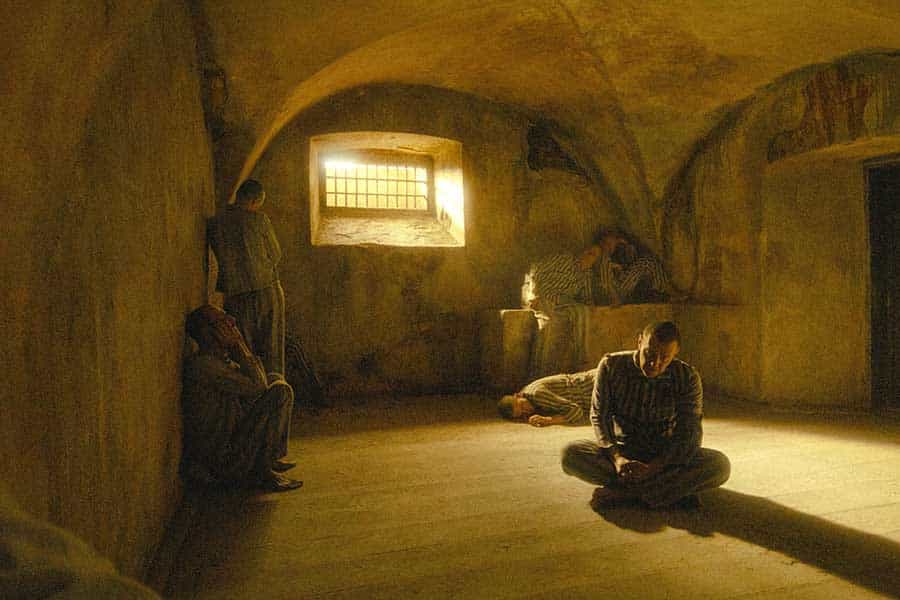
Director and writer Anthony D’Ambrosio sets most of the action inside the grim bunker where St. Maximilian and nine other men were sentenced to death by starvation, a microcosm of the Nazi extermination plan in World War II.
“What are we here to do? To kill?” proposes Karl Fritzch (Christopher Sherwood), the sadistic SS commander of Auschwitz. “No. We are here to break the will of Poland so that the Reich may reset the bone. That is why I do what I do.”
It’s August 1941, and when a prisoner goes missing, Fritzch picks 10 men at random to starve to death until the man is found. When the tenth man begs for mercy, mentioning his wife and children, Father Kolbe (Marcin Kwasny), a few months into his internment, steps forward and volunteers to take his place.
Fritzch agrees, but has an ulterior motive. A Conventual Franciscan friar, Father Kolbe was a well-known figure who rallied Catholics through his newspaper and radio station. Eliminating him had its advantages.
“You are a man of the media,” Fritzch says. “You know the power of stories.”
What happens next is as unexpected as it is astonishing. The men do not die as quickly as the Nazis expect. Instead, under the leadership of Father Kolbe and learn their backstories, they slowly come to terms with their fate, confess their sins, and form a brotherhood.
“Brothers, we are dying,” Father Kolbe says. “But we don’t have to die like animals. We can die as men if we fix our eyes on God.”
In private moments, Kolbe’s own humanity is laid bare as he tries to cope with the unimaginable, when his fellow prisoners experience the effects of starvation, including violent mood swings and hallucinations.
“Holy Mother, you called me here,” he says. “Give me the words they need.”
Our Lady does, and then some. “‘My God, my God, why have you abandoned me?’ Do you know who said that?” he asks his brothers. “I’m just grateful that I have a Savior who came to be with me in my suffering.”
Despite ashes from the crematorium wafting into the bunker, the men find hope and meaning in their suffering, and strength in song, including a lullaby based on the “Hail Holy Queen” prayer. This infuriates Fritzch and the Nazi guards, but inspires prisoners outside who can hear the singing.
With graphic (but not gratuitous) violence and executions by Nazi guards and humiliating treatment of the prisoners, “Triumph of the Heart” is not for the squeamish. But it is a film that demands to be seen and discussed, not only as a historical reminder of the Holocaust and man’s inhumanity to man, but of how the courage, selflessness, and unwavering faith of a single man can make a difference.
That is truly a triumph of the heart.
The film contains Holocaust themes, frequent graphic bloody violence, images of sickness and death, an attempted suicide, and two crude oaths. The OSV News classification is A-III — adults. Not rated by the Motion Picture Association.
Read More Movie & TV Reviews

Copyright © 2025 OSV News
