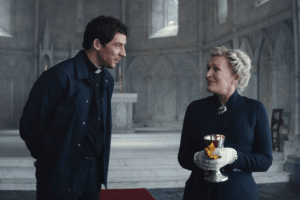
NEW YORK (OSV News) — Clues and conundrums aren’t the only things that need to be sorted through in the murder mystery “Wake Up Dead Man” (Netflix). An equivocal, though ultimately positive, portrayal of faith marks this third film in the “Knives Out” franchise that began in 2019. Mature believers will thus be left with much to unpack and much to assess.
Josh O’Connor plays boxer-turned-priest Father Jud Duplenticy. After an incident during which he shows that he has yet to set his pugilistic instincts entirely aside, his insightful bishop (Jeffrey Wright) gives the upstate New York-based cleric a challenging assignment.
Father Jud is sent to Our Lady of Perpetual Fortitude, a rural parish where the pastor, Msgr. Jefferson Wicks (Josh Brolin), has managed to entrench himself as a sort of cult leader. Wicks’ small but fanatically devoted flock of followers is led by his girl Friday, parish secretary Martha Delacroix (Glenn Close).
Wicks’ grandfather Prentice (James Faulkner), we learn, was a vastly wealthy man who, after being widowed, was ordained and served as his grandson’s predecessor at Our Lady of Perpetual Fortitude, where he lies buried in an imposing mausoleum. No one knows what became of Prentice’s fortune and his legacy has proved bitter for all concerned.
Father Jud soon finds himself in such open conflict with Wicks that, when the latter is slain, he is widely suspected of the crime. To clarify the murky situation, the local police, headed by Chief Geraldine Scott (Mila Kunis), turn to Benoit Blanc (Daniel Craig), the presumably Cajun private detective who is the recurring main character in the series.
Blanc soon becomes convinced of Father Jud’s innocence. But the circumstances of Wicks’ death remain a classic example of a locked-room mystery — he died in what was apparently an otherwise empty storage closet that no one else was observed to enter before his demise — with a host of possible perpetrators.
In adding Catholic ingredients to his ensemble whodunit recipe, writer-director Rian Johnson shows his antipathy toward the church’s more controversial moral teachings, which he depicts as condemnatory and divisive. Thus Wicks’ strategy for uniting his acolytes involves angrily denouncing other members of the congregation, such as an unmarried mom and a gay couple.
The script also hints that an orthodox outlook on sexual matters is not only harmful but inextricably tied to a MAGA political stance as well.
Yet Father Jud is portrayed as, in many respects, a model clergyman, one who prioritizes the spiritual needs of his parishioners and is prepared to place their welfare ahead of his own vindication. Through him, Johnson displays insight into the nature — and power — of genuine pastoral solicitude.
As for religious belief considered more broadly, Blanc is used to lay out the case against it, as well as against the church’s history as an institution. But the narrative’s sympathy, as demonstrated by a symbolic visual effect, is clearly on Father Jud’s side in his debate with the sleuth.
Still, the ultimate verdict seems to be that, whether or not the creed is true — especially where the Resurrection is concerned — the care for others it inspires is, as a practical matter, helpful. That’s not, of course, a final word with which viewers of faith will be satisfied.
They’ll also be disturbed by the movie’s somewhat frivolous and unsettling treatment of the sacrament of reconciliation. Wicks repeatedly uses it as a forum for making Father Jud uncomfortable by confessing, in graphic detail, to obsessively pleasuring himself.
A later plot development makes these scenes less unpalatable and a climactic sequence involves the same sacrament put to its proper use. But the distastefulness of the earlier encounters lingers.
Though it lacks the comic sparkle that characterized its precursors, “Wake Up Dead Man” remains, in purely dramatic terms, a high-quality production. Whether the movie’s overall artistic merits are a sufficient reward for enduring its dodgier patches, however, remains an open question.
The film contains an ambiguous attitude toward Catholicism, some gory and gruesome images, gritty content, including clerical misconduct and repeated sexual references in the context of confession, a few uses of profanity, about a half-dozen milder oaths, at least one rough term, much crude and occasional crass language, vulgar images and an obscene gesture. The OSV News classification is L — limited adult audience, films whose problematic content many adults would find troubling. The Motion Picture Association rating is PG-13 — parents strongly cautioned. Some material may be inappropriate for children under 13.
Read More Movie & TV Reviews

Copyright © 2025 OSV News
