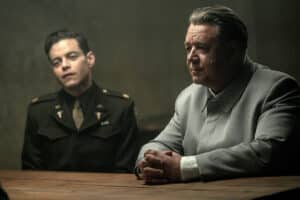
A new thriller about the Nuremberg trials held to prosecute high-ranking Nazi Germany officials following World War II wrestles with the capacity of ordinary men to commit extraordinary evil.
“I grew up with that history,” James Vanderbilt, writer, director and producer of “Nuremberg,” told OSV News about his grandfathers who fought in World War II. “The generation below me now — my kids — it feels like it’s talking about the Civil War (with them) … it’s so far removed.”
He added: “I think it’s important to not forget the past, and we have to be able to look backwards in order to move forwards.”
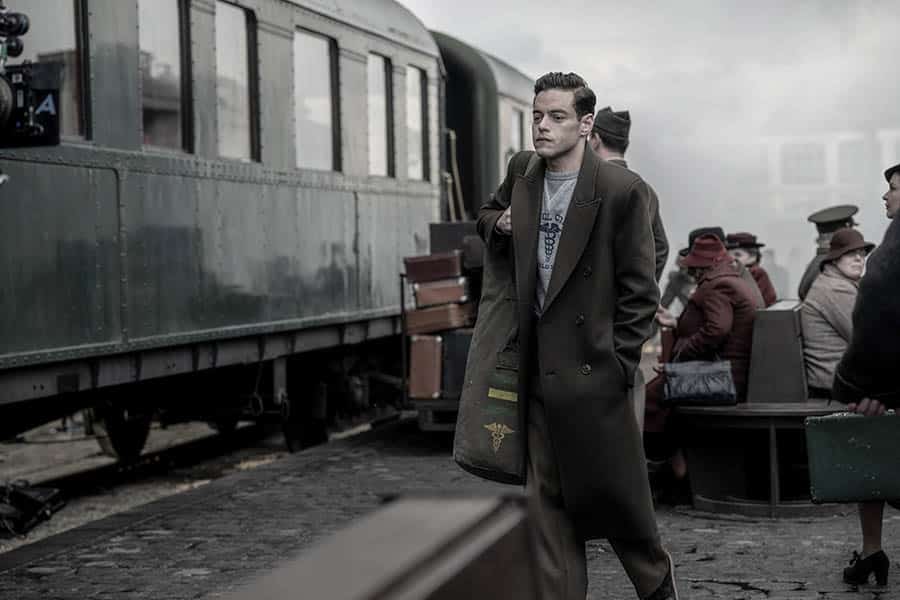
In theaters nationwide on Nov. 7, “Nuremberg” follows Douglas Kelley (Rami Malek), a U.S. Army psychiatrist tasked with evaluating Nazi leaders before trial, as he develops a relationship with Hermann Göring (Russell Crowe), who once served as Adolf Hitler’s second in command. During the two-hour-28-minute film, which is rated PG-13, Kelley exhibits a fascination with Göring and becomes consumed with the idea of dissecting evil in order to understand it.
“You want to know why it happened here?” U.S. Army Sgt. Howie Triest (Leo Woodall), who serves as Kelley’s translator, eventually asks Kelley in the film. “Because people let it happen.”
The film draws its inspiration from the book “The Nazi and the Psychiatrist,” by journalist Jack El-Hai, who serves as a “Nuremberg” executive producer. The movie also weaves in the story of Supreme Court Justice Robert H. Jackson (Michael Shannon), the chief U.S. prosecutor at the trials.
From the beginning, Jackson insists on putting together an international tribunal to hold Nazi officials accountable for the atrocities of the Holocaust and the slaughter of an estimated 6 million Jews.
“Robert Jackson is a man I greatly admire, and the more I learned about him, the more I loved him,” Shannon, who is known for starring in films such as “Revolutionary Road” and “Man of Steel,” told OSV News. “It was an honor to get to embody him.”
In addition to Shannon, Crowe, Malek and Woodall, the star-studded cast includes Richard E. Grant, John Slattery, Mark O’Brien, Colin Hanks, Lydia Peckham, Wrenn Schmidt and Andreas Pietschmann.
As it progresses, the film infuses the past into the present. Historical video footage of Nazi concentration camps, which shows machinery clearing away piles of corpses, plays in the film as it did at the actual trials.
“Beyond simply good and evil, the merry-go-round of hypocrisy is what I was most fascinated by,” Shannon told OSV News about “Nuremberg.” He pointed to “Göring’s ability to throw our own actions back in our face — not that they’re equivalent to what the Nazis did, we all know better than that.”
In the film, Göring responds to Kelley’s accusations against him at various points by referring to America’s use of the atomic bomb and its internment of Japanese Americans during World War II.
The film’s mixture of reality and fiction prompts viewers to ask questions about the past. One opportunity comes when Shannon’s character, Jackson, visits the pope, presumably Pope Pius XII, who led the Catholic Church from 1939 to 1958. The film shows Jackson persuading a reluctant pontiff to back the Nuremberg trials.

Richard F. Crane, a professor of history at Benedictine College in Atchison, Kansas, and a former visiting fellow at the United States Holocaust Memorial Museum in Washington, spoke with OSV News about the Vatican’s relationship with the Nuremberg trials.
“Pope Pius XII did not condemn the Nuremberg trial verdicts and sentences, nor did he actively discourage those war crimes trials from being held in the first place,” he said in emailed comments. “But he did express deep concern about the possibility of the German people suffering collective punishment for Nazi atrocities.”
He added: “Although he condemned the ideology of Nazism, he did urge clemency or at least commutation of death sentences for some of the worst war criminals.”
As an example, Crane pointed to a New York Times story published in 1946 with the headline “POPE ASKS MERCY FOR NAZI; Intercedes for Hans Frank, Ex-Governor of Poland.” He noted that Frank converted to Catholicism while imprisoned.
“It is simplistic to portray Pius XII as somehow soft on or sympathetic to Nazi murderers,” Crane concluded. “But the historical evidence clearly points to a pontiff who wanted the victorious Allies to abandon any notion of collective German guilt.”
“Also, Pius hoped that the denazification process would be sped up in postwar Germany,” he said. “What we might today call historical amnesia he saw as healing.”
As a “Nuremberg” filmmaker, Vanderbilt hopes that his movie sparks questions about the past and present.
“I worked with a guy named David Fincher years ago, who’s a great filmmaker, who said something that always stuck with me, which was that good movies make you ask questions, and bad movies give you all the answers,” Vanderbilt said of the award-winning director.
“If there’s one thing people take away from it, I hope that they ask questions,” he said of his film. “They ask questions about the world we live in now … questions about where we came from.”
Read More Movie & TV Reviews



Copyright © 2025 OSV News
