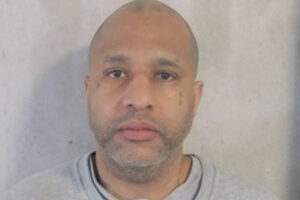
OKLAHOMA CITY (OSV News) — Death-row inmate Kendrick Simpson is to be executed by lethal injection Feb. 12 unless Oklahoma Gov. Kevin Stitt grants him a last-minute reprieve or the U.S. Supreme Court grants a stay.
On Feb. 9, advocates for Simpson filed a petition on his behalf with Supreme Court Justice Neil Gorsuch asking the high court to stay his execution. Gorsuch oversees the federal judicial circuit that includes Oklahoma.
The governor-appointed Oklahoma Pardon and Parole Board voted 3–2 on Jan. 14 to deny clemency for Simpson, convicted of the 2006 killings of Glen Palmer and Anthony Jones.
Advocates for clemency say jurors were not permitted to hear evidence of his severe post-traumatic stress disorder, a mental health factor they say might have led to a different outcome than capital punishment.
Archbishop Paul S. Coakley of Oklahoma City released a statement urging state leaders to grant clemency to Kendrick Simpson, explaining that while Simpson’s life has been marked by profound suffering and trauma, these factors do not diminish the gravity or pain of the crime. Instead, they “call us to a deeper moral reflection on justice, mercy, and the dignity of the human person.”
“From the teaching of Our Lord, we must conclude that the death penalty is inappropriate because it attacks the inviolability and dignity of the human person, and because society today has the means to protect itself without ending another human life,” he said in a Jan. 20 statement.
Archbishop Coakley had asked everyone entrusted with the solemn decision to grant Simpson clemency to consider if execution is actually necessary, “or whether mercy, accountability and the possibility of redemption can better witness to the values we seek to uphold as a people.”
Opponents of clemency say Simpson has not shown remorse and they support carrying out his execution. Attorney General Gentner Drummond asked the Pardon and Parole Board to deny clemency for Simpson, saying, “Kendrick Simpson hunted his victims, executed them without hesitation, and then boasted about what he had done.
“The families left behind have endured unimaginable pain, and nothing in Simpson’s decades on death row has shown that he deserves the mercy he refused to give to others.”
Tena Jefferson, a friend of Simpson and a member of the Criminal Justice Action Team of VOICE, a local community organizing coalition, said she has personally witnessed concrete changes during his time in prison.
She said Simpson is “horribly remorseful and sorry” for what happened and would do anything for his victims’ families or to change the past. Jefferson believes the jury might have reached a different verdict if they had been fully informed about his PTSD, paranoia and trauma experienced before coming to Oklahoma.
According to Jefferson, Simpson has four sons and a granddaughter whom she said he is “absolutely crazy about.”
In addition to earning his GED, Simpson has written a book of poetry. In 2024, his poem “Who Am I?” was selected as the winning entry for the Pegasus Publication by Rose State College. Another of his poems, titled “Remorse,” is a reflection on the irreparable harm he caused and his desire to rebuild his life.
In a place he has “absolutely nothing to give,” said Jefferson, “he still finds ways.”
Emmjolee Mendoza Waters, director of Death Penalty Abolition at the Catholic Mobilizing Network, said Simpson’s case reflects broader national concerns about how capital punishment is applied. Waters said capital punishment disproportionately affects people with trauma, mental illness and disabilities.
“Accountability and mercy do not need to be at odds,” she told the Sooner Catholic, the news outlet of the Archdiocese of Oklahoma City. “It does not require killing a person in the name of justice. In the United States, our modern incarceration system has the capacity to keep society safe. There is this tension about accountability and mercy. We don’t have to kill someone to teach that it was wrong.”
Waters said capital punishment perpetuates a cycle of trauma and harm, noting that while the state may keep people physically safe, executions leave families grieving the loss of friends, sons and fathers.
Oklahoma Sen. Dave Rader, a Republican from Tulsa, said Oklahoma’s history of the execution process shows “much improvement is needed.”
Pointing to the 46 recommendations of a 2017 commission report on Oklahoma’s handling of execution and everything that accompanies the process and protocol, Rader said, “of all the recommendations made, very few, if any, were followed, let alone implemented.”
Author Eliana Tedrow is a freelance writer for the Sooner Catholic, the news outlet for the Archdiocese of Oklahoma City. This story was originally published by the Sooner Catholic and distributed through a partnership with OSV News.
Read More Respect Life





Copyright © 2026 OSV News
