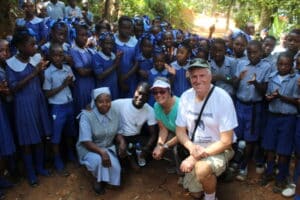
The first time Nancy Goff visited Haiti, it took her two hours to hike to St. Elizabeth of Hungary in the mountain town of Perodin. During her next visit in 2019, the journey stretched to three hours, and she rode a donkey on the way down. Now 79, Goff knows her knees will not allow another trip.
“It is very hard,” Goff said of the trek up the mountain. Still, physical limitations are not what keep her and fellow parishioners of the Pastorate of Our Lady – made up of Our Lady of Perpetual Help in Edgewater and Our Lady of Sorrows in West River – from returning to their sister parish.
“We can’t go back,” said Goff, citing gang activity and ongoing anti-government sentiment. “We don’t want to be kidnapped.”
A partnership tested by crisis
The Archdiocese of Baltimore entered a partnership with the Diocese of Gonaïves in Haiti in 1997, encouraging parishes to form relationships with Haitian parishes and schools through spiritual, financial and hands-on support. Annual visits were once common, with parishioners traveling to Haiti to assist with projects and participate in Mass.
Haiti was chosen not only because it was the home country of Deacon Rodrigue Mortel – a former director of the archdiocese’s Missions Office and a native of Haiti – but also because of alarming data collected by the archdiocese on malnutrition, infectious disease and illiteracy, according to its website. Deacon Mortel, who died in 2022, founded the Mortel High Hopes for Haiti Foundation, which works closely with the archdiocese’s Haiti program.
Nearly three decades later, that partnership endures, even as Haiti faces escalating instability.
“Parts of it are just beautiful, and parts of it just destroyed,” Goff said. “It is a very poor country.”
Haiti faces overlapping humanitarian, political and security crises with devastating consequences for civilians. More than 16,000 people have been killed since January 2022, 1.5 million displaced, and over half the population does not have enough food to eat, according to the United Nations Office on Drugs and Crime.
Armed gangs, fueled by trafficked weapons and illicit revenue, now control much of the country, carrying out killings, kidnappings and sexual violence while restricting movement and strangling commerce, particularly in and around Port-au-Prince, the capital. According to the U.N., most firearms are trafficked from the United States, giving gangs access to military-grade weapons that outmatch the Haitian National Police. Proceeds from extortion, kidnapping and trafficking are funneled through cash smuggling and front companies, often with the complicity of politically connected elites, deepening the country’s instability.
The assassination of Haiti’s president in 2021 further destabilized the nation, leaving many institutions fractured or nonfunctional.
Rachel Bowles, director of operations for the Mortel High Hopes for Haiti Foundation, said conditions are challenging.
“Sister parishes used to have regular visits, and priests visited,” Bowles said. “None of that has been able to happen.”
Commitment grows stronger
Unable to send parishioners to Haiti, the Pastorate of Our Lady has instead deepened its financial commitment to St. Elizabeth of Hungary.
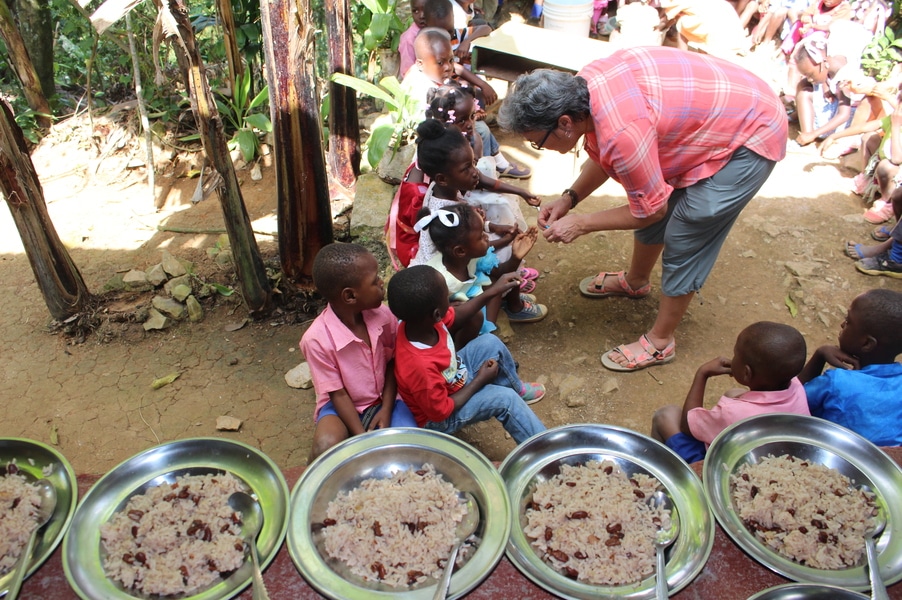
Originally, the pastorate sent $5,000 to feed 240 students. Last year, it sent $82,000 to provide meals for 500 students, pay teachers’ salaries and purchase school supplies.
“Every year we meet our obligation,” Goff said. “People know exactly where their money is going. We know we are making a difference up on that mountain.”
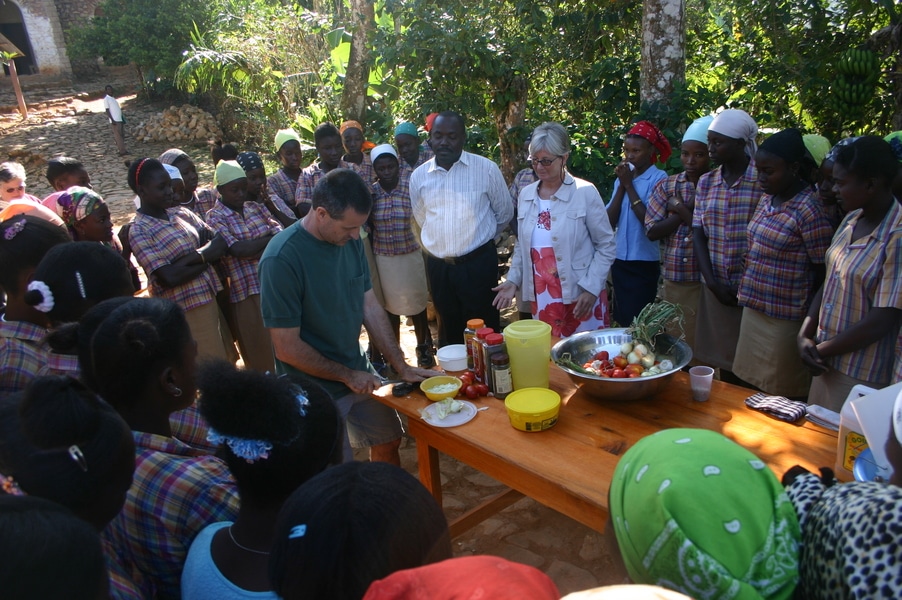
Beyond food and salaries, the parish has funded rain barrels for drinking water, solar-powered lanterns and a new home economics program. Its latest effort is raising an additional $96,000 to build a second story on the newest school building to create more classrooms.
“From my perspective, it is important (to give) to the least amongst us,” said Father Zack Crowley, pastor of the Pastorate of Our Lady. “The people of Haiti suffer immensely in all sorts of ways.”
While many churches in Haiti’s cities have been forced to close, St. Elizabeth of Hungary continues to thrive – largely because of its isolation.
“Ours is still going strong because it is so remote,” Goff said. “Gangs are not going up there. There is nothing up there.”
Reachable only by foot, the mountain parish has been spared much of the violence consuming other parts of the country, turning its remoteness into both a challenge and a safeguard.
Bearing witness and holding hope
The Haiti ministry at the Pastorate of Our Lady is the focus of “What They Saw Up the Mountain,” a documentary produced and directed by Nick Garrett, the pastorate’s evangelization director.
“The whole story is remarkable. I was totally blown away,” Garrett said. “All ministries are important, but this is literally impacting one’s daily life.”
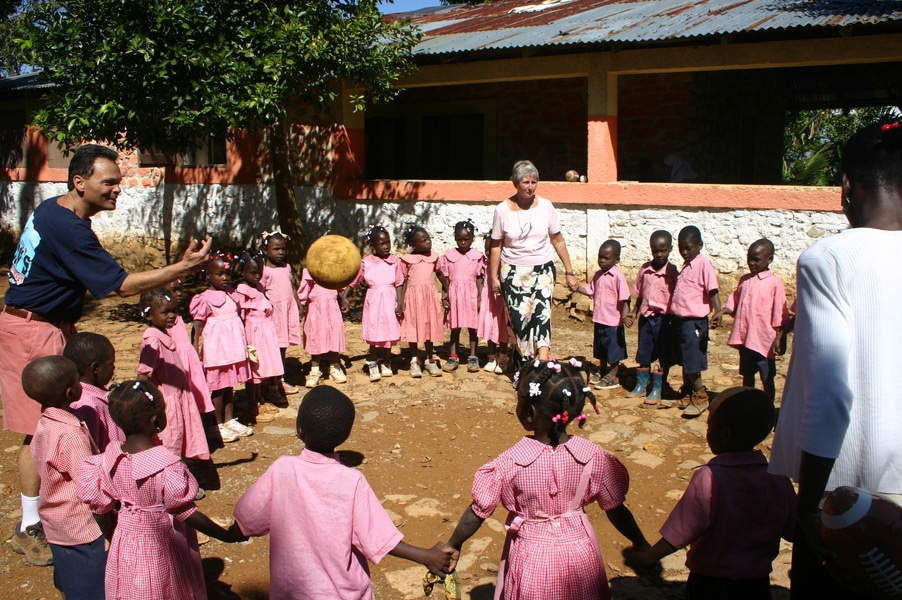
The Haiti committee at the pastorate is small, but Goff hopes its members – and others – will someday be able to return to visit their sister parish and school. She remembers the joy of those encounters vividly.
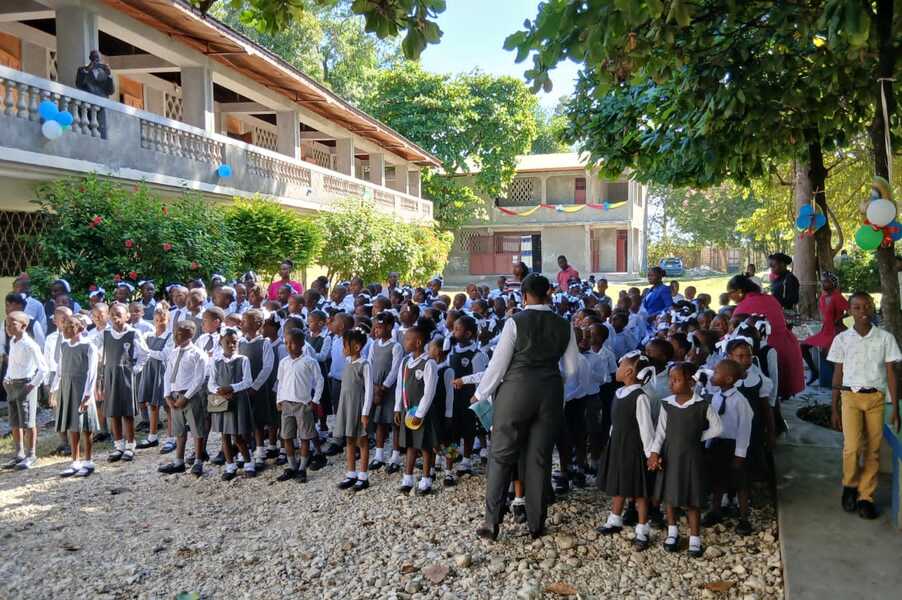
“They were very, very happy to see us. The kids were delighted to talk English with us,” Goff said. “Sunday Mass, the singing is just as loud as can be.”
Despite the suffering, Bowles remains inspired by the people she serves.
“The people are amazing … even with the suffering. Hopefully there will be an end soon,” she said.
Like Goff, Bowles, too, hopes to return.
“Haiti is a hard place. There’s a lot of beauty in it,” Bowles said. “We’re Christian. We’re Catholic. We believe in hope. We’re hoping for peace.”
FACTS ABOUT DIOCESE OF GONAÏVES
Established: Oct. 3, 1861
Territory: Covers 1,926 square miles in the Artibonite region of north-central Haiti
Catholic population: 1,031,000 Catholics (56.4% of the total population of 1.8 million in the diocese)
Partnership: Sister diocese of the Archdiocese of Baltimore since 1997
Catholic schools: Catholics in the Archdiocese of Baltimore support several Catholic schools in Haiti, including the Good Samaritans School in Gonaïves that was dedicated by Baltimore Cardinal William H. Keeler in 2001.
Email Katie V. Jones at kjones@CatholicReview.org
Read More Local News
Copyright © 2026 Catholic Review Media
