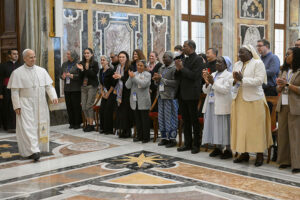
VATICAN CITY (CNS) — The world continues to fall short of protecting and caring for its children, leaving them with few opportunities to succeed and at greater risk of suffering abuse, Pope Leo XIV said in a speech Feb. 5.
In his address to the steering committee of the project “From Crisis to Care: Catholic Action for Children,” Pope Leo praised the Catholic organizations for their work with children, and he shared concerns about the lack of progress globally.
“Regrettably, I see that the situation of children today has not improved during the past year, and it is also of deep concern to learn of the lack of progress in protecting children from danger,” he said in the Apostolic Palace’s Clementine Hall at the Vatican.
Pope Leo expressed further worry over international priorities.
“One must question whether global commitments for sustainable development have been cast aside when we see in our global human family that so many children still live in extreme poverty, suffer abuse and are forcibly displaced, not to mention that they lack proper education and are isolated or separated from their families,” the pope said.
As of August 2025, only 35 percent of the United Nations’ sustainability goals were on track or making moderate progress, according to the most recent UN report on Sustainable Development Goals. These targets were created a decade ago by more than 190 countries as a promise to work toward ending poverty, protecting the planet and addressing inequalities by 2030.
Of the 17 targets, the report said that nearly half were progressing too slowly and another 18 percent were actually regressing. Last March, the U.S. President Donald Trump’s administration formally rejected the goals for the United States, saying that they infringed on the country’s sovereignty.
Global poverty has remained at a near standstill, with continual extreme poverty affecting one in ten people worldwide, according to a United Nations report last year. The World Bank’s most recent Poverty and Shared Prosperity report agreed, projecting 2020-2030 to be “a lost decade,” due in part to the COVID-19 pandemic.
Nearly half of the world’s population — 44 percent — survives on less than $6.85 a day, an income considered basic in upper-middle-income countries, the World Bank report said. At this rate of progress, ending extreme poverty would take decades — and lifting people above this income level would take more than a century.
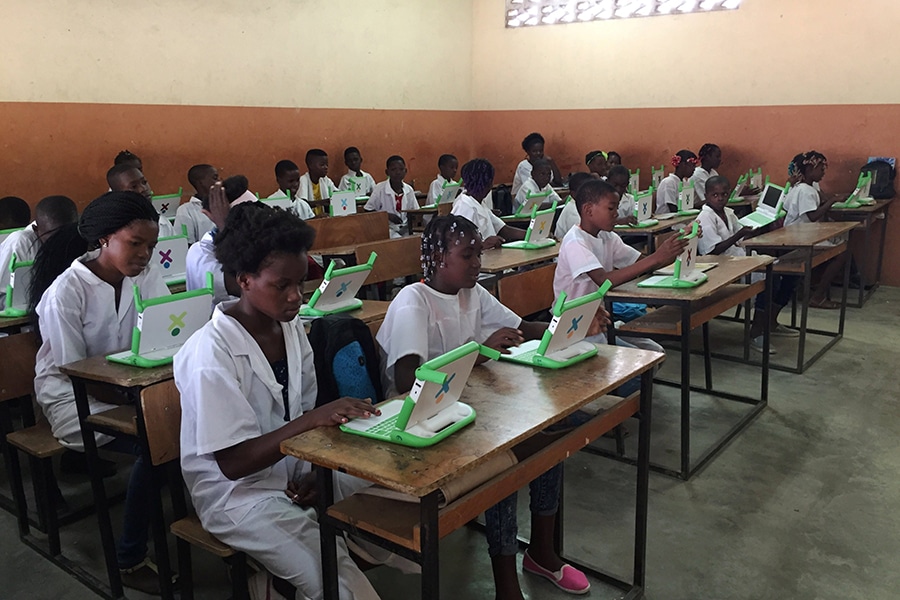
As for global education efforts, UNESCO’s annual Global Education Monitoring Report last year found that the number of children who are still not in school — 251 million — has barely changed since 2015. Three out of four children in developing countries cannot read and understand simple text by the age of 10.
The pope recognized that Catholic organizations often serve children through specialized missions, but warned that focusing too narrowly on one area may leave other needs unmet, urging greater collaboration to ensure holistic care.
“I urge you, however, to find ways to work together in greater harmony so that children receive care that is well balanced, taking into consideration their physical, psychological and spiritual welfare,” he said.
He recognized his predecessor’s work last year, convening the first International Summit on Children’s Rights, where experts and leaders from various nations explored opportunities for safeguarding children globally. Pope Leo asked the committee to address concerns raised at the summit and to support “those who have no voice.”
“Keep that in mind when the temptation to be discouraged arises because of failed initiatives, seeming lack of interest from others or the sense that the situation is not improving,” he said. “Let the good you know you are doing carry you forward.”
Read More Vatican News
Copyright © 2026 Catholic News Service/U.S. Conference of Catholic Bishops
