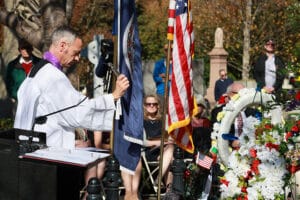
RICHMOND, Va. (OSV News) — On a brilliant autumn day brimming with historic significance, Eliza Monroe Hay, daughter of the fifth U.S. president, James Monroe, was reinterred alongside her father and mother in Richmond’s Hollywood Cemetery.
The rite of committal followed a Mass of remembrance at the Cathedral of the Sacred Heart in Richmond, both celebrated by Father Anthony Marques, rector of the cathedral.
“Death is the dawn of eternity,” said Father Marques. “Today is about bringing Eliza Monroe home, but Eliza’s soul is already at home with God.”
Hay became a Catholic in the 1830s and died in Paris in 1840. Upon her death, her physical remains were buried in an unmarked grave in Père Lachaise Cemetery for 185 years. At 2 p.m. on Oct. 23, her remains were laid to rest at the edge of her father’s famous tomb, nicknamed “The Birdcage” for its Gothic design, on a hill overlooking the James River at the historic Richmond cemetery.
“She’s being reunited with her family,” said Paul Christiansen, who served in the Sons of the American Revolution color guard during the ceremony.
Known as Eliza throughout her adult life, Elizabeth Kortright Monroe Hay was born to James Monroe and his wife, also called Elizabeth, in 1786. During her father’s presidency, Hay served as acting first lady while her mother was ailing. Joining the Catholic Church as an adult was a choice that biographer Barbara VornDick said may have contributed to a negative perception of her in the society of Washington.
“Precious little had been written about Eliza in the historical record,” said VornDick, a parishioner of Sts. Peter and Paul in Palmyra, Va. “What was written about her was often unflattering and unkind. I found these reports … lacking concrete examples.”
VornDick wrote “Eliza’s True Story: The First Biography of President Monroe’s Eldest Daughter” after discovering mountains of evidence about her true character, including proof in the archives of Saint-Philippe-du-Roule church in Paris that she was a practicing Catholic, as well as letters demonstrating her devotion to her family.
Hay’s husband, mother and father all died within nine months of one another. Her husband, George, died on Sept. 21, 1830; her mother died on Sept. 23, 1830; and her father died July 4, 1831.
After her daughter, Hortensia, died in December 1834, she took care of her three grandchildren in Baltimore before she returned to Paris, where she had spent some of her childhood when her father was the U.S. minister to France (1794-1796) and later assisted in the negotiations for the Louisiana Purchase.
“We tend to think of Eliza as an historical figure, someone in the distant past, and peripheral to the well-known story of her father,” said VornDick. “But she was a real, living, breathing human being. She was a daughter, a sister, a wife, a mother, a grandmother.”
This portrait differs from the traditional picture of Hay often found in the biographies of James Monroe and his contemporaries.
“The press called her ‘Queen Elizabeth,’ and (President) John Quincy Adams called her ‘an obstinate little firebrand,'” said Republican state Sen. Bryce Reeves, who spoke at the reinterment. “In today’s world, she would be applauded for her tenacity and resolve.”
With many family members dead and her inheritance delayed, Hay was stranded in Paris before her own death in 1840.
“She didn’t intend to live out her life in Paris; she got stuck there. I knew the right thing to do was to bring her home and bury her with her family,” said VornDick. “Burial of the dead is a corporal work of mercy.”
President Monroe was the last U.S. president to have served in the American Revolution; he was wounded at the Battle of Trenton in 1776. The Sons of the American Revolution were joined at the event by other heritage groups, including the Daughters of the American Revolution and the National Society Daughters of 1812. Wreaths from these associations and others flanked the grave of the nation’s fifth president, who was in office 1817-1825.
One distinguished guest, Michael Kamtman, traveled from Winston-Salem, N.C., to serve as pallbearer for his great-great-great-great-great-grandmother. Born close to Hay’s last home in Baltimore, Kamtman said that he always knew he was descended from President Monroe’s eldest daughter, but that VornDick was an “extraordinary historical detective” who cast a “shining light” on his family, bringing justice to his ancestor and righting an historic wrong.
“Today moved me in a way that is kind of hard to describe,” Kamtman told The Catholic Virginian, the news outlet of the Diocese of Richmond. “Eliza and the president being ancestors of mine is a gift I’ve enjoyed for my whole life. It’s not a piece of paper, or a letter, or an object that can be lost or stolen. It’s something that’s a part of me, and will always be a part of future generations, that can never be tarnished. It’s something I find priceless.”
“They’ve made everything possible for me,” he continued. “I’m standing on their shoulders. If it weren’t for them, where would I be? It’s brought home a sense of loving responsibility that I feel toward future generations.”
Father Marques sprinkled holy water on Hay’s new grave and the cathedral schola sang “Salve Regina,” concluding the ceremony.
“Knowing that Eliza has a permanent resting place here is an extraordinary relief,” said Kamtman. “It’s like one of those dreams where you’re lost, and you can’t find your way home. In the good dreams, someone helps you find your way back.”
There were many people helping Eliza back home, but it was VornDick who began the process. VornDick, meanwhile, gave all the credit to God.
“I could see God’s hand in this from the beginning,” she said. “I felt drawn to Eliza’s story. It touched my heart, and I believed I was intended to do this.”
“I’ve never done anything like this in my life. I’m not an historian by trade,” she continued. “But even when it got tough, I never doubted it would happen, because I knew God wanted it to happen.”
“It’s meant a great deal to be close to Eliza, to speak to her, to welcome her back and to wish her well,” said Kamtman. “After 185 years, I’m thrilled that she’s back with her family.”
Read More World News
Copyright © 2025 OSV News
