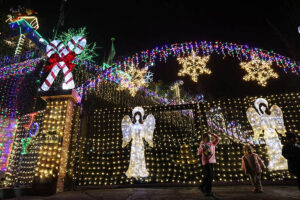
On Dec. 26, our Evangelical neighbors had their Christmas tree out on the curb, and all the stores had marked the decorations down to 50 (then 75 and 90) percent off.
I know that there’s a Catholic contingent that insists on observing the Christmas season through Feb. 2 (the feast of the Presentation of the Lord), but that always seemed a bit too long to me.
We’ve always maintained the holiday décor until Epiphany. But in recent years — for practical as much as liturgical reasons — we’ve kept it all up a week or two longer.
Time, however, marches on. In stores across America, Christmas reds and greens have morphed into hearts and shamrocks. Easter pastels are beginning to appear on some shelves. Clearly, there’s something about us that makes it difficult to live in the present moment. Even the liturgical year propels us forward to the next thing. While plans may not yet be fully fleshed out, most Catholics are already thinking about Lent.
Ordinary Time means a return to ordinary life: the sleeker, uncomplicated and functional way we most often pass through time. But while the house looks more spacious and less cluttered again, there’s always something sad about packing pretty things into attic-bound boxes to be stored away. Ten months is a long time to live without Christmas.
The mystery of Emmanuel, the Word of God irrevocably made flesh, is a key to more deeply understanding everything about our faith. But — hear me out — we haven’t even begun to scratch the surface. Christmas is a mystery of the highest order. We cannot clearly see or fully grasp any other aspect of our faith apart from its light. And yet, the Incarnation still baffles us, perhaps even frightens us. Two millennia of contemplation has not yet plummeted its depths or adequately grasped how Jesus of Nazareth, fully God and fully human, changes everything.
We’re in good company. From the first disciples, Christians have been unpacking the mysteries of their faith. Some of the holiest hearts and the most brilliant minds in human history have been utterly confounded by the truths we blithely rattle off in the Creed at Sunday Mass. Yet all of us, according to our ability, have been called to ponder them. Indeed, the cycle of our liturgical year is meant to help us grasp all of what God has given and revealed in Christ by drawing our attention to one mystery at a time.
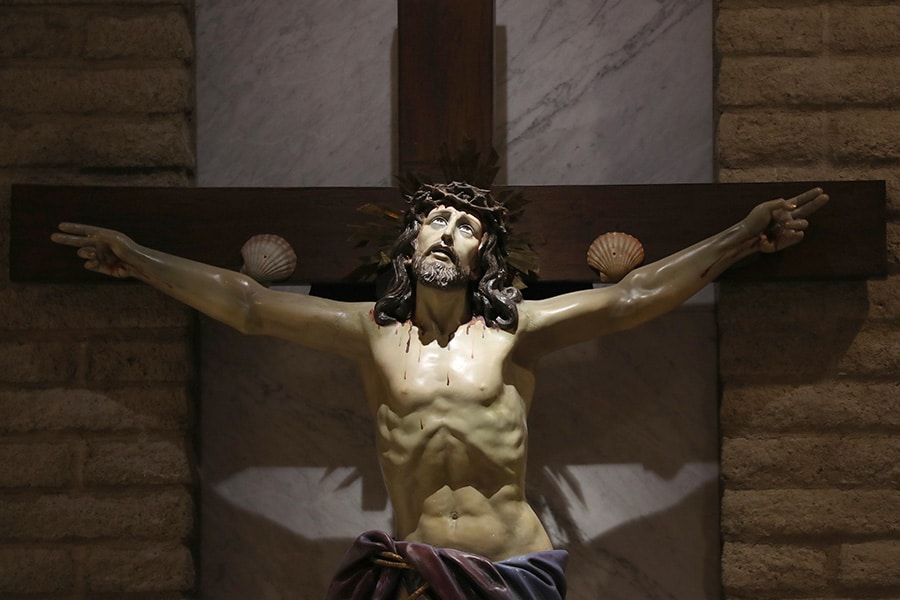
And yet, the Church’s catechetical focus and liturgical emphases have evolved. Over the centuries, the Paschal Mystery — that is, Christ’s saving passion, death and to a lesser extent his resurrection — have become the lens through which we are taught to see everything else. It’s understandable, but reductive, nonetheless. The question, “Why was Jesus born in Bethlehem?” can be answered simply: “To save us from our sin on Calvary.” But if that is the only angle from which we view the life of Christ, our faith will be impoverished.
Most of us have been taught to see the crib in the shadow of the cross. But what if we were able to see the crucifixion in the light of the Incarnation? What if the reason Jesus came and lived, suffered and died — and rose again — was to unite humanity and divinity in mystical marriage for eternity? What if, as some theologians (like John Duns Scotus) have suggested, the Incarnation was God’s plan from the beginning, and not an Option B necessitated by sin? What if the mission of Christ wasn’t just to save souls, but to redeem our bodies too? Could St. Athanasius have been right — that “God became man, so that man might become god?” Is theosis or divinization the whole point?
As we move together toward Lent and Easter, we ought to resist stuffing the full impact of the Incarnation into a box of decorations we keep in the attic of our spiritual lives until December rolls around. Christmas is good all year, and it’s a mistake for us to put it away at all.
Read More Commentary


Copyright © 2026 OSV News
