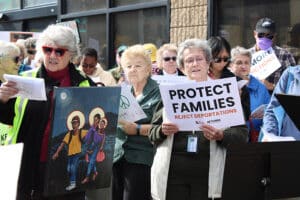
History has shown that collectively America’s bishops have taken controversial stands that have helped animate and even shape the national discussion.
Perhaps most noteworthy was their 1919 “Bishops’ Program for Social Reconstruction,” which laid the groundwork for the New Deal and positioned the church firmly on the side of the working class and immigrant populations.
In the 1980s, the bishops debated a nuclear arms pastoral letter called “The Challenge of Peace” that stimulated an international discussion about the morality of a nuclear policy that threatened Mutual Assured Destruction. That was followed by “Economic Justice for all: Pastoral Letter on Catholic Social Teaching and the U.S. Economy” in 1986.
Historian Leslie Woodcock Tentler wrote that “no statements issued by the U.S. hierarchy had ever elicited such widespread notice and discussion” as those two.
Since then, the U.S. bishops’ collective voice has become more subdued. In part this reflected a more divided conference that shied away from big statements and debates that might reveal their own internal differences. The commotion over efforts to issue a statement on Catholic politicians, the Eucharist and abortion in 2021 only heightened this reluctance.
The backlash from the clergy sexual abuse crisis since 2002 has also muted their voices. “Who are they to be preaching to us” is a lazy but common rebuke anytime someone disagrees with a bishop’s position.
This year, however, the annual November meeting in Baltimore has an opportunity to take a public stand on an issue that is roiling the neighborhoods and parishes of many American communities — the current administration’s aggressive campaign to seize and deport undocumented immigrants.
In recent months, a number of individual bishops have issued letters and even taken to the streets to protest this often violent and cruel campaign intended to sow terror, including the separation of parents from children, harsh treatment and abusive jail conditions often far from their communities, and deportation to countries where they have no citizenship or connections.
What has not happened yet, however, is a unified challenge from the bishops to not only condemn these wrongs, but also to engage their faithful and the broader public in a critique of our broken immigration system and to issue a call to action.
What may give the bishops cover to speak out more forcefully at this moment is the example of Pope Leo.
A former missionary in Peru who has seen firsthand the suffering of the global south, Leo has been particularly assertive in his criticism of anti-migrant campaigns. The American pope is not focusing only on the situation in our country, but his words still sting.
“Ever more inhuman measures are being adopted — even celebrated politically — that treat these ‘undesirables’ as if they were garbage and not human beings,” he said in an Oct. 23 speech. “States have the right and the duty to protect their borders, but this should be balanced by the moral obligation to provide refuge.”
The U.S. bishops have been saying for years, if not decades, that the U.S. immigration system is broken. Archbishop Jose Gomez, former president of the bishops’ conference, in his book, “Immigration and the Next America,” made this case in 2013, recalling the very real contribution immigrants continue to make economically and culturally, as they have for more than two centuries.
This is an opportune moment for the U.S. bishops’ conference to rally around the pope’s leadership and engage their own nation in a serious effort to reform the immigration system while protecting the due process and rights of those undocumented who currently reside in the country.
America’s bishops can make themselves heard if they want. America needs to hear their voice now. Justice demands it.
Read More Commentary
Copyright © 2025 OSV News
