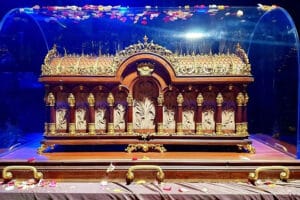
Sister Judy Long, prioress of the Carmelite Monastery in Towson, vividly remembers the last time the sacred relics of St. Thérèse of Lisieux visited Baltimore. It was 1999, the same year she entered religious life, and she was among the throngs who filled both the Carmelite Monastery and the Basilica of the National Shrine of the Assumption of the Blessed Virgin Mary. Those two local stops were part of a national tour that drew more than one million faithful across the country.
“People just come out of the woodwork for her,” Sister Judy recalled, describing how pilgrims reverently sought the popular saint’s intercession as they venerated her relics. “You know, she crosses cultures and barriers in a way a lot of others can’t. She’s so accessible.”
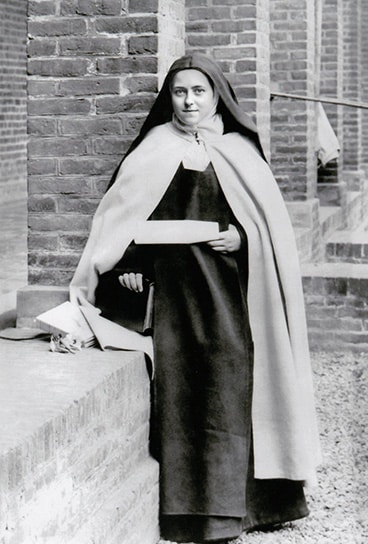
Now, more than 25 years later, Sister Judy is overjoyed that Catholics in the Archdiocese of Baltimore will again have the opportunity to pray in the presence of St. Thérèse’s relics – some of the bones of the beloved saint – when they return to the Carmelite Monastery Nov. 25-26.
Housed in an ornate 300-pound reliquary, the objects have journeyed from St. Thérèse’s native France as part of a pilgrimage marking both the 100th anniversary of her canonization and the Catholic Church’s Jubilee Year. The tour began on her feast day, Oct. 1, in Michigan and will include multiple stops across the United States before coming to Maryland.
St. Thérèse, known worldwide as the Little Flower, was a 19th-century Discalced Carmelite nun whose humble life and deep love for God continue to inspire millions. Though she died at only 24, her writings revealed a profound spirituality that led to her canonization and her recognition as a Doctor of the Church.
Her “Little Way” teaches that holiness can be found in ordinary acts done with extraordinary love and trust in God. She believed that simple gestures of kindness, patience and faith could lead a soul to spiritual greatness, showing that sanctity is attainable in everyday life.
Sister Judy noted that St. Thérèse’s faith is especially powerful because it endured despite deep suffering. Stricken with tuberculosis, the saint experienced what Sister Judy described as a “dark night of the soul.”
“She was tormented by the idea that there was no heaven – that after death, you go into nothingness,” Sister Judy said. Yet, despite her doubts and pain, “she made a conscious effort to love every day. And that was her vocation.”
There’s a poignant irony in St. Thérèse’s life and death. The young nun longed to be a missionary, yet she spent her short life behind cloistered convent walls beginning at age 15. In death, her human remains really are traveling the globe.
Beyond that, her spiritual message has reverberated far and wide since her death, Sister Judy said.
“Thérèse was beyond her time when she was emphasizing God’s love,” Sister Judy said. “Everyone back then was into Jansenism and offering themselves as victims of God’s justice. Thérèse offered herself to divine love. To her, love was the most important of God’s attributes.”
When You Go
The relics of St. Thérèse of Lisieux will be at the Carmelite Monastery, 1318 Dulaney Valley Road, Towson, Nov. 25-26
Veneration (open to all): Nov. 25: 3-8 p.m. and Nov. 26: Noon-2 p.m.
Mass celebrated Nov. 26 in the presence of the relics at 10 a.m. by Carmelite Father Steven Payne, chairman of Carmelite Studies at The Catholic University of America. (Tickets required)
Advance registration required to attend the Mass due to limited seating.
Register at tinyurl.com/CarmelMass2025.
The Mass will also be livestreamed; register to watch at tinyurl.com/CarmelLivestream.
Visitor details
Parking is limited. Carpools are encouraged.
No large bags or backpacks permitted.
Email George P. Matysek Jr. at gmatysek@CatholicReview.org
Read More Local News

Copyright © 2025 Catholic Review Media
