
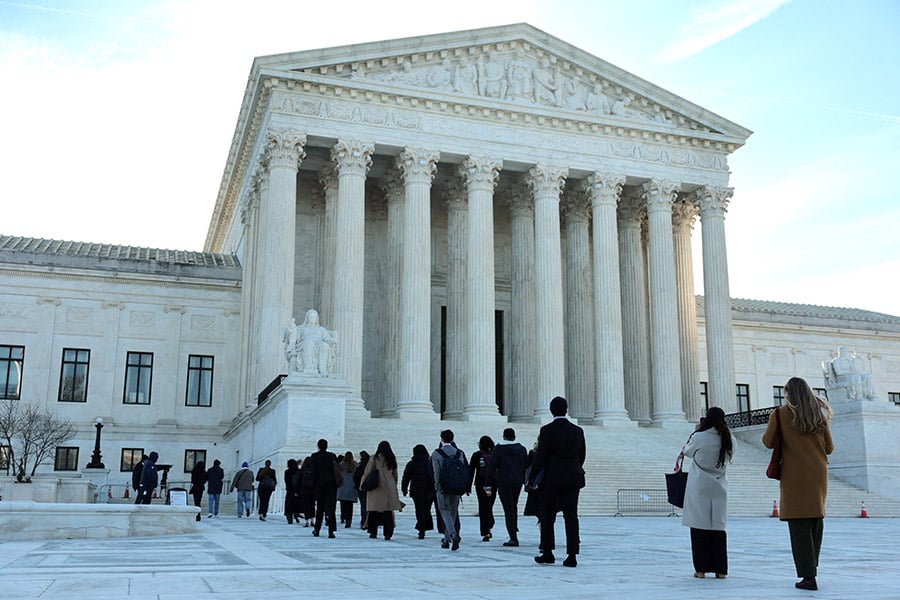
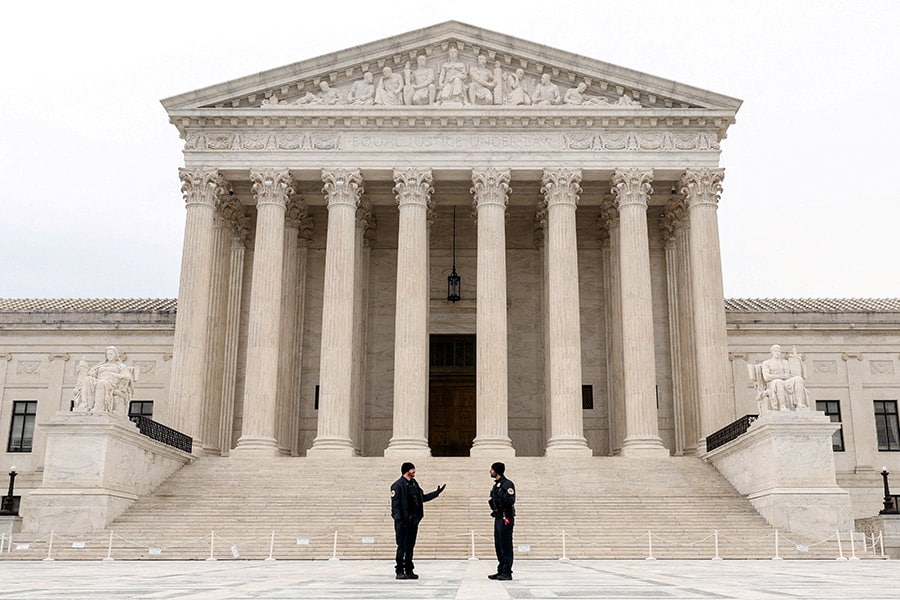
WASHINGTON (OSV News) — The U.S. Supreme Court heard oral arguments March 24 in a case concerning a policy of turning away asylum-seekers along the U.S.-Mexico border.
Sometimes called “metering” or the “turn back policy,” the policy of sending back some asylum-seekers who presented at the border was first sometimes used under President Barack Obama and later expanded during the first Trump administration before it was rescinded in 2021 by President Joe Biden’s administration. The second Trump administration has sought to reinstate the policy, which is not currently in effect amid ongoing legal challenges.
Reimplementing the policy would block asylum-seekers from setting foot on U.S. soil, where federal law would then allow them to seek asylum, which, if granted, would provide protection from persecution in their country of origin. Other efforts made by the second Trump administration to curtail asylum are facing separate legal challenges.
Kevin Appleby, senior fellow for policy and communications at the Center for Migration Studies of New York and the former director of migration policy for the U.S. Conference of Catholic Bishops, told OSV News, “The administration not only wants to deny asylum-seekers entry to the U.S. by shutting down the border but also deny them the chance to claim asylum unless they are on U.S. territory.”
“The practical effect of these policies is the withdrawal of asylum protection altogether, which is a violation of both U.S. and international law,” he argued.
Dylan Corbett, executive director of the Hope Border Institute, a group that works to apply the perspective of Catholic social teaching in policy and practice to the U.S.-Mexico border region, told OSV News, “Over the last decade, we’ve seen the near complete undermining of asylum for people fleeing persecution and danger.”
“While in need of real reform, asylum was carefully crafted as a critical measure of protection to address the needs of refugees at our border, essential for meeting the needs of the vulnerable as well as the moral health and credibility of our country as a nation of immigrants,” Corbett said, calling the case “a bell weather for our commitment to both humanitarian protection and U.S. global leadership.”
A central question in the case is whether noncitizen asylum-seekers must literally cross the border in order to apply for asylum, or those who appear at the border and seek entry must also be allowed to apply.
During the arguments, some justices questioned whether the policy would incentivize irregular border crossing by requiring asylum-seekers to cross the border rather than present themselves at it, running afoul of congressional intent.
“Why would Congress privilege someone who illegally enters the United States?” Justice Brett Kavanaugh asked at one point, questioning if it draws a distinction “between the illegal entrant and the person who lawfully gets very close and wants to follow the rules.”
Justice Ketanji Brown Jackson questioned whether the policy should be sent back to lower courts since it is not currently in effect.
“Why wouldn’t we wait until we had an actual policy with real facts in the record regarding what’s going on?” she asked, adding, “It just seems to me that we have a lot of hypotheticals regarding how this policy may have worked in the past, how it’s possibly going to work in the future, but we don’t have a policy in effect right now that we can actually rule on.”
But Assistant to the Solicitor General Vivek Suri argued that the policy is “a tool (the Department of Homeland Security) will want in its tool box” and that the court should not leave it “to future uncertainty.”
Appleby said, “I think all sides would agree that the U.S. asylum system should be more efficient, but the nation should not address the problem by weakening its commitment to the protection of human rights.”
Catholic social teaching on immigration balances three interrelated principles — the right of persons to migrate in order to sustain their lives and those of their families; the right of a country to regulate its borders and control immigration; and a nation’s duty to regulate its borders with justice and mercy.
An amicus brief filed by the USCCB in support of the migrants challenging the policy said, “The policy violates the obligation to care for refugees — a fundamental legal and moral principle that runs through nearly two millennia of Catholic faith, an international humanitarian consensus, and this Nation’s history.”
A decision in the case is expected by the end of the court’s term, which typically ends in June.
Read More Immigration & Migration

Copyright © 2026 OSV News
