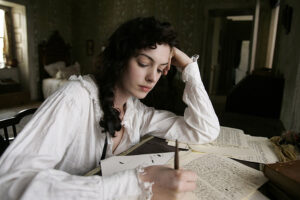
“What vile creatures her parsons are! she has not a dream of the high Catholic [ethos].” So wrote John Henry Newman a generation after the death of Jane Austen. Newman was then a clergyman in the Church of England; he was troubled by the religion of the day, which he thought one of comfort, elegance and mere propriety.
“Conscience,” he warned, “is no longer recognized as an independent arbiter of actions.” Austen’s worldly clergymen Mr. Collins and Mr. Elton could never have pleased him, and although he liked her character Emma and found the novels “clever,” he was concerned that the action in them was “frittered away in over-little things.”
Today’s reader of Austen’s stories can, with the young Newman, skate across the surface of her plots, laugh at the foibles of her characters, and miss their deeper significance. Yet perhaps this possibility points to one of the merits of Jane Austen’s art. For she was the chronicler of ordinary time, not of heroic, penitential seasons. And she was the spiritual daughter of the great Dr. Johnson, who had so convincingly depicted and modeled an everyday Christian charity, one that was perhaps a bit Stoic in its reserve, but no less an inward religion for being less openly declared.
The Catholic reader of Jane Austen’s novels should find them to be dramas of conscience. Her heroines are women of thoughtfulness and integrity. In her last completed novel, “Persuasion,” she gave her most compelling example of Christian character in Anne Elliott. The novel begins seven years after Anne has declined an offer of marriage from a bold, young naval officer, a choice that she had made after taking counsel from a mentor, her late mother’s best friend. At the story’s end, Anne looks back upon her decision, declaring it to have been right: “if I had done otherwise, I should have suffered more in continuing the engagement than I did even in giving it up, because I should have suffered in my conscience.”
Other stands on principle are made by Fanny Price in “Mansfield Park” and Elinor Dashwood in “Sense and Sensibility,” and it is characteristic of Austen that their actions should have been instances of restraint — the one refusing an offer of marriage, the other keeping a promise of silence even though it had been given under a duress bordering on coercion.
Jane Austen’s novels also abound in positive acts of charity, although they may be of a modesty to bring delight only to her more attentive readers. Some are marked by their warmth: Mr. Knightley’s gift of apples to the spinster household of Miss Bates and her aged mother; Anne Elliott’s fidelity to her childhood friend Mrs. Smith; Elizabeth Bennet’s gift of a visit to Charlotte Lucas, recently wed to the absurd and bothersome Mr. Collins. Yet even the chilly and stern Sir Thomas Bertram has a heart, as he shows by giving a ball for his niece Fanny Price and honoring her brother William with his regard.
It was Newman himself who observed in one of his most celebrated sermons that “one little deed, done against natural inclination for God’s sake” is a stronger proof of Christian character than “all the dust and chaff of mere profession.” And in Jane Austen’s more virtuous characters, we find ample support for the conclusion that, while most eminently delighting her readers, she sought also to instruct them.
Still, this is the woman who admitted that “pictures of perfection” made her “sick and wicked.” And the Catholic reader of Jane Austen must not suppose that her business was to write fictionalized lives of saints. None of her characters escapes her gentle irony; all her protagonists have some learning to do. For some, like Elizabeth Bennet and Emma Woodhouse, the needed growth in self-knowledge and self-possession comes through a shock of recognition. For others, such as Marianne Dashwood and Frederick Wentworth, it is a longer period of suffering that teaches the necessary lesson. Nor was she afraid to portray characters who were either incapable of learning — the morally-stunted Lydia Bennet and George Wickham — or who chose not learn when given the opportunity to do so, as in the tragic case of Henry Crawford.
What is common to her portrayal is a trait that she shares with the greatest of Catholic novelists — Sigrid Undset, Georges Bernanos and Alessandro Manzoni — which is a deep sympathy for her characters. Imaginary though they were, she loved them into existence that we might contemplate in them a reflection of the little spark of the divine that we are called to perceive and to love in our neighbor.
Dec. 16, 2025, marks the 250th anniversary of Jane Austen’s birth.
Read More Commentary




Copyright © 2025 OSV News
