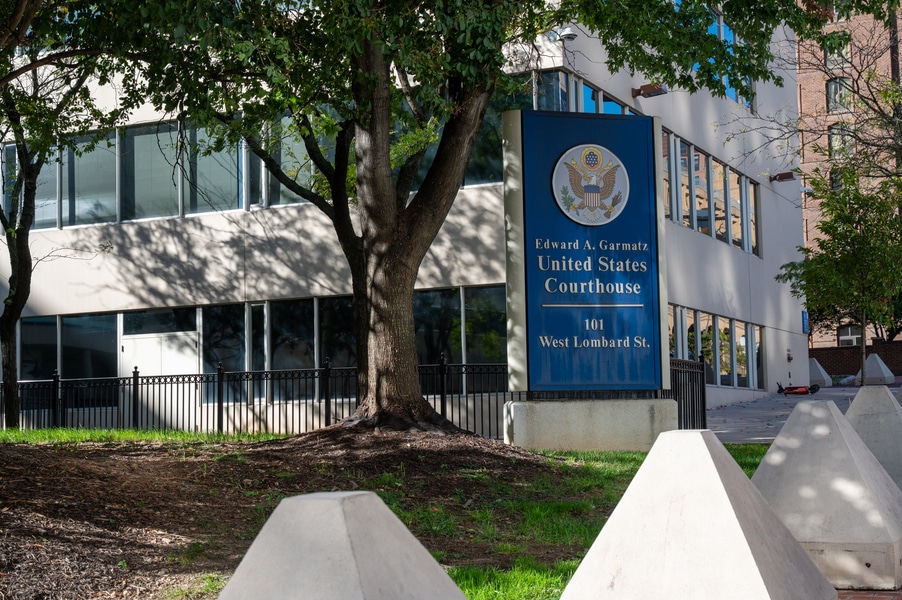
In a federal courtroom in Baltimore Nov. 5, 10 people stepped up to give impact statements about the effects of their abuse as minors by people connected to the Archdiocese of Baltimore. Their stories included tears and frustration, as well as signs of hope and healing.
After each one completed their statement, a couple dozen supporters in the gallery stood in silence with their arms crossed over their chest in a sign of support and solidarity.
Judge Michele M. Harner allowed the witnesses as part of the archdiocese’s Chapter 11 bankruptcy reorganization proceeding. This was the third such set of impact statements provided in the case.
Baltimore Archbishop William E. Lori and Auxiliary Bishop Adam J. Parker attended the session, as they have for the other two similar hearings.
Before the session, a court officer ordered all those in the courtroom to completely turn off their electronic devices. An order from the court noted that although the session would be recorded as part of the process, it would not be transcribed and would not be used as evidence in the case.
Harner said, “As with the prior two (impact statement) sessions, today is an opportunity for individuals to engage in the Chapter 11 process and be heard.”
As such, to allow as much time as possible for the witnesses, she asked the parties in the case to forgo opening statements. The session, scheduled for two hours, ran an extra 30 minutes.
The first victim-survivor to the stand noted that his parents had sacrificed to send him and his three brothers to Archbishop Curley High School. He detailed abuse by one of the teachers there, a Conventual Franciscan, and noted that the priest is still alive. He said the fact that he still is listed as a Franciscan is “an insult to me and to God himself. I am a believer in God, but this is an insult.”
(While some of those who gave impact statements gave partial or full names in their statements, the Catholic Review is not naming any of them, to respect their privacy.)
The witness said the experience of abuse by the priest left him “lost, confused and broken.” He said he shared his story in the case to show how the effects linger long after the abuse.
A female victim-survivor who had been abused in the foster care system and then by a nun at Villa Maria School said she spoke not only for herself but for others who were in pain, hidden and dismissed. She said she wanted to feel safe but instead was abused by those she was supposed to trust.
She was abused again at another school. “My voice was silenced, and my pain was ignored,” she told the court, noting that because of the trauma, humiliation and neglect, by the time she left the foster system, she had the equivalent of a third grade education. This led to a cycle of low-end jobs, abusive relationships and feeling discarded like trash.
She noted that empathy, accountability and recognition of harm are essential to providing healing. “The time to take responsibility is now,” she said. “For decades, I have waited for this day – to be heard.”
Other witnesses echoed some of the same concerns – lack of trust, trouble with intimacy, addictions and strained relationships.
One witness explained that his mother was such a devout Catholic that she would not have believed anything bad about priests or nuns. He detailed the ways that priests groomed and then abused him, but he could not tell his mother or others about the abuse. He doesn’t have friends because he cannot communicate with people.
“Everything that happened to me is still inside me,” the now-77-year-old said. As he broke down in emotions, he said, “My day is coming when I am going to see God. Tonight, I can say, ‘God, I told the truth.’”
A transgender woman took the stand to note how she had been abused, which resulted in struggling to live as a male, unable to have a relationship with women.
“The abuse took my health, education and dignity,” she said. Diagnosed at one point with AIDS and expecting to die, she now notes that through Narcotics Anonymous she has been seven years without drugs and 15 years without a drink.
“I have been on a long journey to be here today” to be able to help others. “I wonder what my life would have been like without the darkness of these abuses,” she said.
She concluded her statement saying, “I will always be a survivor.”
At least two of the witnesses addressed Archbishop Lori specifically, expressing anger and frustration at what they see as inadequate response from the church and the bankruptcy process. One noted that many adults in the church failed the girls who were victimized at parish schools.
Another victim, who is representing himself in the case, noted that he had been sexually abused by a gay choir director 20 years ago this month. Like others, he detailed the impact of remaining silent about the abuse, including never feeling safe.
Five years ago, a friend told him, “It’s OK to be you.” Those five words – which no one had said to him before – set something free, he said. Maybe he was not beyond repair or beyond hope.
He filed his claim in the bankruptcy case in 2024, including laying out the timeline of abuse. Five months later, he attended a Mass of healing for victims of abuse, where he went from tears of healing to tears of gratitude.
He said survivors cannot find hope and healing if they remain hidden. “We need at least one other person” with whom they can share their story. These can lead to glimpses of redemption.
Abuse is not confined to a single event in the past, he said, noting that the impact is real. But he said he is not “crushed” by the past.
He said his wife – “by the grace of God” – has chosen to stay with him. Others, including his children and priests he knows, stand with him when he could not stand alone.
He added that he is discerning a call to the permanent diaconate so that he can be part of the healing for others. “The church heals when it listens,” he said, noting that he wants to be available for people, as he had wanted someone to listen to him.
What was done to him is not the end of the story. “What happened cannot be undone. That betrayal is real and long-lasting,” he said, but it does not mean there cannot be forgiveness.
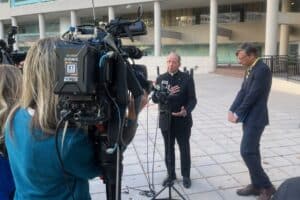
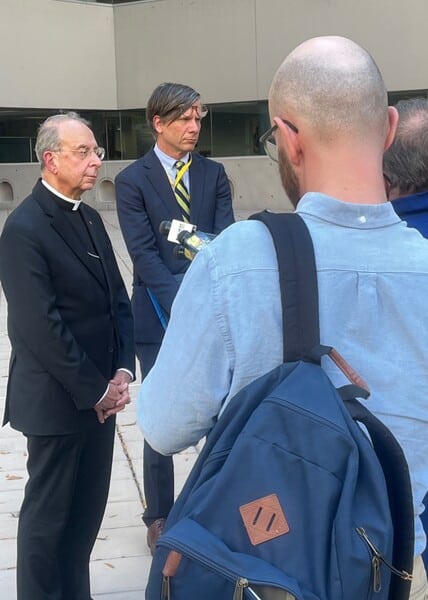
After the hearing adjourned, Archbishop Lori spoke to reporters gathered outside the courthouse and called the stories he heard that day “soul-searing.”
“I’ve apologized many times, but I realize there is no apology that can ever cover what has happened to these individuals, and I certainly admire their courage for being willing to do this,” the archbishop said. “I cannot imagine – I do not pretend to imagine – how difficult this must be for the people who have survived abuse, to speak about such things in their lives.”
He said he recognized as he listened to the witnesses that the church must be accountable. “Of course, the church must continue to pursue everything that can possibly do to ensure that this does not happen again. We have striven to do this over many decades, but I also recognize if this has happened to you, even those efforts are probably not going to seem to be enough,” Archbishop Lori said.
He noted that in addition to those involved in the archdiocese’s case, many others have been abused in other places, including state institutions and other public or private schools.
“There’s a lot of pain out there. And I think that it’s important that it be heard as well,” he said.
The archbishop said he is anxious and hopeful for a settlement in the case in the near future that would provide fair, just, equitable compensation, and at the same time continue the church’s mission in parishes, schools and charities.
“I think it is very important in the lives of those who have been harmed, that there be some closure. There’s never full closure, but some sort of assistance,” he said. “From the very beginning, we have said that we will put the resources of the church toward a settlement. And we have already made a proposal to do that to provide a considerable amount of money in order to do that. And it is our desire to bring this to closure as soon as we can.”
He said the archdiocese has done and is doing everything possible to ensure that that abuse is not continuing in the church.
Paul Jan Zdunek, who chairs the Official Committee of Unsecured Creditors – a group of seven people who represent all the victim-survivors in the case – told the Catholic Review after the hearing that he did not make planned opening and closing remarks due to the judge’s request to allow time for the victims to speak.
“A lot of the things that were in my speech were in the remarks that came from survivors,” he said, including that the Chapter 11 process seems to be taking a lot of time and that victim-survivors should be more than a line item.
“Patience and perseverance are important in this. This has ruined lives. It’s a moment in time that has a long tailwind that again, as today, is just not going away for a lot of people. It’s really heartbreaking,” Zdunek said.
He said the committee and attorneys reached out to various victim-survivors and their legal counsel to see who would be willing to share their stories. “It’s very difficult thing to do,” he said, noting that for some, today – as in past sessions – was the first time speaking out in the public and to their loved ones about the abuse they experienced, “which I can’t even imagine.”
Zdunek, a victim of abuse himself, said although the court process cannot hear all the survivors who want to share their stories, “I think they do represent, just like we on the committee represent, the rest of their voices,” he said.
Read More Bankruptcy

Copyright © 2025 Catholic Review Media
