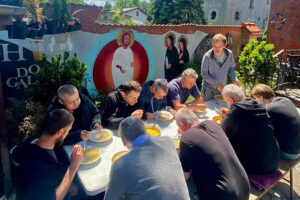
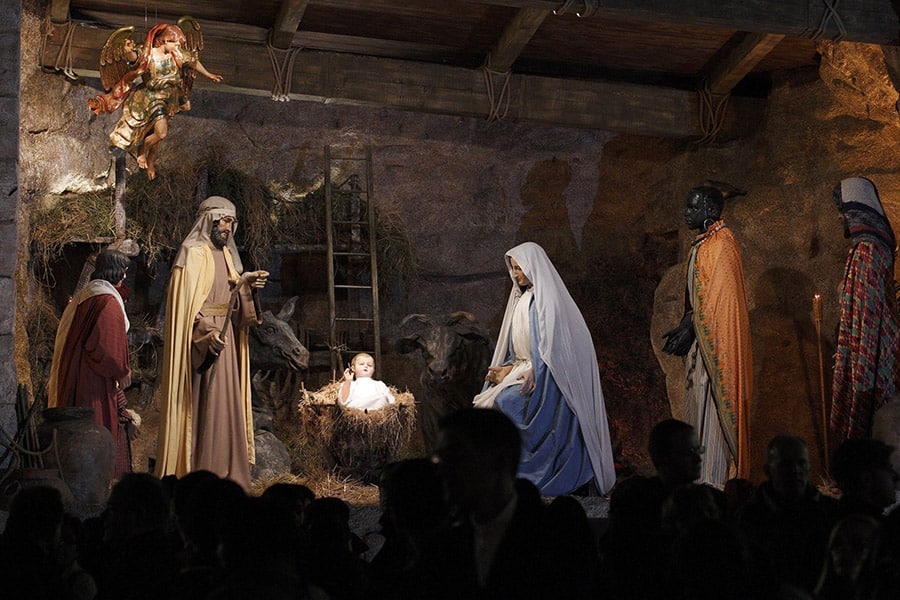
GRECCIO, Italy (OSV News) — Eight centuries ago St. Francis of Assisi came to this hillside village to show the world that God chose to be born among the poor, staging the first Nativity scene in a cave outside the town of Greccio.
Today, that same Franciscan vision has drawn a Polish priest and his community to Greccio — and left them praying for a Christmas miracle to realize their dream of having a retreat house for the poor in a place where God asked St. Francis to renew his church.
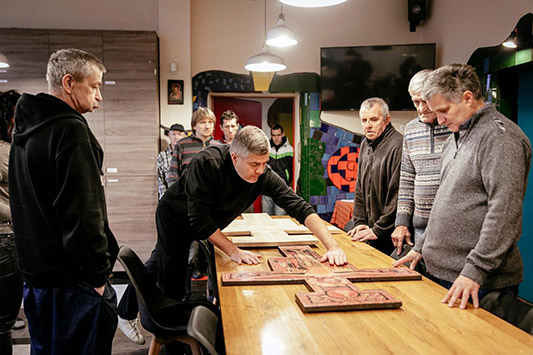
For almost 30 years, Father Miroslaw Tosza, a priest of the Diocese of Sosnowiec in southern Poland, has lived in the Betlejem (Bethlehem) community in Jaworzno — a house shared by people who have lost jobs, families, homes, health, sobriety and, very often, trust in anyone at all. Now, he dreams of establishing a retreat house for his poor in Greccio.
He insists the idea of the original Betlejem house was not really his. “The impulse? I simply keep trusting that the impulse came from above,” he told OSV News. “It wasn’t just an idea. I received a kind of vocation within a vocation.”
As a young priest in Paris, he spent some time with the Monastic Fraternity of Jerusalem community. Once he returned from overnight adoration only to realize at 4 a.m. that he had no key. As he waited under an archway, a homeless woman with a child appeared at the monastery door.
“For me the whole situation was irrational … like an apparition,” he remembered. “Later I read it as a double adoration … first Christ in the Eucharist, and then the same Christ at the door of the monastery. It’s the same presence.”
That moment, he said, became the theological root of what came later: one Christ present both on the altar and in the poor.
Back home in Jaworzno — a town that is part of the industrial pattern of southern Poland’s Silesia region — on Feb. 14, 1996 — “on Valentine’s Day,” he noted — he stopped by his home parish for coffee. The pastor told him the city wanted to give away an abandoned school for charitable work. “Do you have an idea what we could establish there?” the pastor asked.
“I came to see the school,” Father Tosza recalled. “It was in total ruin,” he said, feeling at the same time it was precisely “the place God was sending me to.”
He moved in — and immediately invited others. “From the beginning, the intention for the house was that we would not do something for the poor, but together with them,” he said. “We didn’t wait until the house was ready. We entered the former school as it was and tried to renovate it together with the poor.”
The name came later, inspired by Bethlehem and the first adoration of Christ. “God chose the poor as the first ones who were to welcome him here,” he explained. “It all came together — that in Bethlehem the poor come to the poor. It’s about an encounter.”
Over the years, he said, the name became a kind of script for their life. “The longer the name stayed with us, the more we discovered that … we find in it a whole program of life for us. We established a little slogan: ‘Bethlehem, a place that changes you.'”
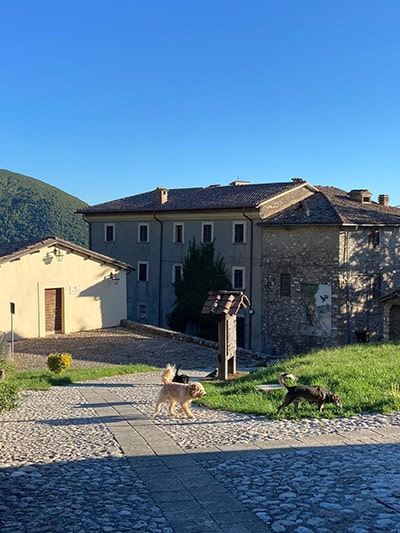
At the heart of the Betlejem community is reciprocity. “Reciprocity is at the heart of the Gospel,” Father Tosza said. “The new thing in the New Testament … is, ‘Love one another as I have loved you.'”
And he is blunt about a common sin we commit toward the poor: “It is the notion that they have nothing to give,” he said. “Pope Francis often said: there is no one so rich that they need nothing, and no one so poor that they have nothing to give. A person wakes up to life when they discover that someone needs them.”
Betlejem is not an institution, Father Tosza said, but a house. “What makes us different is that we have managed to create a house in which the poor … do not feel ashamed to say they live in Bethlehem. They say their real names … show their faces without shame.”
He recalls one man, Lukasz — a well-known massage therapist who fell into alcoholism — arriving at their house on the feast of Corpus Christi.
“His wife brought him here with a suitcase … She had kicked him out of the house. So we had a Corpus Christi at the door.”
The man stayed five months, began therapy and stopped drinking. “The beautiful thing is that he wasn’t ashamed that he lived here,” the priest said. By now, he is “reunited with his wife” — and returns from time to time to finish tasks he once promised to do. He shows up “simply because he said he would.”
Beauty itself, Father Tosza believes, is part of the healing. Over time the Betlejem house has developed a vivid artistic style — bright colors, mosaics, following the style of Austrian famed artist Friedensreich Hundertwasser (1928-2000).
“We discovered how important creativity is … to create works we are proud of … truly beautiful and original in themselves.”
Many who arrive at Betlejem have lost almost everything — “house, family ties, money, health, respect, freedom, sobriety,” he said. Some come with nothing but a plastic bag.
Art, Father Tosza said, “helps us discover that we are made by the creator of all creation.”
That, he said, applies equally to homelessness. “Homeless people are often reduced to one dimension — their material needs. … But a person can have a roof over their head and still be lonely and homeless in their heart.”
The town has been gathering around the Betlejem community for three decades now. While 15 people live in the house — three Sunday Masses draw about 300 people, including around 30 homeless living outside the community. Afterward, residents serve Sunday lunch to their guests.
Father Tosza’s vision now stretches beyond Jaworzno. In Greccio — the “second Bethlehem,” where St. Francis created the first Nativity scene — the community purchased an old hotel and stone house for a retreat center.
“We felt a call to create a kind of sister house there,” Father Tosza said.
The project, however, has put the original community under financial strain. “We never had big money, but we never had big debts either,” he said. Now a second loan installment is due in the summer of 2026.
“Some people are convinced we must have some secret source of money … but we really don’t. We live from the work of our own hands” — like art — “and from donations,” Father Tosza said.
If the community cannot raise the needed funds, they may lose the house in Greccio.
“I’ve already allowed myself to face the possibility that maybe we will have to go through some humiliation … unless something happens,” Father Tosza told OSV News, hoping deep in his heart a miracle donor arrives to make Betlejem’s mission cross borders and concluding: “People wake up to life when they discover they are needed.”
The retreat house project in Greccio can be supported through the following website: https://www.betlejem.org/dom-belvedere-w-greccio/#wesprzyj.
Other projects of the Betlejem community can be supported here: https://www.betlejem.org/wybierz-projekt-i-wesprzyj-2.
Read More Christmas
Copyright © 2025 OSV News
