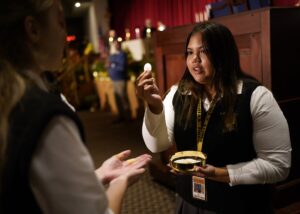
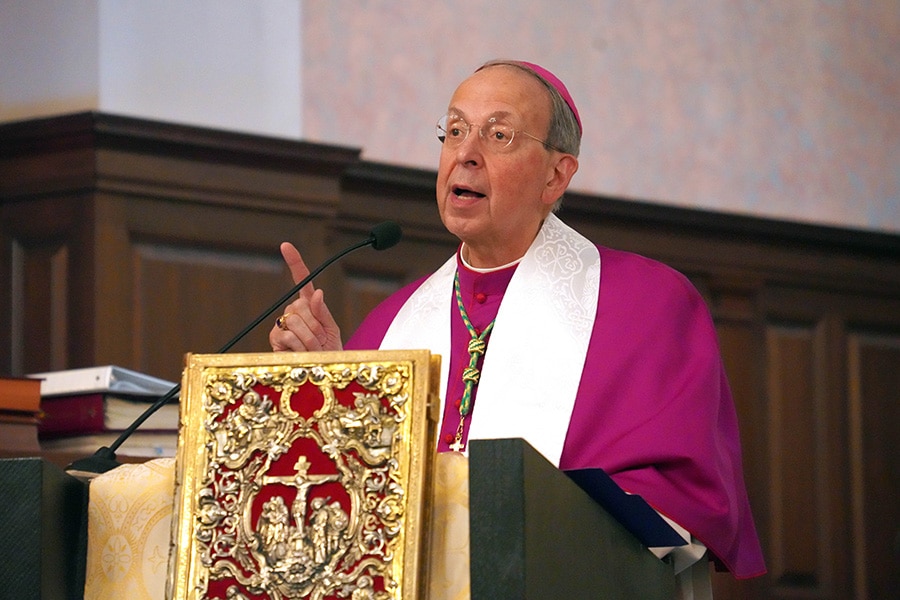
In an effort by Archbishop William E. Lori to emphasize the importance of the Eucharist, the Archdiocese of Baltimore has released norms and a “Pastoral Guide for Extraordinary Ministers of Holy Communion.”
Julie Grace Males, director of the Office of Divine Worship, said that in the 10 years she has been with the archdiocese, “the biggest request I have received in my office from pastors has been for assistance with formation of extraordinary ministers of holy Communion.”
Bishops, priests and deacons are ordinary ministers of Communion. Since 1973, the Church has allowed appropriate lay people to be delegated with that ministry, which is considered “extraordinary.”
It has long been universal practice – that is, all over the world – that extraordinary ministers of holy Communion must be mandated by the local bishop for a specific place and for a specific time period. In practice, however, many ministers have received training once and then continued indefinitely, or served in more than one parish.
According to the norms released by the archdiocese, those who wish to serve as an extraordinary minister of holy Communion must: be at least 16 years of age; have received the sacraments of baptism, confirmation, and Eucharist; lead a life of faith in keeping with the responsibility to be taken on; demonstrate reverence for and devotion to the holy Eucharist; be able to function with regularity with the requisite abilities and temperament; have his or her name submitted in a request that is written and signed by his or her pastor or chaplain; and participate in a formation workshop approved by the Office of Divine Worship.
To that end, the archdiocese hosted a training workshop in September and has two online workshops scheduled for October, with more dates to come. After the archdiocesan training, those who are mandated will also receive training specific to their parish or pastorate, such as where each Communion minister stands to distribute the Eucharist and other logistics.
“Once a sealed mandate from the Diocesan Bishop has been received, the Pastor or Chaplain is strongly encouraged to commission ministers using the Order for the Commissioning of Extraordinary Ministers of Holy Communion (Book of Blessings, chap. 63). The celebration of this rite is especially fitting on Sundays, in particular the Solemnity of the Most Holy Body and Blood of Christ,” the norms said.
If a certain minister is needed in multiple communities, that person must be mandated for each location.
To even out the future administration of mandates, those who will be mandated in the near future will have staggered terms, so that not everyone’s term expires five years from now, Males said. The typical five-year mandate may be renewed every five years with the completion of a formation workshop.
Lay ministers, including extraordinary ministers of holy Communion, are not able to give blessings within the context of the Mass. If someone who will not receive comes through the Communion procession, the lay minister will offer a prayer of spiritual Communion, “Receive the Lord Jesus in your heart,” without making the sign of the cross or touching the individual in any way.
Males also noted that ministers should not perform more than one ministry within a given Mass, that is, one who is a reader proclaiming one of the Scripture readings or acting as an usher should not also act as an extraordinary minister of holy Communion.
Another change in general practice, although not a change in the Church’s rubrics, is that only a priest, deacon or instituted acolyte may purify the chalice or ciborium to remove any remnants of the Precious Body or Blood. The purification does not have to be done immediately after Communion; the vessels can be set on the credence table to be purified later. According to the Pastoral Guide for Extraordinary Ministers of Holy Communion, “Following Mass and after the vessels have been purified, they are cleaned with soap and then dried. EMHCs may assist in the cleaning that takes place after purification.”
Upcoming formation workshops
- Oct. 13: 2-4:30 p.m. (webinar)
- Oct. 14: 6:30-9 p.m. (webinar)
- Oct. 17: 9 a.m.-noon (en español), St. Gabriel, 6950 Dogwood Road, Windsor Mill
- Oct. 24: 9-11:30 a.m., St. John the Evangelist, 112 E. Second St., Frederick
- Oct. 31: 9-11:30 a.m., Catholic Community of St. Francis Xavier, 13717 Cuba Road, Hunt Valley
- Nov. 10: 6:30-9 p.m., St. John, 43 Monroe St., Westminster
To register for the workshops, visit tinyurl.com/emhc-
Read more local news
Copyright © 2026 Catholic Review Media
