
As the Baltimore County public school system moves to reinstate cursive instruction in elementary classrooms, Catholic schools across the Archdiocese of Baltimore have been teaching it all along.
In an era dominated by keyboards and touchscreens, Catholic educators maintain that penmanship and cursive remain valuable tools for learning, helping students strengthen fine motor skills, improve focus and cultivate attention to detail while mastering the written word.
Daughter of Charity Sister Margaret Ann Wooden teaches first graders at Mother Seton School in Emmitsburg and has found that, as many children have become more accustomed to using smartphones and tablets, their hands are not as strong. She has noticed some of her students have difficulties holding a crayon, cutting or opening a glue bottle. She believes it is because younger students have spent more time on computers rather than handling sculpting clay or building blocks.
“When you have these students who were born with a smartphone, it’s easy, the babysitter will put it on and they can do puzzles and they can do all that,” Sister Margaret Ann said. “But when they go to do 3-D when they go to school, they have difficulties, not having the strength in their hand to hold a pencil and write a sentence.”
For some, the benefits of handwriting extend beyond developing motor skills. They say putting pen to paper helps them retain information, understand concepts and engage more intentionally with their studies.
Joe Robuck, a senior studying biology and theology at the University of Notre Dame in Indiana who won the Zaner-Bloser National Handwriting Contest in 2019 when he was a student at School of the Incarnation in Gambrills, said the slow, intentional process of handwriting his notes has been more effective for long-term learning.
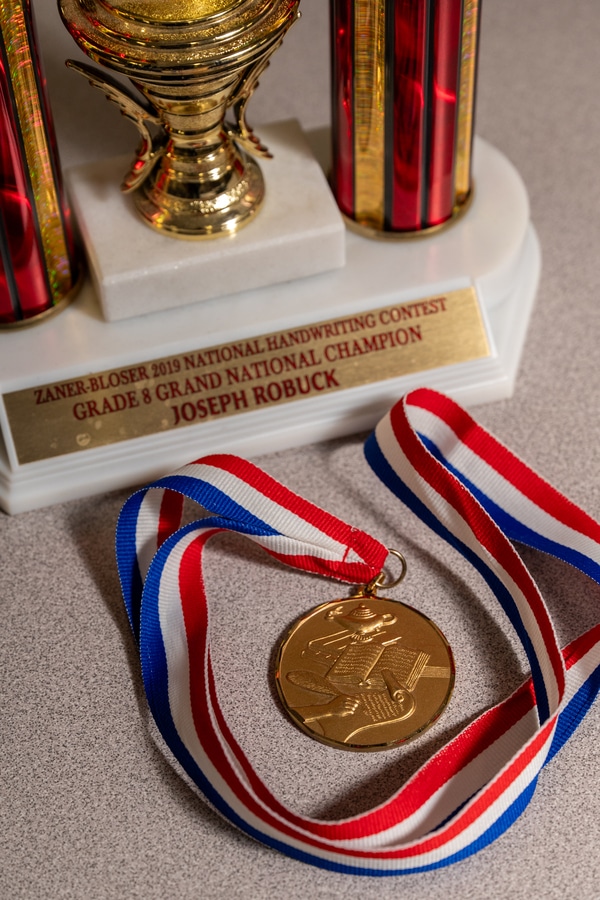
“In classes like physiology and anatomy, having good handwriting and being able to draw is essential and has helped me a ton,” Robuck said. “In my research group, we’re working on a case report right now where we ran into this roadblock where we couldn’t generate a figure or pay for it, and so I just decided to draw one myself, and it ended up working for our submission. So things like that, it makes me really excited to learn and it helps me learn better than if I type.”
Maryn Rajaski, a multiple-time winner of the Zaner-Bloser award during elementary and middle school at Mother Seton School, said reliance on technology increased during the COVID-19 pandemic as classes moved online, with a greater emphasis on efficiency. But she said that efficiency can come at a cost when it comes to retaining information.
“A keyboard can be so helpful. It’s for a teacher or students to get things, get information down quickly,” Rajaski said. “But when there’s the handwritten element that’s lost, it’s certainly a really important aspect of life that’s being ignored, and that’s one that’s not lived digitally.”
Rajaski, who will attend Liberty University hoping to study law and policy, said she connects concepts from class and memorizes them more vividly when she handwrites her notes. There are other benefits, she said.
“To be able to use (penmanship) to thank someone for a gift or tell them how much they mean to you is a really amazing thing,” she said.
Teachers across the Archdiocese of Baltimore devote between 10 and 30 minutes of class time to handwriting each day. While students typically do not learn cursive until third grade, they begin developing foundational skills in letter formation in kindergarten.
That emphasis on handwriting is not simply left to individual teachers. Julie Dellone, director of curriculum for archdiocesan schools, said cursive is a required part of the elementary-school curriculum, and students receive a grade for it on their report cards.
Some teachers have found that students become more focused and develop a sharper attention to detail during handwriting lessons.
“When handwriting is more automatic for them, they don’t spend as much time trying to figure out how to form the letters,” said Melaney Mullineaux, who has taught second grade at Mother Seton School for 18 years.
Handwriting is as unique to a person as a fingerprint, said Peyton Faller, a rising high school senior at Delone Catholic High School in McSherrystown, Pa. Faller won the Zaner-Bloser National Handwriting Contest in 2022 when she was a student at Mother Seton School.
“I think it’s pretty cool that everyone has their different interpretation of the letters,” she said, “and how it just goes out on paper smoothly is just fantastic.”
At least half of U.S. states now require schools to teach cursive – nearly double the number from a decade ago, according to Zaner-Bloser. North Carolina led the way in 2013 with a “Back to Basics” law passed in response to Common Core’s shift toward keyboarding.
The push draws bipartisan support: California’s law passed 79-0 in 2023, and Pennsylvania’s passed 42-5 in February 2026. Other states skip legislation altogether – Georgia and Missouri both require cursive through their education standards instead of state law. Maryland has no state mandate.
Read more Education News




Copyright © 2026 Catholic Review Media
