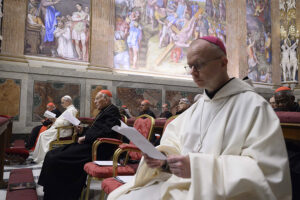
The Lenten season is a reminder that Christians are called to bear witness to Christ through authentic witness, not self-righteous indignation, Norwegian Trappist Bishop Erik Varden told the pope and Vatican officials.
In his first reflection, titled “Entering Lent,” at the start of the Roman Curia’s annual Lenten retreat Feb. 22, Bishop Varden said that faithfulness to Christ’s example and commandments are the “distinguishing mark of Christian authenticity.”
“The extent of the peace we embody — that exemplary peace ‘which the world cannot give’ — bears witness to the constant presence of Jesus within us. It is important to insist on this point at a time when the Gospel is so often instrumentalized as a weapon in culture wars,” the bishop said.
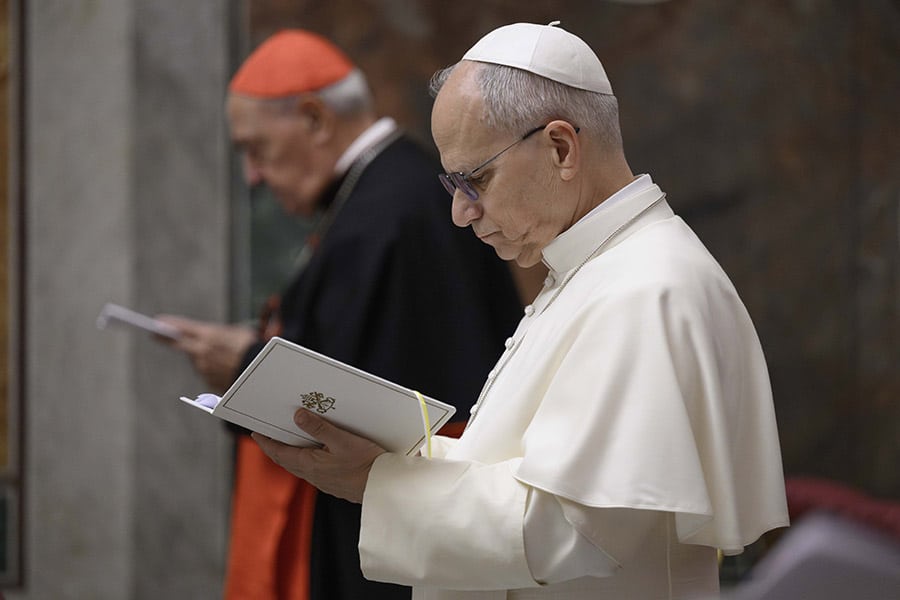
“Every manipulation of Christian words and symbols for other purposes must be vigorously challenged. At the same time, it is important to correct mistaken ideas not only by opposing them with indignation, but by teaching and showing what authentic spiritual struggle truly consists of,” he said.
The Norwegian Trappist bishop of Trondheim was chosen by Pope Leo XIV to preach at the Lenten retreat in the Pauline Chapel. The retreat, which runs from Feb. 22 to 27, will reflect on the theme, “Illuminated by a Hidden Glory.”
In his meditation, which was delivered in Italian, Bishop Varden said the Lenten season “leads us into a material and symbolic space freed from what is superfluous” and allows Christians to “embrace a period of abstinence from the senses.”
“Faithfulness to the example and commandments of Christ is the distinguishing mark of Christian authenticity,” he noted. “The extent of the peace we embody — that exemplary peace ‘which the world cannot give’ — bears witness to the constant presence of Jesus within us.”
Bearing witness to Christ, Bishop Varden continued, means highlighting the fact that “Christian peace is not a promise of an easy life” but rather “the condition for a transformed society.”
While noting the “radical nature of Christian peace” that is rooted “in the just and courageous gift of self,” the Norwegian bishop — citing the words of the seventh-century monk St. John Climacus — said Christians must also remember that “there is no greater obstacle to the presence of the Spirit within us than anger.”
“The Church instills peace into our Lenten program. She does not downplay the call to combat vices and harmful passions: her language is ‘Yes, yes,’ ‘No, no,’ not ‘now this,’ ‘now that.'”
Bishop Varden also noted that for more than a thousand years, on the First Sunday of Lent, the Church prays the hymn “Qui habitat” (“He who dwells”), a liturgical chant drawn from Psalm 91, which he said was “a tract of exquisite beauty that prepares for the Gospel, always the account of Christ’s temptation in the desert.”
“It is a work of melodic exegesis that deserves our attention. It is not the relic of an obsolete aesthetic. The tract communicates a vital message,” he said.
Recalling a series of sermons on “Qui habitat” by St. Bernard of Clairvaux, Bishop Varden said the 12th-century Cistercian monk addressed “what it means to live in grace as we fight evil, foster good, uphold truth and follow the path of the exodus from slavery toward the promised land.”
Following that path, he added, must be done “without turning aside either to the right or to the left” but rather “remaining in peace, aware that beneath what can sometimes seem like walking a razor’s edge ‘are the everlasting arms.'”
St. Bernard “invites us to commit ourselves with renewed fervor to a discipleship that is full of love and clear-sighted,” Bishop Varden said.
The Norwegian bishop reflected on the life of St. Bernard in his second meditation to the Roman Curia Feb. 23.
In that meditation, titled “Bernard the Idealist,” Bishop Varden said that the Cistercian monk was known for “his charisma” and “his capacity for work.”
Recalling the saint’s time at Citeaux Abbey in Dijon, France, the bishop noted that St. Bernard’s “confidence in his own judgment sometimes made him flexible in observing certain procedures that, in other respects, he claimed to defend.”
“His vision of the needs of the Church occasionally led him to adopt rigid positions, displaying a fierce partisan spirit. He was not, however, a hypocrite,” Bishop Varden said.
The 12th-century monk, he added, “was, and remains, a fascinating figure” known for being “genuinely humble, devoted to God, capable of tender kindness, a faithful friend — able even to become friends with former enemies — and a convincing witness to God’s love.”
Reflecting on St. Bernard’s teaching on conversion, Bishop Varden said that his understanding of the subject was grounded in “unparalleled biblical culture” and “well-considered theological insights.”
However, his teachings also sprang “from personal struggle, from learning not to take for granted that his own way was always the right one, instructed by experience, by wounds and by provocations to question his presumption and to marvel at the merciful justice of God.”
“Bernard is an excellent companion for anyone undertaking a Lenten exodus from egocentrism and pride, in the desire to pursue the truth about oneself while keeping one’s eyes fixed on the all-illuminating love of God,” Bishop Varden said.
Read More Vatican News


Copyright © 2026 OSV News
