
Abortion remains a divisive issue in the United States, and while the Catholic Church has taken a clear stand against abortion, different Christian groups have been divided on the issue in a way that has informed the advocacy and arguments surrounding it. Daniel K. Williams, associate professor of history at Ashland University in Ohio, recently wrote on the topic in his book “Abortion and America’s Churches: A Religious History of Roe v. Wade.” He spoke with Charles Camosy for OSV News about the ways in which different Christian denominations have grappled with the issue over the years and the historical consequences of those debates.
Charles Camosy: Your most recent book is so interesting. What led you to do research on how different Christian churches have taken different approaches to abortion?
Daniel K. Williams: This book grew out of my realization that Roe v. Wade was a product of liberal Protestant reasoning.
In early 2022, as I was writing online articles about the Supreme Court’s upcoming Dobbs decision, I stumbled across a reference to some sermons that Justice Harry Blackmun (the author of Roe v. Wade) preached at Methodist churches.
As I discovered, Blackmun was a devout liberal Methodist who was in church every Sunday. I also read editorials on abortion that the “Christian Century” published in the early 1970s, shortly before Roe, and I was struck by how similar their arguments were to the ones that Blackmun adopted. I realized that on both sides of the debate over abortion, religiously based reasoning played a larger role in the debate than many people have assumed.
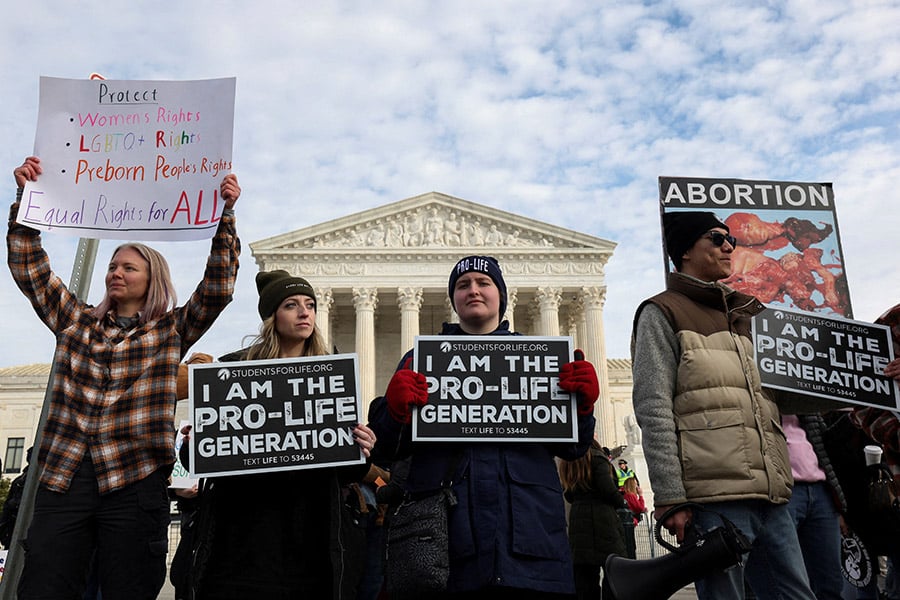
I wanted to explore the theological reasoning that different groups of Christians including both pro-choice and pro-life Christians, as well as some who are in the middle adopted as they grappled with the abortion issue, and I wanted to see how that changed over time. Because I had written “Defenders of the Unborn” a few years before I started working on “Abortion and America’s Churches,” I already knew a little of this story, but I discovered a lot more as I began researching and writing this book.
Camosy: Why do you think Protestants even evangelical Protestants took significantly different approaches than Catholics before Roe? What eventually brought them closer together?
Williams: Before 1960, nearly all American Protestants (both evangelical and mainline) opposed abortion in most circumstances, just as Catholics did, but they also devoted considerably less thought to the issue than Catholics. In the 1940s and 1950s, Catholic periodicals regularly published articles against abortion, but Protestant magazines did not. Protestants also generally disagreed with the Catholic Church’s opposition to artificial contraception.
Partly because of their differences with Catholics over contraception, neither evangelicals nor Protestants were receptive to Catholics’ campaign against abortion in the mid-1960s. At the time, abortion law liberalization proposals were fairly limited by later standards; they would broaden the list of reasons for which abortion was allowed but not legalize purely elective abortions.
Evangelical magazines cautiously endorsed some of these liberalization proposals because, while they generally placed a high value on fetal life, they tended to see fetal life in its early stages more as a potential human being than an actual one.
Liberal Protestants had a similar unclear theology of the beginning of human personhood, but they endorsed abortion liberalization proposals with more enthusiasm because of their strong emphasis on the right of individuals to make moral decisions for themselves without state coercion.
While liberal Protestants’ support for abortion legalization has continued to the present, evangelicals’ views of abortion moved much closer to the Catholic perspective in the 1970s and 1980s because of their opposition to elective abortion and Roe v. Wade.
Even evangelicals who had been willing to accept the idea that some abortions might be medically necessary in rare circumstances quickly came to see Roe v. Wade as a product of a dangerous form of relativistic thinking that replaced the idea of divinely sanctioned, unchanging natural rights with the whims of a liberal state that had accepted the ideas of the sexual revolution.
For that reason, opposition to abortion became a foundational tenet of the evangelical-dominated Christian Right that emerged in the late 1970s and 1980s, and it played a key role in their quest to restore Christian values in public law.
Camosy: As you know, I care quite a bit about the consistent life ethic and have spent much of my career making a case for it. What, in your view, has been its fate?
Williams: The consistent life ethic still has some strong defenders. The Catholic Church still officially maintains it, as do some Protestants and others. But it has not fared well politically.
In the 1980s, Catholics and evangelical Protestants who believed in the consistent life ethic founded the JustLife PAC to support political candidates who held a consistent ethic of life, but the PAC folded in the early 1990s, largely because few politicians aligned with its beliefs. Many Democrats opposed nuclear arms buildup and capital punishment, and many Republicans opposed abortion, but hardly any candidates supported all aspects of the consistent life ethic.
Today, there is at least one alternative party (the American Solidarity Party) that attempts to uphold a consistent life ethic, but pro-lifers who want to work within the two-party system which seems necessary if they want to influence elected officials rather than simply champion ideas have not been able to find candidates who endorse all parts of the consistent life ethic.
Partly for that reason, the nation’s largest, most politically active pro-life organizations have become single-issue organizations rather than more comprehensive champions of a consistent life ethic. That trend dates back to the 1970s, and it shows few signs of abating.
But those who believe in a consistent life ethic can still find many online periodicals and organizations that support their view even if it has not won majority support. The consistent life ethic challenges many conventional American political assumptions, so those who support it have to be willing to uphold a countercultural ideal.
Camosy: We just concluded the March for Life. When you think about the goings-on surrounding the March this year, especially in light of your research, what future do you see for the pro-life movements and the Christian churches?
Williams: American Christianity is now more uniformly committed to the pro-life cause than ever. Fifty years ago, American Protestant denominations were divided on abortion, but as American Protestantism has become more strongly evangelical and as churchgoing Catholics have become more culturally conservative, most churchgoing Americans now oppose abortion.
However, the pro-life movement arguably has less influence on America’s major political parties than it has in decades. To win public credibility, the pro-life movement will have to become less partisan.
There are precedents for this in other countries. In the United Kingdom, the pro-life movement is not allied with any political party, but it has managed to thrive as a minority voice in a largely secular country that supports abortion rights, and it enjoys strong support among some British Catholics and conservative Protestants. The American pro-life movement can thrive in a similar way. But to do that, pro-lifers in the United States will have to give up their dream of exercising political power. That’s not easy to do.
Read More Respect Life


Copyright © 2026 OSV News
