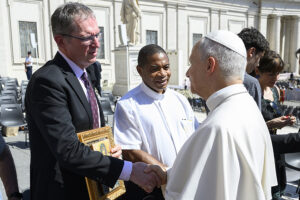
(OSV News) — Andrzej Poczobut, a Belarusian Catholic dissident and journalist, returned to Belarus Sept. 8, following an audience with Pope Leo XIV and after five months in exile in Poland, saying he was prepared to risk arrest and urging Western Catholics to remember Christians imprisoned by the regime.
“I hope people will remember the fate of priests and lay Catholics now suffering in prison, showing through prayers that they’re not indifferent,” said Poczobut, a law lecturer and journalist who was freed in April from an eight-year hard labor term.
“Having no contact with the regime and no guarantees for my freedom, I’ll only find out what’s planned for me when I get to the border. But while I’m afraid like everyone else, I can’t let my life be determined by fears of arrest,” he said before crossing the Polish-Belarusian border and posting his picture in Grodno, at the Niemen River, Sept. 8 on X.
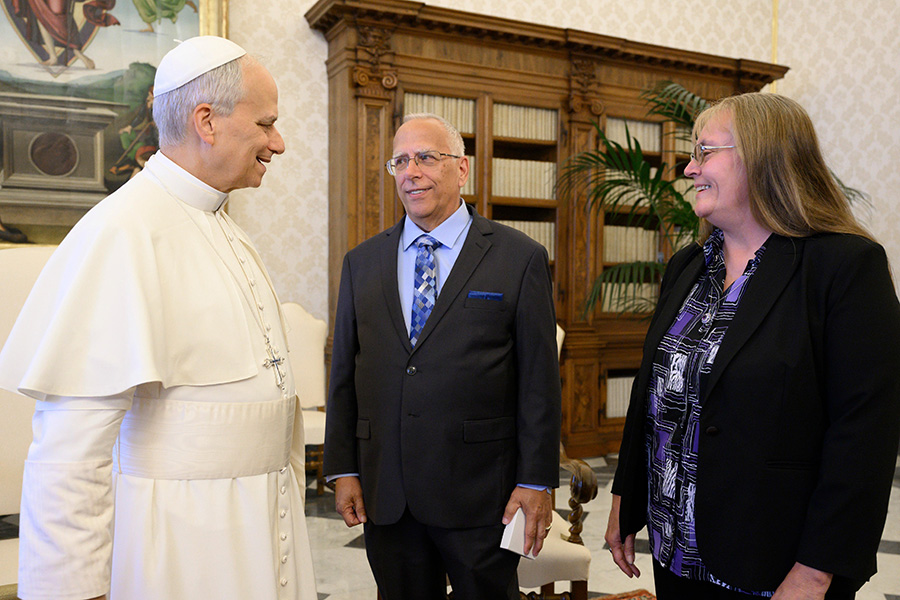
The lay Catholic spoke with OSV News following Sept. 2 talks in Rome with Pope Leo and Vatican officials.
Poczobut, who was raised in a traditional Catholic home, is an essayist, blogger, activist and leading member of the Polish minority in Belarus. Known for his outspoken criticism of the Alexander Lukashenka regime and for his writings on history and human rights, he has been arrested many times, detained since 2021 and sentenced to eight years in a penal colony in February 2023 for allegedly libeling Belarus’ ruler.
Poczobut was released with nine others, including Father Grzegorz Gawel, a Polish Carmelite friar from Krakow, and allowed to go abroad after interventions from the United States and Poland.
He said gestures of support had become increasingly important while international attention focused on Ukraine and other conflict zones, adding that he was grateful to Catholics who had arranged Masses and “expressions of solidarity.”
“For a year of my prison term, I was isolated in a solitary confinement cell with no one to speak to,” Poczobut told OSV News.
“All acts of solidarity were like an extended friendly hand — a reminder that we were not alone against the huge machinery of power. I hope Western Catholics will keep showing support now through prayer and remembrance,” Poczobut said.
In his interview, Poczobut said he had requested Pope Leo’s blessing for his family and for Belarus when he met the pontiff, presenting him with a sacred image of the Virgin Mary dating from 16th-century Grodno, before going to discuss the plight of Belarus’ Catholics with Archbishop Paul Gallagher, the Vatican’s secretary for relations with states.
“For every Catholic, meeting the pope is a special experience,” he told Polish Press Agency PAP right after the audience. “I am incredibly grateful for this opportunity. I feel peace. In recent days and months, I have felt an inner tension. I am very grateful to the pope for the peace I feel now,” he said.
Another recently released Catholic dissident, Ales Bialiatski, winner of the 2022 Nobel Peace Prize, also met the pope, after a Mass in St. Peter’s Square May 27, handing him a letter about human rights abuses in Belarus.
“The policy against Poles and Catholics has been underway for two decades now and poses a serious problem for our communities,” Poczobut told OSV News of the situation in his homeland, where the regime is one of the closest allies of Russia. Belarus is home to a big Polish minority — before World War II, Grodno, where Poczobut is based now, was a Polish city.
“Poland and Catholicism are seen as a threat here — a source of disloyalty to the regime and its state ideology and the number of Catholic priests with Polish citizenship has been already drastically reduced. Although Lukashenka stresses his good relations with the Church and Holy See, pressure against Catholics continues.”
He made his comments as another Polish-born priest, Father Janusz Pulit, became the 17th known to have been refused a state permit during 2026 to continue ministering in Belarus, and prepared to leave after 32 years as rector of Ružany and Lyskavo in the Pinsk Diocese.
In a message to parishioners, Bishop Antoni Dziemianko confirmed that Father Pulit was leaving “against his will” and said the latest “forced departure” of priests was making it “very difficult” for his Catholic Church “to provide parish communities with regular pastoral care.”
Meanwhile, Belarus’ exiled ecumenical Christian Vision organization said more Polish priests could also have been ordered to leave than officially reported, adding that some had requested Belarusian citizenship in order to remain in their parishes.
Catholics make up around a 10th of the 8.92 million inhabitants of Belarus, where Lukashenka, in power for 32 years, began a seventh term as president in January 2025 after claiming 86.8% of the votes in elections.
Two high-profile priests, Father Henrykh Akalatovich and Oblate Father Andrzej Juchniewicz, were freed from long sentences in November 2025, following Vatican intervention, and remain in Rome.
However, another Polish-trained priest, Father Anatol Parakhnevich, arrested in March at his Alkovichi parish on a high treason charge, remains in pretrial detention and is among 880 political prisoners currently recognized by the independent Viasna human rights center.
Dozens of Catholic parishes have been stripped of legal status under a new restrictive freedom of conscience law, in force since July 2024.
Poczobut said the fate of Catholics in Belarus, where Lukashenka’s contested reelection in 2020 was followed by harsh repression and the flight of half a million citizens abroad, had to be seen through the prism of their minority status alongside the predominant Moscow-controlled Orthodox church.
However, he added that contacts with the Vatican had “great importance” for the Lukashenka regime, as it faced Western economic sanctions and a diplomatic blockade over its alliance with Russia.
“This isn’t a democratic country — it’s an authoritarian state in which the government is all-powerful and citizens weak and dependent,” said Poczobut, who received the European Parliament’s Sakharov Prize in 2025 for his human rights work and also holds numerous awards from Poland.
“The Vatican is conducting its own policy towards Belarus — and while I hold my own opinions, I’m observing with interest to see if this will help the Catholic and Polish minorities,” he said. “Belarusian society has tried to gain some self-determination and influence over its own government, but has sadly lost out in its confrontation with the state and faces severe repression.
“Every gesture of solidarity, sympathy, encouragement and spiritual sustenance has become supremely important.”
Read more Vatican News
Copyright © 2026 OSV News
