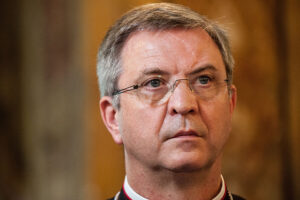
A Belgian Catholic bishop said he “will make every effort to ordain married men as priests” and expressed his commitment to doing so by 2028.
In a pastoral letter published March 19, Bishop Johan Bonny of Antwerp wrote that the question is “no longer whether” married men can be ordained, but “when” and “who will do it.”
“I will make every effort to ordain married men as priests for our diocese by 2028,” Bishop Bonny said. “I will approach them personally and ensure that by then they have the necessary theological training and pastoral experience, comparable to that of other priest candidates.”
The Catholic Church has both married and celibate priests, but a norm of having a married and celibate priesthood exists only in its 23 self-governing Eastern Catholic churches that are in communion with the pope as the bishop of Rome and head of the Latin Catholic Church. Among the Eastern Catholic churches, their Code of Canons states “the hallowed practice of married clerics in the primitive Church and in the tradition of the Eastern Churches throughout the ages is to be held in honor.”
The Latin Church, headed by Pope Leo XIV, has a norm of married and celibate deacons like the other Eastern Catholic churches, but only celibates may go on to ordination to priesthood. The ordination of married men to the priesthood is a limited exception in the Latin Church.
According to the Latin Church’s Code of Canon Law, priests are “bound to celibacy, which is a special gift of God by which sacred ministers can adhere more easily to Christ with an undivided heart and are able to dedicate themselves more freely to the service of God and humanity.”
The Latin Church does allow some former Anglican priests or Protestant ministers who have come into full communion with the Church to petition for ordination to the Catholic priesthood. While the Church affirms the good fruit of their prior pastoral ministry, it does not recognize orders in Protestant or Anglican churches as equivalent to the sacrament of holy orders. These married candidates are ordained to the Catholic priesthood only after undergoing a process of discernment with their wives and receiving appropriate priestly formation.
Bishop Bonny’s assertions on the ordination of married men were among several issues he addressed in his pastoral letter regarding the implementation of synodal processes discussed during the Synod of Bishops on synodality.
In his letter, the Belgian bishop said many dioceses are facing a “historical shortage of local priests,” with the number of unmarried men wanting to join the priesthood falling to “just above zero.”
While expressing his gratitude to foreign priests who have helped fill the shortage in his diocese, Bishop Bonny said, “they cannot meet all our needs.”
“They come to help us, not to replace us. Moreover, it would not be fair to place the burden of our shortages on their shoulders. They, too, are keen to see more local confreres, even married confreres, to work with them,” he wrote.
Globally the Catholic Church is reporting a decline in the number of Catholic priests to 406,000 even as the Church’s population grew to 1.4 billion. A 2025 report from Fides, the Vatican news agency, noted that a priest in Europe on average serves over 1,800 Catholics; but it found that in Africa, where the numbers of priests have grown, the priest shortage is far more acute than any other continent: one priest in Africa on average serves 5,000 Catholics.
Noting that Eastern Catholic churches allow for married men to be ordained to the priesthood, Bishop Bonny said that “no one can explain any longer why the ordination of married men is possible for Eastern Catholic seminarians or for Catholic converts, but not for native Catholic vocations.”
While the Eastern Catholic churches, like their Orthodox counterparts, ordain married men to the priesthood, none of these churches allows their ordained clergy to marry unless they are returned first to the lay state, rendering them no longer in a position of spiritual power over a laywoman whose full and free consent is necessary for sacramental marriage.
Bishops, whether in the Catholic or Orthodox churches, are chosen from only the celibate priests.
Citing church teaching on discernment and the episcopal duty “to support and bring together all the gifts of the Spirit,” Bishop Bonny said he viewed the ordination of married men not as a doctrinal break, but as a necessary pastoral development tied to credibility, local responsibility, and the future of Church life.
“It is an illusion to think that a serious synodal-missionary process in the West still has a chance without also ordaining married men as priests,” he said. “It would be a blessing for the Church if we could also apply this ‘ecclesial discernment’ to the kind of priest a community needs, or to whom the community would see as a suitable candidate for the priesthood.”
While he expressed his hopes to ordain married men by 2028, Bishop Bonny said he would spend the next two years “communicating with the Belgian Bishops’ Conference and with the Vatican, as we can learn from each other’s experiences and insights.”
The ordination of married men, he said, “has become a matter of conscience. At that level, too, transparency, accountability, and evaluation are important for the credibility of the Church,” he outlined.
The subject of married priests became a prominent topic of discussion during the pontificate of Pope Francis, especially during the 2019 Synod of Bishops on the Amazon.
Among the proposed suggestions made in the synod’s working document was a request that “the possibility of priestly ordination be studied for older people, preferably indigenous, respected and accepted by their community, even if they have an existing and stable family.”
While the ordination of married men of proven virtue, or “viri probati,” was supported by bishops in the region as a way to address the lack of priests in remote areas, Pope Francis said that addressing the problem was “not simply a question of facilitating a greater presence of ordained ministers who can celebrate the Eucharist.”
In his post-synodal apostolic exhortation, “Querida Amazonia” (“Beloved Amazon”), the late pontiff said the shortage of priests should be seen as a way to “awaken new life in communities.”
“We need to promote an encounter with God’s word and growth in holiness through various kinds of lay service that call for a process of education — biblical, doctrinal, spiritual and practical — and a variety of programs of ongoing formation,” he wrote.
Although Pope Leo has not directly addressed the possibility of ordaining married men since his election, he has spoken about the importance of celibacy in a June 2025 meditation to bishops for the Jubilee Year.
“Together with material poverty, the life of the bishop is also marked by that specific form of poverty which is celibacy and virginity for the sake of the Kingdom of Heaven,” Pope Leo said.
“Here, it is not just a question of living as a celibate, but of practicing chastity of heart and conduct, and in this way living a life of Christian discipleship and presenting to all the authentic image of the Church, holy and chaste in her members as in her Head,” he said.
Read More Vocations
Copyright © 2026 OSV News
