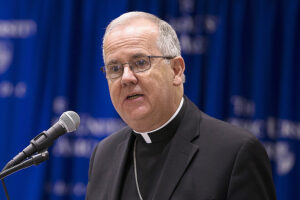
Amid the 2026 Week of Prayer for Christian Unity Jan. 18-25, OSV News spoke with Bishop Joseph C. Bambera of Scranton, Pa., who serves as chair of the U.S. Conference of Catholic Bishops’ Committee on Ecumenical and Interreligious Affairs and the Catholic co-chair of the Holy See’s International Catholic-Pentecostal Dialogue committee, part of the Dicastery for Promoting Christian Unity.
This interview has been edited for length and clarity.
OSV News: How has the recent commemoration of the 1700th anniversary of the Council of Nicaea impacted this year’s observance of the Week of Prayer for Christian Unity?
Bishop Bambera: This year obviously is a very significant year to mark Christian unity, particularly in light of the council’s 1700th anniversary. It certainly is a very significant step forward (in Christian unity) this year.
Our Holy Father, Pope Leo XIV, has really established for his pontificate (a concern for Christian unity) in that incredible gesture of traveling to Nicaea to meet with Ecumenical Patriarch Bartholomew, and to profess a desire, certainly between the Catholic community and the Orthodox community, to pursue — based on our shared appreciation for that creed — work for unity.
OSV News: Where would you say we’re currently at with Catholic-Orthodox efforts to reunite?
Bishop Bambera: It’s very difficult for me to actually spell out specifically where we stand in terms of that relationship. However, I think we see clearly a desire for us to start to move forward in the gesture of Pope Leo going to Nicaea.
And I think we see it also in the gestures of the U.S. Conference of Catholic Bishops, as the conference is now regularly inviting Orthodox observers to come to our plenary meeting in November, as we did this past year.
I also think (the move toward unity gains momentum) because of some of the upheaval that we see in our world and in various countries in which there is tremendous concern for the well-being of people. I’m thinking of Ukraine in particular, and obviously the Middle East.
I think that the need is for us as Christians — Orthodox, Catholics, Protestants — to give whatever evidence we can of our desire to fulfill that prayer of Jesus (for unity, in John 17:1-26). If Christian leaders can’t work together in harmony and peace, how would we ever expect there to be harmony and peace in our world?
Quite the contrary; we need to witness to that. We need to be a voice to those political and social entities that are disrupting peace. We need to call them to something more.
OSV News: So, would you say that these efforts for Christian unity really are, from the perspective of our responsibilities to the Lord, fundamental to creating world peace for all people?
Bishop Bambera: I certainly think they contribute to it.
OSV News: How do you think increased Christian unity might help with interreligious dialogue?
Bishop Bambera: Our ability to journey together as Christians can only impact our relationship with other religions in a positive way. … There’s a wonderful quote attributed to Mahatma Gandhi (the Indian political activist and nonviolence advocate), who had a great, great appreciation as a Hindu for Christ and for the message of the Gospel. He was asked if he would ever consider becoming a Christian, and his response was that he would become a Christian when Christians began to live the example and teaching of their Master.
Doesn’t that really speak very powerfully to the roots of this Week of Prayer for Christian Unity? We are responding to a prayer of Jesus. And so we have to get our house in order first.
I think for anybody to look at us in a way that sees our desire to journey together with them, be they Christians or of other religious traditions — before they’re going to trust us, they have to see that we’re willing to walk this talk.
OSV News: How can this week of prayer speak to the divisions that exist among Catholics themselves in the U.S.?
Bishop Bambera: We ought not set ecumenism to the side. It’s vital to our understanding of the Second Vatican Council. You can’t read the council without a lens towards Christian unity.
And it clearly, clearly is at the heart of the agenda of Pope Leo XIV, as it was with Pope Francis and recent pontiffs.
In the heart of that is this incredible prayer of Jesus (Jn 17:1-26) that establishes this invitation to all of us to work for unity. It’s not an add-on.
OSV News: The work of Christian unity seems to take place at two levels — expert theological dialogue, and the everyday encounters of fellow Christians with one another. How do these two levels intersect and interact?
Bishop Bambera: I think the easiest way to respond to that is to say it really goes back to Pope Francis, who put it in his own style very, very well (during ecumenical vespers for the close of the 2024 Week of Prayer for Christian Unity). He said that if we are focused on theological unity, and if we are looking at addressing all of the various theological factors that have led up to divisions within the churches, repairing those breaks in unity will take centuries. It took a long time for them to surface. It’s going to take a long time for them to be mended.
But there’s also, he said, a unity of life and love, whereby all of us, not just theologians, but more particularly the people in our pews — who are the visible presence and witness to faith and life and indeed unity — are going to embrace it much, much more readily and deeply and authentically. I can see that very, very well in my own life as a priest over the last 43 years in ordained ministry.
At times, from a theological perspective, perhaps we’ve lost our enthusiasm at times for unity. I think on the heels of the Council, many individuals thought that we would be able to move forward very quickly in terms of establishing unity. That’s not necessarily been the case.
But what I think you start to see on a very grassroots level is people walking together as brothers and sisters, almost to the point of not even recognizing our differences.
OSV News: Do you think one obstacle to Christian unity is a fear that oneness will mean compromising the tenets of a given Christian denomination, including Catholicism?
Bishop Bambera: I think so often people worry that we’re going to give away the store to simply achieve this level of unity that we commit ourselves to. And I think it’s so important that we don’t impose a false sense of unity.
The true and most authentic way for us to journey together as brothers and sisters is never to diminish who we are, and never to set up some false sense of unity that we haven’t yet established. It’s to acknowledge our differences.
It’s to recognize there’s a phenomenon called “receptive ecumenism,” whereby we look at really what is best in the other, and it’s not so much what we can give to you, but what we can learn from you and make a part of our lives.
We acknowledge our differences, we respect them, and we learn from one another ways in which we can grow together — recognizing that that full unity may be far, far in the future, but also recognizing that Jesus’ prayer is a prayer that is before us today, and whatever way we can walk together as brothers and sisters is what we’re called to do.
Read More Ecumenism & Interfaith Relations
Copyright © 2026 OSV News
