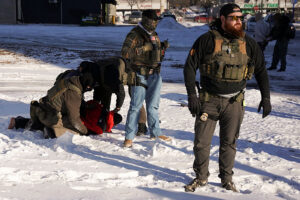
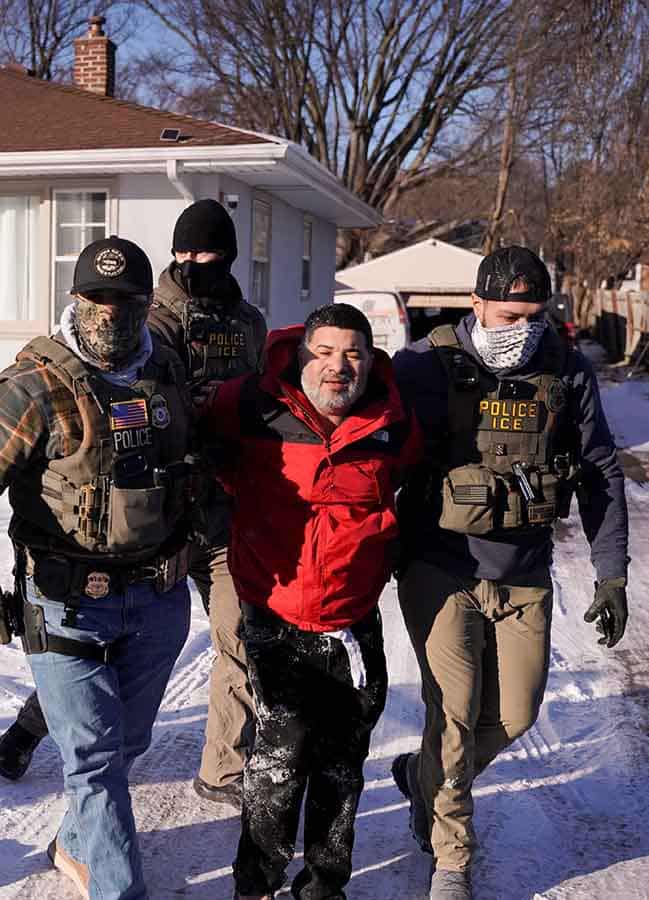
More U.S. Catholic bishops have released messages of concern as tensions continue to soar amid the Trump administration’s immigration crackdown, with clashes between protestors and enforcement agents flaring into deadly violence in cities such as Minneapolis, and former detainees revealing inhumane conditions in migrant detention centers.
Central to the bishops’ pleas is a consistent call for the respect of human dignity, for an end to violence and often dehumanizing rhetoric, and for a moral renewal of the nation.
Among the latest bishops to weigh in are Archbishop Samuel J. Aquila of Denver, Archbishop José H. Gomez of Los Angeles, Bishop Michael F. Burbidge of Arlington, Va., and Bishop Timothy L. Doherty of Lafayette-in-Indiana.
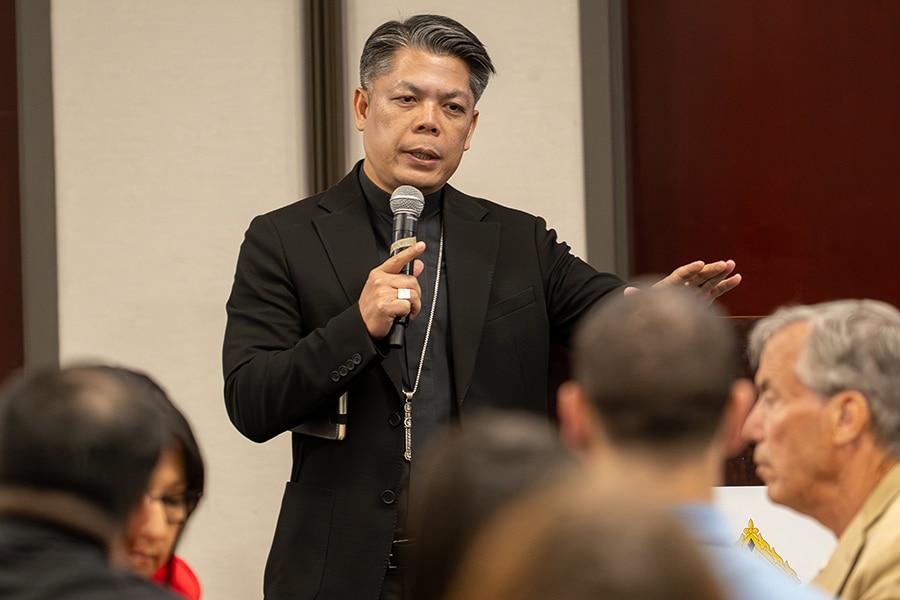
Archbishop William E. Lori joined the growing chorus of prelates. Twice in the span of four days, the Baltimore archbishop was part of statements issued decrying two deaths in Minneapolis and ongoing political unrest. On Jan. 27, Archbishop Lori issued a statement online calling for peace, and a few days later issued a joint statement with other local clergy.
“I write to you today with a heavy heart, aware of deep suffering in our nation, particularly around immigration and public life,” said Archbishop Aquila in a Jan. 29 “Pastoral Call to Peace,” posted to the website of the Archdiocese of Denver.
Archbishop Gomez celebrated a Feb. 3 Mass for peace at the Cathedral of Our Lady of the Angels in Los Angeles, followed by a “Holy Hour for peace.” He lamented in his homily that “we’re in a moment when it seems like many have lost faith in America’s promise and her founders’ vision.”
“And it is sad that this is happening this year, when we are celebrating our nation’s 250th anniversary,” he said. “This should be a time for renewal, not a time of retreat.”
In a Jan. 30 statement, Bishop Burbidge, who also exhorted pastors and faithful to engage in a Holy Hour for peace, said the nation’s current “divisions are not new, and in fact have been developing for a generation or more.”
Archbishop Aquila, who also called for Holy Hours for peace throughout the archdiocese, observed that “the recent violence in Minnesota and rising tensions here in Colorado and across the country have left many fearful, angry and uncertain.”
U.S. citizens Renee Nicole Good and Alex Pretti, both 38, were respectively shot dead by federal agents Jan. 7 and 24 as they protested immigration enforcement actions in Minneapolis.
Other acts of violence have been recounted by U.S. citizens sharing their experience of inhumane treatment and witnessing it inflicted on others while detained by Immigration and Customs Enforcement.
Aliya Rahman, a native-born U.S. citizen of Bangladeshi descent, testified before Congress Feb. 3 about her traumatic arrest Jan. 13 by ICE in Minneapolis. Rahman, who has autism and a traumatic brain injury, described how immigration agents shattered the glass of her car, as she struggled to navigate their directions in an ICE-caused traffic jam on her way to a medical appointment. She said they told her, “Too late,” after she informed them she was disabled, and they manhandled her out of the car.
“I was never asked for ID, never told I was under arrest, never read my rights, and never charged with a crime,” she added.
Rahman, however, said the incident — captured on video — “is still nothing compared to the horrific practices I saw inside the Whipple Center,” the federal building in Fort Snelling, Minnesota, where migrants alleged to lack legal authorization to remain in the U.S. are detained.
“Approaching the Whipple Center, I saw black and brown bodies shackled together, chained together, being marched by yelling agents outdoors. I continue to hear the word ‘bodies,’ because that is how agents refer to us: ‘We’re bringing in a body’; ‘They’re bringing in bodies seven, eight at a time. Where do I put them?’ ‘We can’t use that room, there’s already a body in there,’” Rahman testified. “You have no reason to believe you will make it out alive if you are already being called a body.”
Rahman said agents taunted her and refused to heed her pleas — and that of other detainees — for emergency medical care until she passed out.
“We call ourselves a civilized nation, but we lack rules and accountability around what a person claiming to be law enforcement is permitted to do to another human being,” she told lawmakers.
The Department of Homeland Security’s “Operation Metro Surge” in Minneapolis also saw the afterschool seizure and detention of five-year-old Liam Conejo Ramos and his father Adrian Conejo Arias, who had presented themselves to Texas border offices in December 2024 to apply legally for asylum. The two have since been released and returned to Minneapolis following a federal judge’s order.
Immigration enforcement operations have sparked protests in various locations throughout the country, with demonstrators decrying aggressive tactics by federal agents — most of them masked — and DHS asserting that its personnel are themselves at risk of attack.
Deaths in immigration detention, as well as the high rate of detainees without criminal convictions — in stark contrast to DHS’ stated aim of targeting what it calls the “worst of the worst criminal aliens” — have further inflamed tensions.
In a Jan. 28 statement, Archbishop Paul S. Coakley of Oklahoma City, president of the U.S. Conference of Catholic Bishops, called for a Holy Hour for peace as “a moment of renewal for our hearts and for our nation,” saying that “the current climate of fear and polarization, which thrives when human dignity is disregarded, does not meet the standard set by Christ in the Gospel.”
In his pastoral message, Archbishop Aquila said, “We are living amid heightened anxiety, harmful rhetoric, and a growing disregard for the dignity of human life and the truth that every person, from the moment of conception, is created in the image and likeness of God, no matter what that person does.”
In a Feb. 3 statement, Bishop Timothy Doherty of Lafayette-in-Indiana said his diocese was “keenly aware of these issues,” noting that “many of our priests and religious have come from other countries to serve in our parishes and schools.
“These individuals are crucial to the success — both spiritual and logistical — of all our ministries,” he said. “It is our duty to ensure that they, and all people, are treated with their God-given human dignity.”
Bishop Doherty pointed to the USCCB’s November special message on immigration, which he said “reaffirmed our Catholic teaching on the ‘fundamental dignity of all persons,’ in particular the lives of immigrants who have for many years ‘made enormous contributions to the well-being of our nation.'”
The bishop noted that the message “also called for an end to dehumanizing rhetoric and violence, whether directed toward immigrants or law enforcement.”
He stressed that “the Catholic Church has always taught that a country has the right — and the duty — to control its borders.
“This is not nationalistic. It is practical,” said Bishop Doherty, clarifying that the USCCB special message had “called proper border protections ‘an antidote’ to such risks and reminded us that human dignity and national security are not in conflict with each other.”
Catholic social teaching on immigration balances three interrelated principles — the right of persons to migrate in order to sustain their lives and those of their families, the right of a country to regulate its borders and control immigration, and a nation’s duty to regulate its borders with justice and mercy.
Bishop Burbidge cited his 2025 pastoral statement on U.S. immigration law, human dignity and the common good, saying it “remains timely.”
The statement offers “pastoral encouragement to civil authorities, as well as all Catholics and people of goodwill, to consider the common good of our country with the light of faith,” said Bishop Burbidge.
He explained that “while the Church recognizes that the state’s core duties include the safeguarding of the common good and the protection of the family and human dignity, it also teaches that ‘more prosperous nations are obligated to the extent that they are able, to welcome the foreigner in search of the security and the means of livelihood which he cannot find in his country of origin.'”
Pointing to the Catechism of the Catholic Church, Bishop Burbidge encouraged “a reasonable public discourse on rightful immigration law and policy that should favor integration and naturalization wherever possible” for those respecting a country’s material and spiritual heritage, while recognizing “the state’s authority to prudentially grant citizenship, lawful residence, or assist compassionately with repatriation.”
“Human dignity and the common good cannot be brought into conflict,” Bishop Burbidge said, urging immigration enforcement agents to avoid “all unnecessary acts of force and violence,” and protestors to “express themselves respectfully, peacefully, and non-violently.”
According to a joint Catholic-Evangelical report published in 2025 by World Relief and the USCCB, 80% of those at risk of Trump’s mass deportation effort across the country are Christian, with the largest proportion — 61 percent — being Catholic. The report found one in six Catholics in America (18 percent) is either vulnerable to deportation or lives with someone who is.
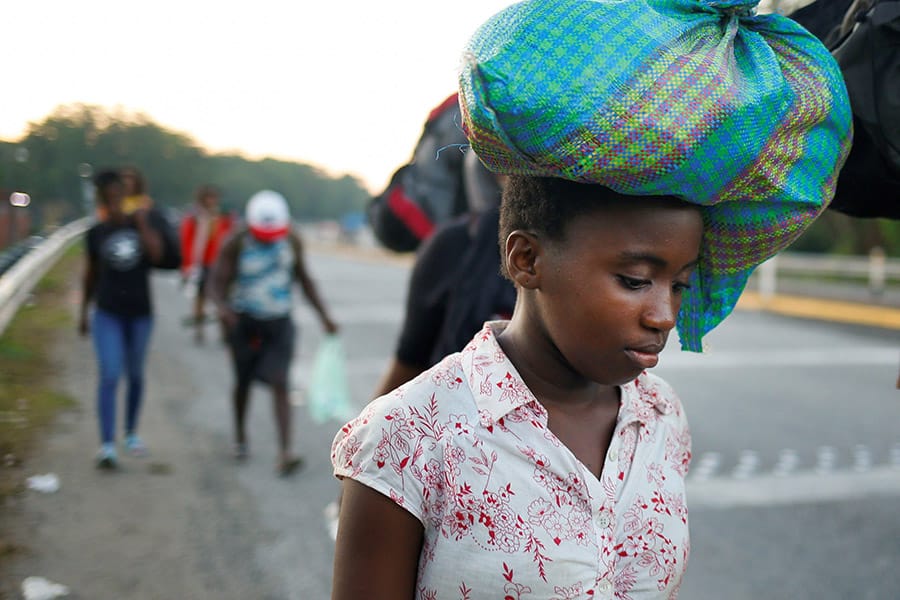
Additionally, the Trump administration has acted to revoke temporary legal protections for hundreds of thousands of migrants that allowed them to live and work legally in the U.S., despite ongoing dangerous conditions in their home countries, with Haitians and Venezuelans, typically Catholic populations, being the most affected.
Ultimately, said Archbishop Aquila, “At the heart of this moment, there is not only a political crisis, but a more important spiritual one.
“When God is no longer our first love, we make ourselves gods, and replace charity, trust and humility with fear or the pursuit of power, wealth or control of others,” he said. “When the command to love our neighbor is neglected, division, hatred, violence, genocide and sophomoric name-calling inevitably follow.”
In his own homily, Archbishop Gomez called Catholics, as disciples of Jesus, to action.
“As Americans, as Christians, we have to speak out for the dignity of the human person,” he said.
He added, “Every crisis is a crisis of saints. So now is the hour for our Christian witness. It is our duty as followers of Jesus, to help America recover her soul.”
OSV News national news editor Peter Jesserer Smith contributed to this report.
Read More Immigration & Migration
Copyright © 2026 OSV News
