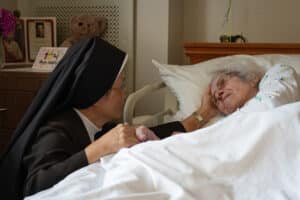
As Maryland lawmakers prepare to revisit legislation that would legalize physician-assisted suicide, Catholic leaders, ethicists and physicians are encouraging Catholics to think carefully about end-of-life decisions, arguing that compassion for the seriously ill should focus on care, dignity and accompaniment rather than assisted death.
For decades, legislation allowing physician-assisted suicide, also known as medical aid in dying by supporters, has surfaced in Annapolis. While advocates argue it allows terminally ill patients to “die with dignity,” opponents contend it places vulnerable people at risk and undermines investments in palliative and hospice care.
Maryland Gov. Wes Moore (D) has expressed support for medical aid in dying, and supporters are expected to continue pushing for passage of the End-of-Life Option Act in future legislative sessions.
The Catholic Church’s opposition to physician-assisted suicide rests on its understanding of the sanctity of human life and the inherent dignity of every person, regardless of age, illness or disability.
Father J. Daniel Mindling, a professor of moral theology at Mount St. Mary’s Seminary in Emmitsburg, said Catholic teaching on end-of-life issues begins with human dignity.
“If you had to read only a couple of things, those two would be the ones I’d recommend,” Father Mindling said of the Catechism of the Catholic Church and “Samaritanus Bonus” (“The Good Samaritan”), a 2020 Vatican document on caring for those in critical and terminal phases of life. The documents address “why we think that people have dignity and why medical ethics is an expression of the recognition of both the sanctity and the dignity of human life.”
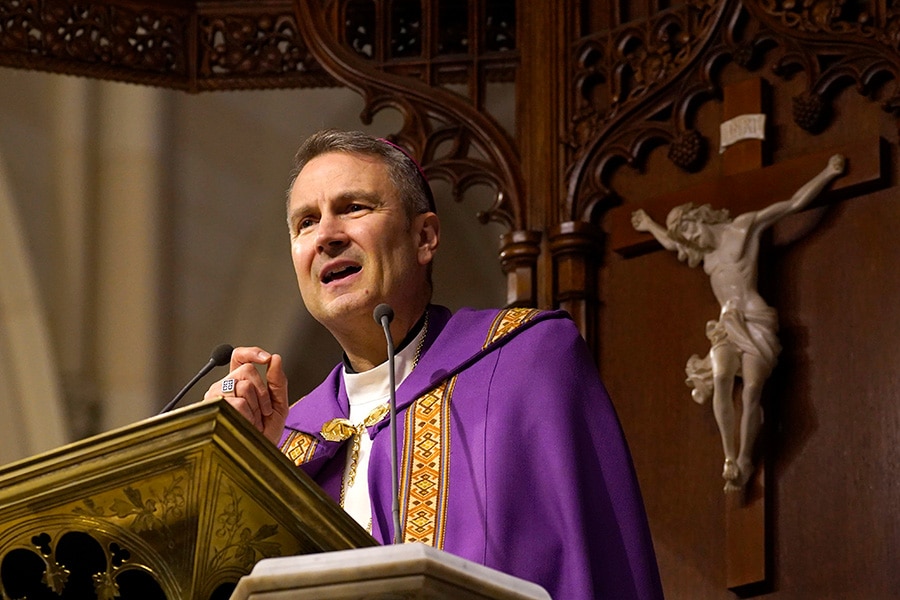
“An idea of being created in the image of God, sustained by grace, redeemed by Christ, called to eternal union with God – this is the ultimate grounds of our dignity, and every medical ethics question starts with the recognition of our dignity,” said Father Mindling, speaking at a Sept. 12 conference at St. Louis in Clarksville titled “In Joyful Hope: A Catholic End-of-Life Conference.”
The event was organized by the Archdiocese of Baltimore’s Office of Life, Justice and Peace, which oversees all respect life ministries
Father Mindling emphasized that Catholic teaching does not require patients to pursue every possible medical intervention. Rather, patients are called to weigh whether a treatment is useful and whether its burdens outweigh its benefits.
“We don’t have to do futile things,” he said. “I don’t have to take an antibiotic that doesn’t treat my virus because it doesn’t do any good. … But we have to be careful that futile treatment is properly understood.
“Useful means it is addressing the condition. It’s appropriate treatment. But useful does not necessarily mean curing the condition.”
He cited examples of patients choosing to forgo additional surgeries or transplants because of the burdens involved. Catholic ethicists would support that decision, according to Father Mindling.
“Could one do that ethically?” he asked of a patient who declined a heart transplant. “Yes, one can … based on the understanding that we are not required to do disproportionate care” to continue living our dignified lives or to resort to suicide, “which is a decision to kill myself to get out of that situation.”
The distinction between rejecting burdensome treatment and intentionally ending a life remains central to Catholic teaching.
The Maryland Catholic Conference, the public policy arm of the state’s Catholic bishops, has been among the leading opponents of physician-assisted suicide legislation. Executive Director Jenny Kraska said Catholics should discuss end-of-life wishes before a crisis arises, including completing advance directives and designating health care decision-makers.
“Once you fill out a health care directive, please let people know,” Kraska said at the conference. “Give a copy to your doctor. If you have a will or other end-of-life documents, make sure that your lawyer has a copy of them and whoever you designate as your health care decision maker. …
“One of the worst things that can happen is that you … have designated somebody as your health care decision maker and have not told them. And so they get a call from a medical facility or a doctor or a family member who say you have decisions to make now.”
The MCC promotes a booklet, “Health Care Decision Making: Resources for Maryland Catholics,” which outlines the church’s approach to end-of-life care. The guide states that people do not have the right to take their own lives or intentionally cause the death of another innocent person, while also emphasizing that patients are not morally obligated to pursue medical treatments that are useless or excessively burdensome. At the same time, it stresses that even when a cure is impossible, compassionate care through pain management, palliative care and hospice care remains both necessary and morally important.
Kraska said palliative and hospice care offer compassionate alternatives for patients facing serious illness.
“Funding for palliative care and hospice care decreases dramatically when physician-assisted suicide passes in states,” Kraska said.
Opponents of legalization contend that physician-assisted suicide is dangerous for vulnerable patients because current proposals do not require mental health evaluations in every case and lack safeguards they believe are necessary to prevent coercion, insurance abuse and misuse of lethal drugs. They also point to the difficulty of accurately predicting life expectancy, concerns about protections for the disabled, and the absence of requirements for family notification, medical supervision or a plan for disposing of unused drugs.
Kraska said supporters of legalization continue to expand their efforts nationwide. She noted that 13 states and the District of Columbia have legalized physician-assisted suicide and warned that Maryland remains a target for advocacy organizations seeking additional states to adopt similar laws.
“It will take all of us to defeat this bill,” she warned. “Legislators need to hear from us, their constituents. Get the message out” about the dangers of PAS. “Never assume how your legislator feels about this issue.”
Medical concerns were also raised by cardiologist Joseph Marine, who has practiced with Johns Hopkins Medicine for more than two decades and has publicly opposed Maryland’s End-of-Life Option Act.
“Assisted suicide is not medical care,” Marine said. “It has no basis in medical science, practice or tradition.”
Marine argued that physician-assisted suicide is unnecessary because modern medicine offers a range of options for pain management and symptom relief through palliative and hospice care. He also encouraged patients to become active participants in their medical treatment.
“I love it when patients come to me and have looked things up on the Internet and come with a whole list of questions,” he said. “That’s an engaged patient.”
Marine additionally questioned what message legalization sends amid ongoing concerns about suicide, substance abuse and mental health.
“The United States and Maryland are suffering from a huge epidemic of drug overdose deaths, largely due to opioids. … What message does the state send when it legalizes and endorses this new form of drug overdose death? What message does it send to young people, who are already suffering from unprecedented levels of mental illness, anxiety, despair and suicide?”
Read more respect life



Copyright © 2026 Catholic Review Media
