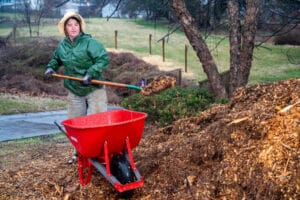
Across the Archdiocese of Baltimore, Catholics are finding creative ways to care for God’s creation, transforming parish grounds, churchyards and personal backyards into vibrant, life-giving spaces.
Wildlife haven
To most gardeners, a Japanese maple is a thing of beauty. To Father Jim Bors, it’s a missed opportunity.
The elegant tree, like many popular ornamentals, is a non-native species that offers little to the insects, birds and wildlife that depend on native plants to survive.
“They may have blossoms on them,” Bors said, “so butterflies or bees might get something momentarily. But many are so engineered that there’s very little nectar or pollen.”
That conviction has shaped both his parish ministry and his home landscape.
A former associate pastor of St. Jane Frances de Chantal Parish in Pasadena, Bors helped transform portions of the parish grounds into thriving pollinator habitats – work that recently earned him a 2025 Habitat Hero Award from the Cape Conservation Corps.
“My love for God’s creation has really been lifelong,” said Bors, a widower who was ordained to the priesthood in 2022 and now serves as priest-secretary to Archbishop William E. Lori. He traces that love to childhood trips to Canada. “I remember being out on a lake, walking through fields of goldenrod, climbing the mountains. I’ve always had this fascination with the beauty of God’s creation.”
As he learned more about ecology, that fascination deepened into a commitment to native plants that sustain local ecosystems. Many ornamental non-native species, he said, are “basically lifeless” in comparison.
At St. Jane Frances, Bors inspired parishioner Andrew Bryant to build a pollinator sanctuary garden as an Eagle Scout project. Native flowers – timed to bloom throughout the season – draw bees, butterflies and birds. The parish grounds also host a flower farm supplying blooms for the sanctuary at Masses, supported by Chesapeake Bay Trust grants secured with help from parishioner Rich Hergenroeder, an Anne Arundel County watershed steward.
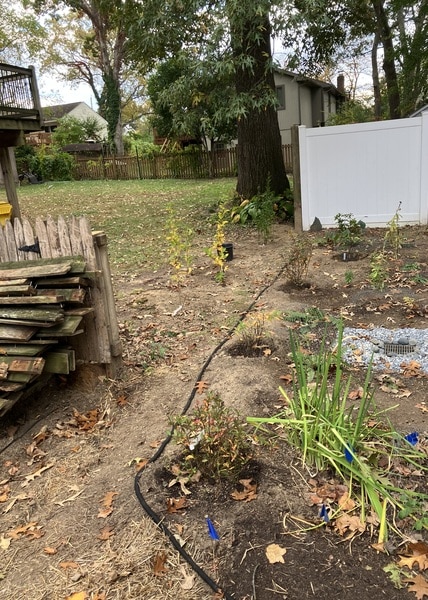
At his Cape St. Clair home, Bors continues replacing ornamental plants with native wildflowers, shrubs and understory trees, creating what he calls an “oasis” for birds, butterflies and other wildlife.
One bench at a time
Her family has nicknamed her the “crazy plastic bag lady.”
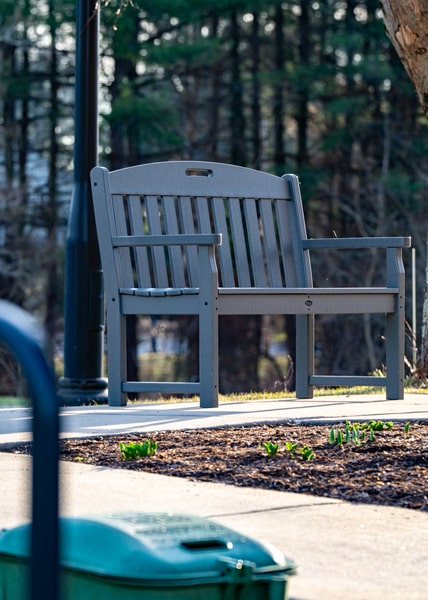
Every week, Nancy Mattes weighs herself, then picks up a bag of soft plastics she collected from St. Alphonsus Rodriguez in Woodstock, then weighs herself again – subtracting the first number from the second to calculate the haul. She admits it may not be the most precise method, but over one year it tallied nearly 1,500 pounds, more than enough to win a recycled-materials bench through the NexTrek challenge.
“It’s a beautiful bench,” Mattes said. “It’s not a cheap bench. It’s very nice.”
The bench – made from recycled products and now sitting near an entryway at St. Alphonsus – comes from Trex, a wood-alternative decking manufacturer whose challenge requires groups to collect 1,000 pounds of soft plastics in a year. Mattes had collected plastic bags for years for her grandchildren’s school before realizing any community group could participate. She brought the idea to her parish in 2024, and the Care for Creation committee – five members total – was born.
Between August 2024 and July 2025, bins went up in church buildings and the preschool, and nothing was wasted – plastic tablecloths from parish gatherings and mulch bags from a Knights of Columbus fundraiser were wiped clean and added to the collection.
“A lot of people canvassed their friends and neighbors, bringing plastics from a wider area,” Mattes said. “It does add up.”
Energized, the committee began a second collection last August, only to learn in December that NexTrek had changed the rules. “You don’t automatically win a bench at 1,000 pounds,” Mattes said. “Now you get tickets for drawings.” Possible prizes range from a life-size Connect 4 to a pop-up theater.
“We’ll figure it out,” Mattes said. “The end result is we’re keeping plastics out of the landfill. With a few people, we’ve done a lot.”
Community gardening grows
Now in its third season, the community garden at Our Lady of Victory in Arbutus offers 14 plots – 30 by 10 feet each – to parishioners free of charge, with one condition: half the harvest goes to the church food pantry.
“The first year wasn’t very fruitful,” committee member Kelly Neale said. “It is so new, the soil is just hard clay.”
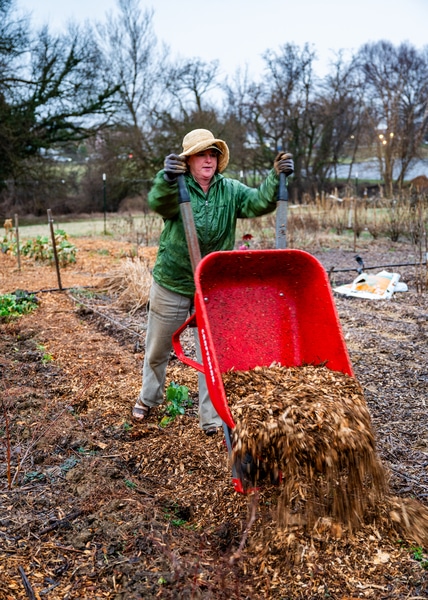
Amendments of cardboard, wood chips and compost have since revived the earth. This year has brought healthy soil and plenty of worms. Neale has already planted onions, peas, potatoes, blueberry bushes and strawberries, with collards and kale to follow.
The garden sits behind the church along a stream, in a neighborhood where residents walk and children play. Native plantings and flowers like geraniums and zinnias round out the space. “I thought the church would be a perfect place for a garden,” she said. “It is good for the soil as we grow organically. It is good for our neighbors as we contribute food to the food pantry.”
Several other parishes, including St. Francis of Assisi in Fulton, Immaculate Heart of Mary in Baynesville and Our Lady of Perpetual Help in Ellicott City, offer similar community gardens.
George Matysek Jr. contributed to this story.
Father Jim Bors was featured on the March 29, 2026 episode of Catholic Review Radio. Click play below to listen.
Also see



Copyright © 2026 Catholic Review Media
