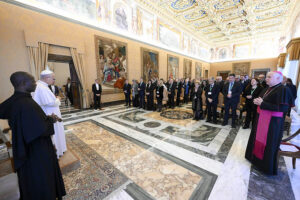
VATICAN CITY (CNS) — Human beings are meant to be actively involved in the world of creation, not just passive consumers of content generated by technology, Pope Leo XIV said.
“How can we ensure that the development of artificial intelligence truly serves the common good and is not just used to accumulate wealth and power in the hands of a few?” he asked Dec. 5.
The pope was speaking to people taking part in a conference held in Rome Dec. 5 organized by the Centesimus Annus Pro Pontifice Foundation and the Strategic Alliance of Catholic Research Universities.
The conference, titled “Artificial Intelligence and Care of Our Common Home,” included the presentation of a book of the same name that compiles research by experts analyzing and assessing the impact of AI, especially in the fields of business, finance, education and communication, and proposes solutions to some of the most urgent challenges.
Pope Leo said, “The research carried out by Centesimus-SACRU represents a truly valuable contribution,” since “coordinated and concerted action involving politics, institutions, businesses, finance, education, communication, citizens and religious communities” is needed.
It is “essential to teach young people to use these tools with their own intelligence, ensuring that they open themselves to the search for truth, a spiritual and fraternal life, broadening their dreams and the horizons of their decision making,” the pope said. “We support their desire to be different and better, because never before has it been so clear that a profound reversal of direction is needed in our idea of maturing.”
“We must pause and reflect with particular care upon the freedom and inner life of our children and young people, and the possible impact of technology on their intellectual and neurological development,” he said.
“The new generations must be helped, not hindered, on their path to maturity and responsibility,” he said. “The well-being of society depends on their ability to develop their talents and respond to the demands of the times and the needs of others, with generosity and freedom of mind.”
“The ability to access vast amounts of data and information should not be confused with the ability to derive meaning and value from it,” Pope Leo said. “The latter requires a willingness to confront the mystery and core questions of our existence, even when these realities are often marginalized or ridiculed by the prevailing cultural and economic models.”
Addressing this challenge, he said, “requires asking an even more fundamental question: What does it mean to be human in this moment of history?”
“Human beings are called to be co-workers in the work of creation, not merely passive consumers of content generated by artificial technology,” he said. “Our dignity lies in our ability to reflect, choose freely, love unconditionally and enter into authentic relationships with others.”
While artificial intelligence has opened “new horizons for creativity,” he said, “it also raises serious concerns about its possible repercussions on humanity’s openness to truth and beauty, and capacity for wonder and contemplation.”
“Recognizing and safeguarding what characterizes the human person and guarantees his or her balanced growth is essential for establishing an adequate framework for managing the consequences of artificial intelligence,” the pope said.
“This commitment comes before any partisan interest or profit, which is increasingly concentrated in the hands of a few,” he said. “Only through widespread participation that gives everyone the opportunity to be heard with respect, even the humblest, will it be possible to achieve these ambitious goals.”
Read More Vatican News

Copyright © 2025 Catholic News Service/U.S. Conference of Catholic Bishops
