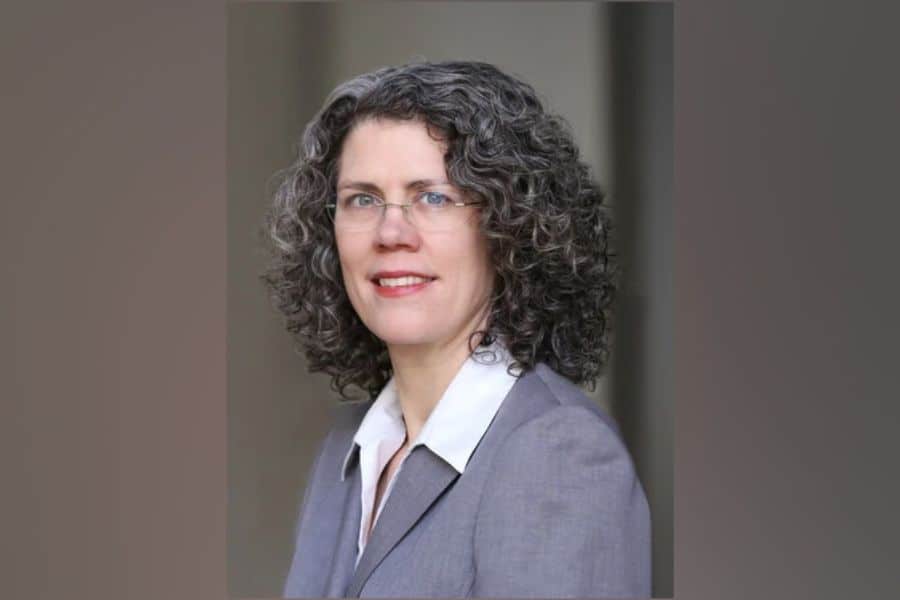
Editor’s note: This article was based on a Catholic Review Radio interview with Martha Hennessy. To listen to the full program, scroll to the bottom of this article.
The first memory Martha Hennessy has of her grandmother is also one of her earliest memories of a spiritual awakening. She was just 3, nestled against Dorothy Day, the renowned Catholic convert and co-founder of the Catholic Worker movement.
“I had my ear on her chest and I could hear and feel the sound of her voice and her heartbeat and this great resonation occurring,” Hennessy remembered. “And as a tiny little child, I think I felt the presence of God through her for the first time.”
Hennessy, who was 25 when Day died in 1980, has spent much of her life reflecting on her grandmother’s faith and commitment to the poor. Active in the Catholic Worker movement, Hennessy will speak about Day’s life and legacy at a symposium beginning at 2 p.m. Nov. 8 at St. Joseph’s Monastery in Baltimore. Jesuit Father Timothy Brown, associate professor of law and social responsibility at Loyola University Maryland in Baltimore, will also speak.
Hennessy said her grandmother’s story cannot be understood apart from her conversion to Catholicism.
Before becoming Catholic, Day was a journalist who reported on the hardships facing poor and working-class families in New York City. As a young woman, she was drawn to the Catholic Church by the devotion of working-class immigrants she encountered in New York churches.
“She felt it was the Catholic Church (that) was the church of the poor, of the immigrant,” Hennessy said.
Day was also attracted to the beauty and ritual of Catholic worship, including the incense, bells and the stained glass windows, according to her granddaughter.
Hennessy said her grandmother’s devotion to the Eucharist reflected a deep understanding of the connection between Christ and the Church.
“It’s the taking in of the body of Christ,” she said. “We become part of Christ. Christ becomes part of us with the Eucharist. We have the Eucharist and we have one another,.”
That spiritual connection extended into Day’s work welcoming people experiencing poverty and homelessness through the Catholic Worker movement. Day founded it in the early 1930s with Peter Maurin, a French-born philosopher who had immigrated to North America. Together they started The Catholic Worker newspaper and opened the first houses of hospitality.
Hennessy said prayer is essential to sustaining those houses, where volunteers encounter Christ in those they serve.
“The person who comes to the door, who is very difficult and who is in great duress, very much is Christ in disguise,” she said.
Today, Hennessy sees the Catholic Worker mission continuing in communities around the world. Speaking from Brisbane, Australia, where she was visiting a Catholic Worker house of hospitality, she described a small community providing shelter and support to refugees and others in need.
“The Sermon on the Mount is our manifesto. Feed the hungry, clothe the naked, give shelter to the homeless, visit the prisoner,” she said.
For Hennessy, Day’s commitment to serving the poor was inseparable from her opposition to war and violence. Day’s lifelong pacifism and her commitment to the nonviolence of Jesus, Hennessy said, are an especially important part of her legacy.
“Catholics and Christians need to pay attention to that aspect,” she said.
She believes Catholics must embrace a comprehensive understanding of the dignity of human life rather than allowing political divisions to determine which issues deserve attention.
“I do believe in the seamless garment: no abortion, no euthanasia, no capital punishment, no war,” Hennessy said.
Day’s cause for canonization has been under way for more than two decades. She was named a Servant of God in 2000 after Cardinal John O’Connor, then archbishop of New York, petitioned the Vatican. That title marks the first formal step toward sainthood. The diocesan phase of her cause concluded in December 2021, and the case is now under review in Rome. Reflecting on the effort, Hennessy recalled her grandmother’s famous response to those who suggested she was already a saint.
“I know that she has been quoted as saying, ‘Don’t call me a saint, I don’t want to be dismissed that easily,’” Hennessy said. “I believe what she meant was, ‘There’s tremendous work to be done, come help me do it.’”
Hennessy believes that invitation remains at the heart of Day’s legacy. She sees her grandmother as an example of an ordinary laywoman whose extraordinary relationship with God inspired a lifetime of service.
Day’s example also challenges Catholics to recognize their own calling to holiness, Hennessy said.
“A prophet, a Christian prophet, is not someone who laments the past or tries to predict the future,” she said. “Dorothy was a prophet because she spoke of the here and now, what was right before us and how to recognize it as evil and confront it.”
Martha Hennessy was featured on the Nov. 1 episode of Catholic Review Radio. Click play below to listen.