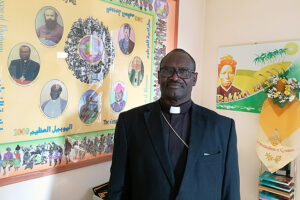
(OSV News) — In a decision described as a brave and generous witness of fidelity to his little flock, Bishop Yunan Tombe Trille Kuku Andali is staying on in the Sudanese city of El-Obeid, even as organizations warned that the North Kordofan’s state capital was increasingly being encircled by the paramilitary Rapid Support Forces, or RSF, and its allies.
Father Diego Dalle Carbonare, provincial superior of the Comboni Missionaries in Egypt-Sudan, said Bishop Andali was in the city with several diocesan priests, serving the Christian community in a very tense situation.
“The choice made by Bishop Tombe and the few diocesan priests who are in El-Obeid is a brave and generous witness of fidelity to the little flock that remains,” Father Carbonare told OSV News in an interview. “It is inspiring, especially for foreign missionaries who felt it was not safe to remain.”
“We keep them in our prayers and thank God for being their support,” he added.
When reached for comment, Bishop Andali, said he could not speak about the situation at the moment.
In December 2024, Bishop Andali was beaten by the RSF as he returned to his diocese from Juba, the South Sudanese capital, where he attended a Eucharistic Congress and the Golden Jubilee of the Sudan and South Sudan Bishops’ Conference. Earlier that day, he had lost money he was carrying to soldiers of the Sudan Armed Forces.
Bishop Andali had just crossed into Sudan at the South Sudanese border town of Renk, when the paramilitary officers pounced, beating him on the face, neck and on the side of the head. The bishop later said he narrowly escaped martyrdom.
At the moment, according to Father Carbonare, the paramilitary force controlling the city from the North, South and the West, and the people of the region, are getting provisions through the East, which is controlled by the army.
“It seems after what they did in El-Fasher at the end of October, they are now aiming at El-Obeid, which is of course one of the biggest cities in Sudan and the center of trade,” he said.
El-Obeid “is very important and strategic. For them it’s clearly an objective,” said the missionary priest.
The paramilitary had sieged El-Fasher, the capital of North Darfur in western Sudan for 18 months. When the paramilitary finally captured the city, its fighters were accused of ethnic cleansing, crimes against humanity and acts bordering genocide.
At least 6,000 people were killed in just three days when the force captured the city in October, according to a February United Nations report, which cited mass killing, summary executions, torture, abductions and sexual violence against civilians.
El-Obeid is currently under constant bombardment and drone strikes, as the paramilitary attempts to dislodge the Sudanese armed forces. The two militaries, initially government partners, have fought a bitter three years of war centered on political control of the country in Northeastern Africa and on mineral wealth.
Catholic bishops in Sudan and South Sudan have frequently called the war senseless and urged its ending.
While the battles were intense in the capital, Khartoum and the surrounding area, and the Darfur region in the earlier part of the war, it has now shifted to North Kordofan state, threatening El-Obeid, the region’s capital.
Here, daily bombardment and drone strikes have hit markets, schools, fuel stations, water infrastructure and vehicles, cutting off the city of an estimated 500,000 people from the rest of the country for months.
On June 30, Tom Fletcher, U.N. under-secretary-general for humanitarian affairs, warned that El-Obeid could not be allowed to become another El-Fasher. He warned that intensifying drone attacks were killing civilians and increasing the risk of deeper human suffering.
“I call for an immediate end to attacks, including drone attacks on populated areas and critical civilian areas,” said Fletcher in a news release. “Civilians who wish to leave El-Obeid must be able to do so safely. Whether they leave or remain, they must be protected and have access to essential service.”
Amid growing concerns of an impending humanitarian crisis in El-Obeid, an alliance led by the RSF said July 6 that El-Obeid was a “legitimate military target” since it was hosting military bases, command centers, command rooms, ammunition depots and facilities used for military operations.
But Father Carbonare urged scaling up of all international diplomatic efforts for meaningful and speedy steps toward an end to the fighting.
“Unfortunately, though, the world media is focused elsewhere and the war in Sudan is largely forgotten,” he said.
Read More World News
Copyright © 2026 OSV News
