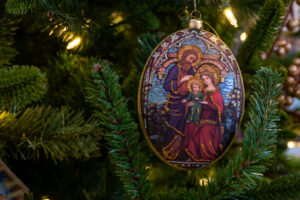
One of my favorite old movies is “Meet me in St. Louis,” but it includes one of my least favorite Christmas songs – “Have Yourself a Merry Little Christmas.” Written during World War II, its melody is appropriately bittersweet. But it’s not the melody I object to so much as the lyrics.
The song’s title, “Have Yourself a Merry Little Christmas” is OK if it means “give yourself permission to have a merry Christmas.” But if it means “create a merry Christmas for yourself,” then there’s a problem. We don’t create Christmas for ourselves; it is the Lord’s gift of himself to us.
I’m also less than fond of the words “a merry little Christmas.” There is no such thing as “a little Christmas.” Our celebrations can be simple and intimate. But, by definition, Christmas is big. It is the turning point in human history. Born in the humblest of settings, Jesus’ coming into the world was the greatest gift God could give the human race.
Next come the (original) words, “Next year all our troubles will be out of sight.” Understandable. In 1944, hopes were high that World War II would be over by the following year. But our troubles weren’t over in 1945. And they won’t be over in 2027. Christmas isn’t the feast of optimism. It’s the feast of hope.
Don’t get me wrong. I like the old Christmas songs as much as I like old movies – and that’s a lot! But warm and familiar though they may be, they just don’t do justice to Christmas.
What does? Something called Advent.
Advent is the most underrated and overlooked season in the Church’s liturgical year. It passes quickly, almost without notice. It’s overshadowed by holiday cheer. And its message is drowned out by a yuletide spirit that glosses over or even negates the point of Christmas. Only Advent gives Christmas its due.
Advent comes from the Latin word, “adventus,” which means “coming” or “arrival,” specifically God’s arrival. Far from giving us a privatized view of Christmas, Advent celebrates with deepest hope the coming of God into the world; in fact, three distinct comings.
The first is the entry of God into human history. When humanity went astray by sinning, God in his eternal wisdom fashioned a plan of salvation, what St. Paul calls “the mystery.” He chose a people. He intervened to save them. And promised to send a Messiah to save them, not only from earthly enemies, but from sin and death. In Advent we meet holy men and women who believed God’s promises would be fulfilled: the Blessed Mother, St. Joseph, St. Elizabeth, St. John the Baptist. They seek to inflame our hearts with the same hope that Christ’s birth in Bethlehem ignited in them.
Advent celebrates the coming of Christ in our everyday lives: in Word and sacrament, in private prayer, in those around us, in the poor and in our tribulations. It doesn’t promise our troubles will be over but that we can find Christ in their midst.
Advent also looks ahead to the second coming of Christ at the end of time. Not with dread but with hope. It speaks to the “joyful hope” with which Christians should await the coming of Christ in glory, the moment of final victory over sin and death, the moment when we are to be clothed with glory.
So, if you want to give Christmas its due, give Advent its due. Set aside more time for prayer. Put an Advent wreath in your home. Light the candles week by week and pray as a family. Purify your heart in confession. Catch the spirit of hope Advent offers. Ask the Holy Spirit to enlarge your heart so that Christ may be born in you anew.
Read more christmas


Copyright © 2026 Catholic Review Media
