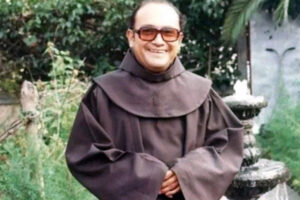
At first glance, the official photo of Venerable Augusto Ramírez Monasterio — known simply as “Fray Augusto” — shows a smiling Franciscan friar standing in a small garden, hands clasped and slightly hidden within the sleeves of his brown habit.
Yet the joyful and peaceful demeanor of the friar masked the horrors he was subjected to before his 1983 martyrdom, which was recognized by Pope Leo XIV Jan. 22.
The photo was taken in June 1983, moments after he endured hours of torture at the hands of the military.
In an interview with OSV News Jan. 29, Franciscan Father Edwin Alvarado, vice postulator of Father Augusto’s sainthood cause, said that before his release, his torturers forced him to sign a document stating he had been “treated well” and “only interviewed.”
The official photo “was taken after his torture,” Father Alvarado said. “They wanted to take some photos of him, so he went and placed his hands in his habit so as not to see the burns on his hands.”
The vice postulator told OSV News that he came across the photo and its origin while gathering information on Father Augusto’s life. He immediately sent it to Franciscan Father Giovangiuseppe Califano, the postulator general who oversees the causes of beatification and canonization within the Franciscan order.
Upon receiving the photo, Father Califano said, “There is no better photo than that one, which shows what had happened,” Father Alvarado recalled.
At that time, Guatemala was in the grip of a brutal internal conflict where the Catholic Church frequently became a target of state-sponsored violence, especially under Guatemalan President Efraín Ríos Montt.
Upon seizing power in a 1982 military coup, Ríos Montt oversaw, in his brief one-year tenure, the killing of the Indigenous Mayan population. Catholic priests and nuns were also targeted for their support of the Mayan people.
Father Alvarado, who hails from Costa Rica, recalled his arrival in Guatemala in November 1983 as a postulant, or a candidate for the Franciscan order.
“When I arrived at the airport — I was 17 years old, just a kid — the man who opened my suitcase saw the religious habit and said, ‘Here, you pay for this with your life.’ I didn’t understand because my country, Costa Rica, didn’t have this sort of hostility,” he told OSV News.
It was just a few days later, on Nov. 7, when he heard the news that a priest had been killed. “I didn’t know him … and it was the 13th one they had killed.”
It was Father Augusto.
Born Nov. 5, 1937, in Guatemala City, the would-be Franciscan studied in Nicaragua and Spain, where he was ordained in 1967. He returned to Guatemala to serve as the parish priest of San Francisco el Grande in Antigua Guatemala, dedicating his ministry to youth and the poor during the country’s brutal 36-year civil war.
According to Father Alvarado, witnesses at the time remember “Fray Augusto” as a joyful man who was tirelessly dedicated to the youth and the suffering in Guatemala. As a talented musician, he taught “Solfa,” a singing technique, which allowed him to connect with young people through music.
Father Alvarado told OSV News that those in the parish of San Francisco El Grande, especially members of the church choir, remembered the Franciscan priest’s jovial demeanor and his penchant for making jokes.
“There’s a story about one member of the choir who would always bother people. His name was Francisco but everybody called him (by his nickname) Paco. And Father Augusto called him ‘Paco Satanas,’ (Paco Satan or Paco the devil),” the vice postulator recalled.
“That man still remembers it to this day, saying; ‘That’s the nickname the father (Father Augusto) gave me. He used to say that I was the only Satan that worked in the Church,'” Father Alvarado said.
However, he wasn’t just known for his cheeky sense of humor. The fondest memories many witnesses told Father Alvarado were of how the Franciscan priest would visit the sick at their homes or at the hospital at all hours.
But what he was best known for was the time he spent at the confessional, sometimes for hours, attending to those seeking the Sacrament of Reconciliation.
“Recently, I found the testimony of one friar who said Father Augusto would do everything in pastoral ministry: as a pastor, as a superior, but where he spent the most time was seated at the confessional,” Father Alvarado said, adding that in Guatemala, especially on Sundays, confessions would begin at 6:30 in the morning, and aside from bathroom or lunch breaks, priests would stay until late in the day in confession.
Sadly, Father Alvarado told OSV News Father Augusto’s torture and subsequent martyrdom were not because of his charitable works or youth ministry, but specifically because of his fidelity to the seal of the confessional.
The events leading to his death began in June 1983, when a former guerrilla leader, who was hoping to accept a government amnesty offer went to Father Augusto for confession. Wanting to help the man reintegrate into society, the Franciscan priest accompanied him to the municipality to obtain an identification card.
However, authorities at the municipality recognized the man from past activities and alerted police, who then arrived and arrested Father Augusto, the man, and his three children, who were accompanying him. They were then handed over to the military, Father Alvarado recounted.
Despite the man’s pleas for the soldiers to release his children and Father Augusto, the soldiers took the priest to a separate room, blindfolded him and had his hands tied.
“It was there that he was tortured to ‘tell the truth’ and say that the man belonged to a paramilitary group,” Father Alvarado said. “Father Augusto told them, ‘It was a confession, I cannot speak about it.’ Then they tortured him; they burned his hands, the soles of his feet and other parts of his body.”
Although he was released after posing for the photo and signing the document assuring he was treated well, from that moment, Father Augusto was marked for death by the government.
He was followed by the Guatemalan government for months and received death threats, and on Nov. 7, 1983, Fray Augusto was kidnapped, tortured and, in an attempted escape, was shot dead by police officers loyal to the government.
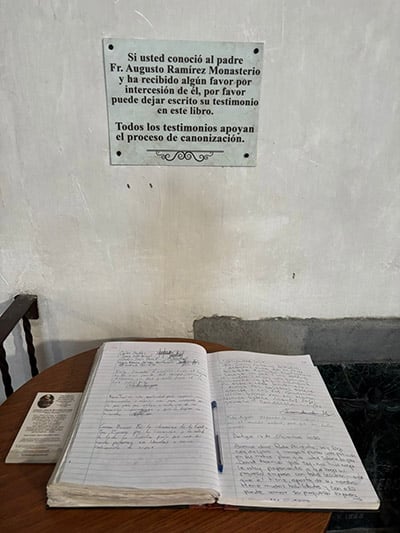
For Father Alvarado, that moment in June when Father Augusto refused to divulge the man’s confession is at the heart of his martyrdom: his willingness to suffer physical torture rather than violate the spiritual safety of a penitent.
“For us priests, for the people, it says a lot about how a priest can guard one’s confession to the point of giving his life,” Father Alvarado told OSV News. “This only reinforces the sacrament of confession.”
Through his torture and death, he said, “Fray Augusto has told us that it must be this way; that is what the seal of confession is worth.”
With his beatification confirmed, Father Alvarado told OSV News that he was surprised by a providential coincidence while discussions on possible dates were ongoing between the Archdiocese of Santiago de Guatemala, the Vatican Dicastery for the Causes of Saints, and the Franciscan general postulator.
“For these celebrations, they usually ask that it be a Saturday, not Sunday, so that the majority of the clergy can attend,” he said. However, Father Alvarado noted that the calendar was already filled with other ecclesial events, including beatifications in the United States and Italy.
Upon reviewing the dates available in the year, Father Alvarado was surprised to discover that the only Saturday available was Nov. 7, the same day of Father Augusto’s martyrdom.
“I don’t know how it happened, but it is a Saturday. So we confirmed the date with (Archbishop Gonzalo de Villa y Vásquez),” which will be the 43rd anniversary of his martyrdom, Father Edwin said.
The advancement of Fray Augusto’s cause came as the universal Church celebrated the World Day for Consecrated Life on Feb. 2.
In a letter sent Jan. 29 to religious men and women, the Dicastery for Institutes of Consecrated Life and Societies of Apostolic Life encouraged those in consecrated life, noting that they are called to be a “presence that remains” alongside wounded peoples and individuals, in places where the Gospel is often lived in conditions of fragility and trial.”
Read More Vocations
Copyright © 2026 OSV News
