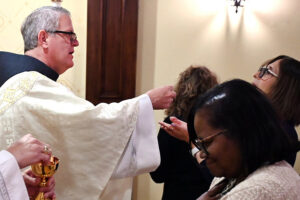
CHARLOTTE, N.C. (OSV News) — Bishop Michael T. Martin, a Baltimore native, has established guidelines for the reception of holy Communion in the Diocese of Charlotte to strengthen unity in worship, uphold the church’s liturgical norms and encourage active participation by the faithful.
Bishop Martin announced the new norms in a pastoral letter that affirms the common posture of standing to receive holy Communion, encourages priests to offer Communion under both bread and wine more often, and calls for the broader use of trained laypeople to serve as eucharistic ministers.
“The liturgy of the Church is the work of God and the work on behalf of God in the life of the Church,” wrote Bishop Martin, an Archbishop Curley High School graduate, in the Dec. 17 letter. “These norms for our diocese move us together toward the Church’s vision for the fuller and more active participation of the faithful.”
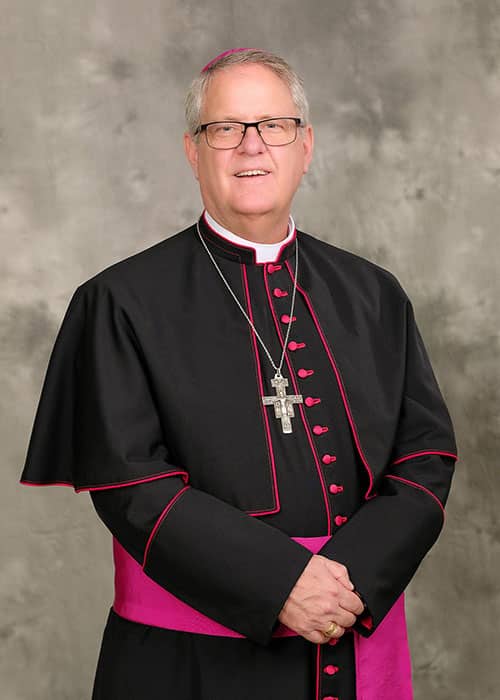
In his pastoral letter, the bishop emphasized that the celebration of the Eucharist is a communal act of worship, not only an individual act of piety.
“Throughout the ages and within the context of our rich liturgical traditions from the East to the West, our unity as believers in Holy Communion is expressed through our postures and gestures that reflect our mystical communion and unity as fellow believers,” he said.
The new guidance does not replace the diocese’s general liturgical norms established in 2005, but builds upon them and aligns closely with the Catholic Church’s universal norms (what is called the “General Instruction of the Roman Missal”) and directives set by the U.S. Conference of Catholic Bishops.
The pastoral letter follows months of consultation with the diocese’s Office for Divine Worship and the Presbyteral Council of priests, which represents all priests of the diocese in administrative and policy discussions.
In his pastoral letter, Bishop Martin affirmed the “normative posture” for receiving holy Communion in the United States is standing, after bowing the head as a sign of reverence.
The directive instructs any parishes that currently use altar rails for distributing Communion to discontinue the practice and remove any portable kneelers or prie-dieus by Jan. 16, noting that such practices are “a visible contradiction” to the prescribed posture of standing.
“Instead,” his pastoral letter states, the church “emphasizes that receiving Holy Communion is to be done as the members of the faithful go in procession, witnessing that the Church journeys forward and receives Holy Communion as a pilgrim people on their way.”
In many churches, altar rails are architectural elements that differentiate the sanctuary from the nave and once were used for Communion distribution.
Over the past decade or so, a small number of churches in the diocese reintroduced the use of rails or kneelers to distribute Holy Communion, but most diocesan churches already follow the practice of receiving Communion while standing, consistent with U.S. norms.
In his pastoral letter, the bishop reiterated that individuals may not be denied holy Communion if they choose to kneel, yet he encouraged the faithful to “prayerfully consider the blessing of communal witness that is realized when we share a common posture.”
Clergy and catechists, he added, “are to instruct communicants according to the normative posture in the United States” and “are not to teach that some other manner is better, preferred, more efficacious, etc.”
In guidance to pastors that accompanied the bishop’s pastoral letter, the diocese’s Office for Divine Worship noted that if a communicant wishes to kneel but is physically unable, the pastor should address the situation privately.
“He is to catechize and remind the person that standing to receive is no less reverent or worthy a way to receive Our Lord,” advised Father Noah Carter, diocesan liturgy director. “In both ways, the communicant who is properly disposed to receive holy Communion gains the same graces and gifts contained in the Eucharist, regardless of standing or kneeling.”
In his letter, Bishop Martin also encouraged pastors, where and when possible, to distribute holy Communion under the forms of both bread and wine more often.
While affirming church teaching that Christ is fully present — body, blood, soul and divinity — under either bread or wine, he encouraged priests to consider the “fuller sign” of distributing holy Communion under both kinds to foster “a deeper participation in the Eucharistic mystery,” consistent with prevailing church practice.
The bishop specifically noted that “a significant number of parishes” did not resume distribution of the Precious Blood in the wake of the COVID-19 pandemic. “To foster unity, it is helpful that we all practice a similar way of distributing Holy Communion,” he said.
“Parishioners who travel from parish to parish because of their own needs may otherwise rightly question why the Precious Blood is always available in one church and never available in another.”
The pastoral letter specifically recommends distributing the Precious Blood for at least one Mass every Sunday and for major solemnities, including: Christmas, the Easter Vigil, Divine Mercy Sunday, Pentecost, Trinity Sunday, Corpus Christi, Christ the King Sunday, and Holy Thursday. It also encourages distributing holy Communion under both kinds for first holy Communion Masses, wedding Masses, parish patronal feast days and church anniversaries.
It reaffirms that the consecrated host may be received either on the tongue or in the hand, at the discretion of the communicant.
It explicitly prohibits the practice of intinction — dipping the host into the Precious Blood before placing it on the communicant’s tongue — at public liturgies.
In his pastoral letter, the bishop also encouraged parishes to enlist more laypeople to help clergy with distributing holy Communion.
Priests and deacons are the “ordinary ministers of holy Communion,” while laypeople may serve as “extraordinary ministers of holy Communion” when needed, such as when there are too many communicants for the clergy to distribute Communion efficiently.
In many parishes, extraordinary ministers also take Communion to the sick and homebound.
The diocese’s existing liturgical norms already call for extraordinary ministers in such situations and provide for people to serve in three-year terms. The new guidelines formalize practices that are already commonplace in the diocese and across the U.S.
They set eligibility and formation requirements, and direct parishes to have enough eucharistic ministers “for roughly 75 communicants” at each Mass. Parishes are also directed to invite people to serve as extraordinary ministers and offer training at least once a year.
To be appointed as such, a layperson must: be a practicing Catholic who has received the sacraments of initiation; be at least 16 years old; “demonstrate a deep reverence for and devotion to the holy Eucharist”; be “distinguished in their Christian life, faith and morals”; and take part in the diocese’s safe environment training.
Read More Eucharist



Copyright © 2025 OSV News
