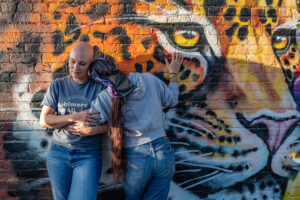
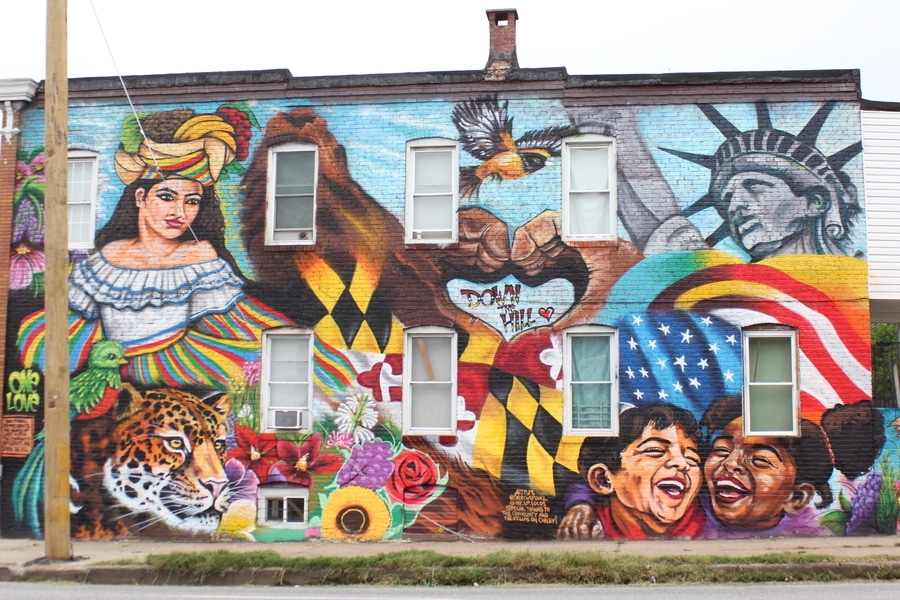
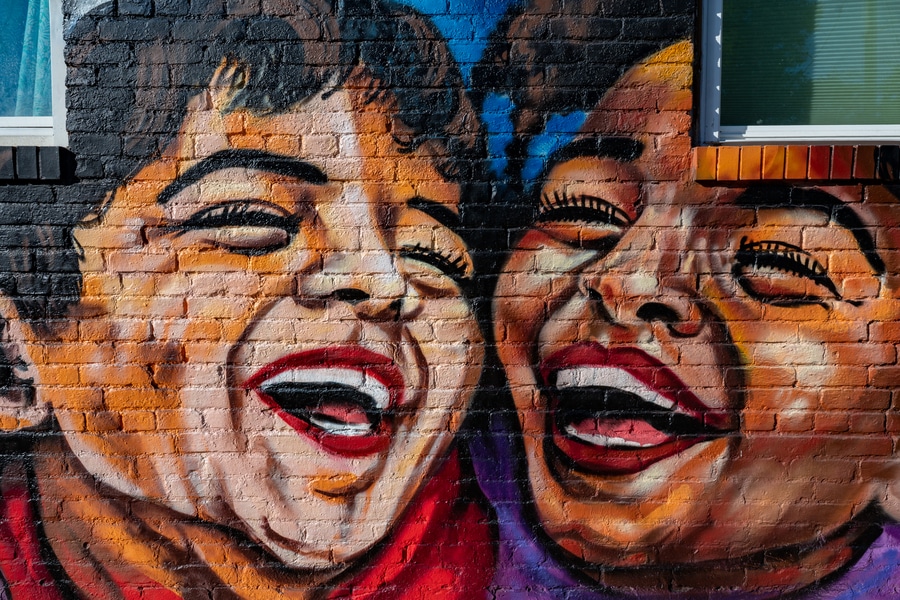
Rush-hour traffic roared along Route 40 in East Baltimore early in October, but “Nezuko” stood still on a weed-choked sidewalk, one hand resting against an enormous rowhouse mural.
From the colorful wall, the piercing amber eye of a jaguar stared back at her. In her native Guatemala, the big cat has long symbolized strength and courage – qualities that are deeply personal for Nezuko.

The 25-year-old Baltimore resident, who asked to be identified by a pseudonym, is a survivor of human trafficking who arrived in the United States nearly eight years ago. She helped design the recently unveiled mural on North Curley Street as part of a youth advisory board for Asylee Women Enterprise (AWE). The Baltimore-based organization, founded in 2011 by a coalition of Catholic women’s religious communities, helps asylum seekers, trafficking survivors and forced migrants rebuild their lives.
The mural reflects migration, pride and belonging – and, for Nezuko, survival.
“I hate it when people say to me that I should leave what I went through in the past,” said Nezuko, speaking in Spanish through an interpreter. “It’s not something I can just leave in the past. I’m always going to carry it with me.”
With AWE’s support, Nezuko has received counseling, enrolled in English classes and begun rebuilding her life while raising her young son.
It is a long way from where she was when she first entered AWE’s programs a few years ago. Then, overwhelmed by severe emotional distress, she was physically harming herself.
“I came to realize that it’s not me against the world,” Nezuko said.
Nezuko’s story is one of many in a city where human trafficking is largely hidden and rarely reported. Across Baltimore, a network of investigators, nurses, advocates and faith communities is working to find survivors and give them a new start.
‘Major problem’
Human trafficking is notoriously difficult to measure because people caught up in it often do not recognize themselves as victims and rarely seek help from authorities.
The National Human Trafficking Hotline identified 175 trafficking cases involving 259 victims in Maryland in 2025. Those figures reflect only cases reported through hotline contacts, however, and advocates say they capture just a fraction of the problem.
“(Survivors) don’t self-identify,” said Thomas Stack, director of the Baltimore City Human Trafficking Collaborative. “Very rarely does someone call 911 and say, ‘I’m a human trafficking victim. Come help me.’ They don’t do it.”
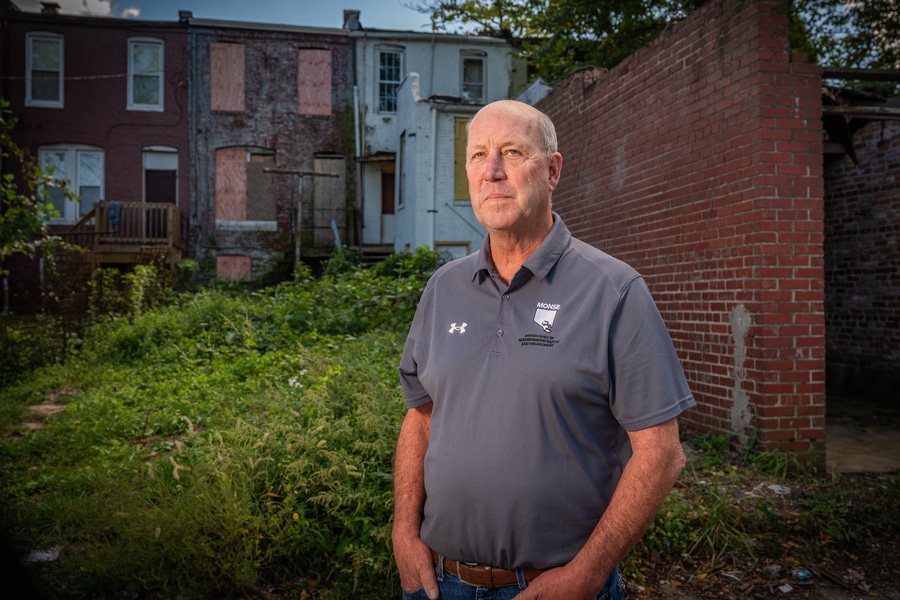
Stack, a parishioner of St. Paul in Damascus whose brother is a priest of the Archdiocese of Washington, spent 26 years with the Montgomery County Police Department, including 14 in its vice and intelligence unit, before becoming one of Maryland’s early human trafficking investigators. He later served as the state’s human trafficking coordinator and helped establish the Baltimore City Human Trafficking Collaborative in 2017, a network of 60 stakeholders that includes law-enforcement agencies, healthcare providers and service organizations such as Catholic Charities of Baltimore.
Because trafficking is so often hidden, Stack said there is no reliable way to count victims in Baltimore at any given time. But the problem is real and persistent.
The city sits along Interstate 95, a major route linking some of the nation’s largest metropolitan areas. Rail service, highways, a busy port, major sporting events, a large casino and conventions make Baltimore attractive to traffickers seeking both customers and anonymity.
In Baltimore, neighborhoods marked by poverty often lie only blocks from areas of relative affluence. Those disparities create vulnerabilities that traffickers exploit, while wealth generates demand for commercial sex.
“You can have a neighborhood that’s got a lot of money and literally one or two streets over, man, you are in it,” Stack said.
Contrary to popular perception, Stack said most trafficking victims are not typically kidnapped by strangers or smuggled into the country by criminal syndicates.
“The majority of human trafficking victims in the United States are domestic,” he said. “They are our own kids who get lured into it.”
Traffickers typically prey on vulnerability, whether it stems from poverty, addiction, family instability, abuse or low self-esteem.
“Traffickers know Maslow’s hierarchy of needs better than anybody, because they find those weaknesses and exploit them,” Stack said.
For immigrant survivors, language barriers, uncertain immigration status and fear of reporting crimes to authorities compound that vulnerability. Those are among the challenges AWE was created to address.
Laura Brown, AWE’s executive director, described its approach as “holistic case management.”
Established by Catholic women’s religious communities, AWE now operates as a secular nonprofit, though several religious sisters still serve on its board and religious communities remain important supporters and advocates. Despite its name, Brown said, AWE serves people of all genders.
“Most of our clients are fairly recently arrived in the United States and are pursuing some form of immigration protection, humanitarian protection like a trafficking visa,” Brown said. “But they haven’t been granted that status yet, so they often are experiencing significant financial vulnerability and generally aren’t eligible for any public benefits.”
Brown estimated that roughly one-third of AWE’s clients are trafficking survivors. In 2025, the organization served about 100 survivors, along with 40 to 50 family members who also needed support. Most come from Central America, though AWE serves clients from approximately 15 countries.
AWE’s services range from intensive case management and English classes to financial literacy, rental assistance and help with food, clothing, diapers and other necessities. It also provides individual and group therapy for adults and youths, and some health care for uninsured clients.
Most survivors come to AWE after they have escaped or left trafficking situations, Brown said. Even then, many remain vulnerable because of trauma, unstable housing, lack of work authorization, unfamiliarity with U.S. laws and fear of government agencies.
“A lot of the work we do is trying to help support them so that they can make decisions that provide more safety and stability and remove some of the risk factors of further victimization,” Brown said.
Historically, most of AWE’s trafficking clients were referred through federal agencies after being formally identified as survivors. Those referrals have declined, Brown said.
“We have seen a reduction in enrollment,” Brown said. “However, we are also seeing folks becoming increasingly vulnerable because of restrictions to work authorization, changes to immigration policy, delays in adjudicating applications and just confusion and fear.”
Network of care
Debra Holbrook, a nurse at Mercy Medical Center in Baltimore, directs a team of about 30 forensic nurses who care for patients affected by all forms of trauma, including human trafficking. Mercy also receives patients from a 30-state region seeking asylum based on torture and persecution in their home countries.
Trafficking patients come from across the country, many referred by the Polaris Project, which runs a national hotline.
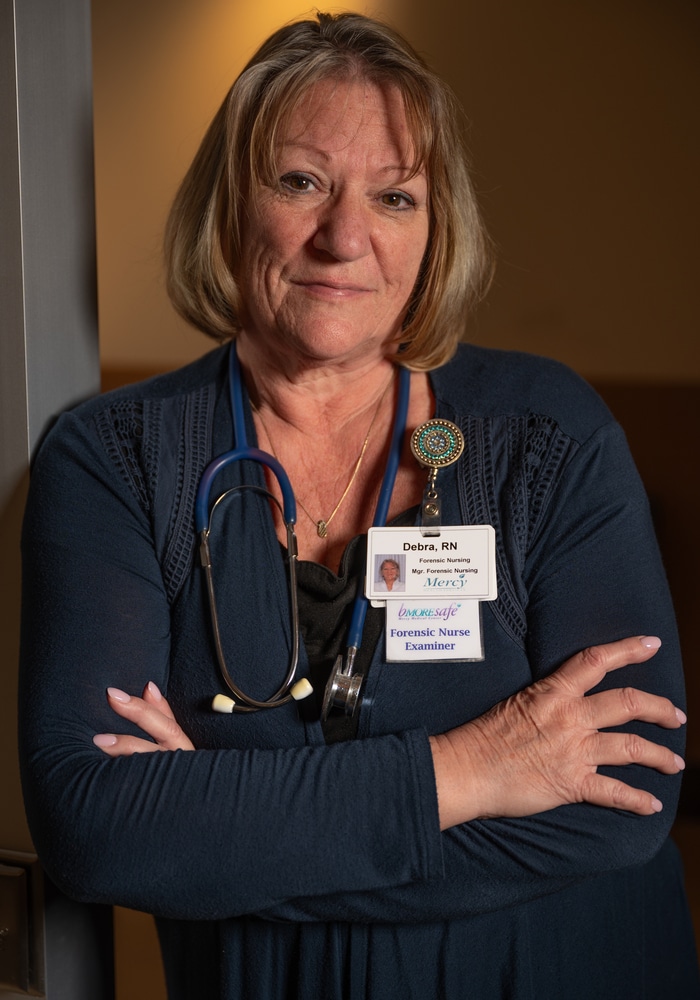
“They’re sent to us on buses, planes and trains,” said Holbrook, who estimates Mercy sees two to three trafficking cases each week.
Through the “Blue Dot” initiative, Mercy also receives referrals from hospitals and other stakeholders across the city. Holbrook chairs a medical subcommittee representing the city’s 13 hospital systems. About 150 staff members, known as “champions,” have been taught to recognize trafficking. Holbrook said she hopes healthcare workers look beyond a patient’s immediate medical needs to recognize signs of trafficking and identify opportunities to help.
Holbrook’s patients include women, men and transgender people affected by sex trafficking, labor trafficking and elder trafficking. Some cases involve familial trafficking, in which relatives exploit children or other family members. Although some victims are brought from other countries, the vast majority are American citizens, she said, many of them children and young adults.
The youngest trafficking patient Holbrook has worked with was 12; the oldest was 91.
Traffickers exploit victims’ vulnerabilities and dictate many aspects of their lives, Holbrook said.
“Once traffickers have them where they want them, they begin to exert control, abuse and torture,” Holbrook said. “They own them – their name, their phone (and its GPS), what they eat, wear and say. They are not allowed to have eye contact with anyone. They’re owned – every fiber of their being.”
Labor trafficking often receives less attention than sex trafficking, despite occurring across a wide range of industries, including agriculture, construction, domestic work and food service. It can also occur in settings such as massage parlors, where victims may be subject to sexual exploitation.
Young people who are trafficked for labor, often from African countries, are forced to work for families under the threat of being sent home, Stack said.
“They are sometimes allowed to go to church,” he said. “So that’s the one time you have to reach them and let them know there’s help.”
The U.S. Conference of Catholic Bishops and the Maryland Catholic Conference, which represents the state’s Catholic bishops in Annapolis, have spoken against human trafficking and supported awareness initiatives such as the bishops’ “Become a Shepherd” campaign.
Paula Gentile, a parishioner of Our Lady of the Chesapeake in Lake Shore, has educated fellow parishioners through the campaign by placing information in bulletins and distributing resource cards in airports. One parish fundraiser generated $2,000 for anti-trafficking efforts, she said.
Both Gentile and Stack warned that teens are particularly vulnerable to traffickers who exploit social media to reach young people on their phones around the clock.
“They’ll send a message and tell someone how pretty they are or, oh, your eyes are so beautiful,” Stack said. “If you have someone with low self-esteem and you tell them how pretty they are, they’re not used to hearing that. They want to hear more.”
Finding forgiveness
Maria Tell’s exploitation began at age 4, when a daycare provider allowed adults to abuse her. Years later, as a college student in her native Colorado, she fell under the sway of a trafficker who groomed her with promises of love, protection and financial security.
Tell shared her story with the Catholic Review in 2025 at a conference in Linthicum sponsored by the Alliance to End Human Trafficking, a nonprofit established by women’s religious communities across the country.
“He was very handsome – tall, charismatic,” Tell said of her initial trafficker. “I was consumed by the lie that he was going to protect me and that I was going to make all this money and it was going to be a lavish lifestyle.”
Tell eventually became entangled with a gang-affiliated trafficker. After her escape, a priest friend encouraged her to pray the Divine Mercy chaplet for those who had abused her, which she said helped with the difficult work of forgiveness.
“I don’t know what else to do but to forgive them because it was like I was carrying the weight of their shame and their disgust on my back,” said Tell, founder of A Courageous Rose, which helps trafficking survivors.
Denying demons
When the young woman who helped design the mural overlooking Route 40 was asked what name she would like to use to preserve her anonymity in this story, she paused briefly before answering confidently: “Nezuko.”
The name comes from “Demon Slayer,” a Japanese anime series whose Nezuko character struggles against darker impulses out of love for her family.
The trafficking survivor said she sees something of herself in that struggle.
“I identify with that character a lot,” Nezuko explained, “because sometimes you want the demons to take over – you just want to let them. But I know I have a family to fight for. I don’t want my son seeing that I’m sad because if I’m sad, then he’s going to be sad and then I’m going to be more sad.”
Despite everything she has endured, Nezuko remains focused on the future. One day, she hopes to work as a pediatrician or another health care professional. She wants to make enough money to build a home for her parents.
Until then, whenever she glances at the mural along Route 40, she said, she feels “excited.”
“When people see that mural, I want them to know that family might fail them or fall away,” she said, “but there’s always going to be someone who’s there and available to help you.”
Email George Matysek at gmatysek@CatholicReview.org
Also see: Entrepreneur uses tech to combat human trafficking
Where to turn for help and information
U.S. Conference of Catholic Bishops | usccb.org/topics/anti-trafficking-program
Alliance to End Human Trafficking | alliancetoendhumantrafficking.org
Talitha Kum | Talithakum.info
Asylee Women Enterprise (AWE) | asyleewomen.org
Araminta | aramintausa.org
A Courageous Rose | acourageousrose.org