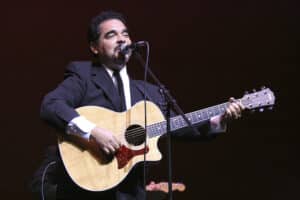
“Every culture, every language” has value in the celebration of the Mass — and bilingual liturgical music can help heal divides, while drawing faithful into an encounter with Jesus Christ and one another, a longtime Hispanic Catholic composer told OSV News.
“The climate of the liturgical music in the Catholic Church is changing drastically; it’s shifted a lot in the last six, seven years,” said Jaime Cortez, whose hymns include “Rain Down,” “Take Up Your Cross” and “Somos el Cuerpo de Cristo/We Are the Body of Christ.” That last song he co-wrote with fellow liturgical music composer Bob Hurd.
Cortez, who was born in New York and raised in El Salvador, has engaged in multicultural music ministry throughout his career, collaborating with peers on a number of projects — including “Gracia y Amor/Grace and Love,” a collection with Hurd and Eleazar Cortés, and “Our Common Home.” The latter, a project inspired by Pope Francis’ encyclical “Laudato Si’,” features Cortez’s song “Let Us Sing as We Go,” along with music from several other well-known Catholic composers.
Along with six solo collections released by Oregon Catholic Press, Cortez has translated Dan Schutte’s “Mass of Christ the Savior” (“Misa Cristo Salvador”) setting into Spanish and bilingual versions.
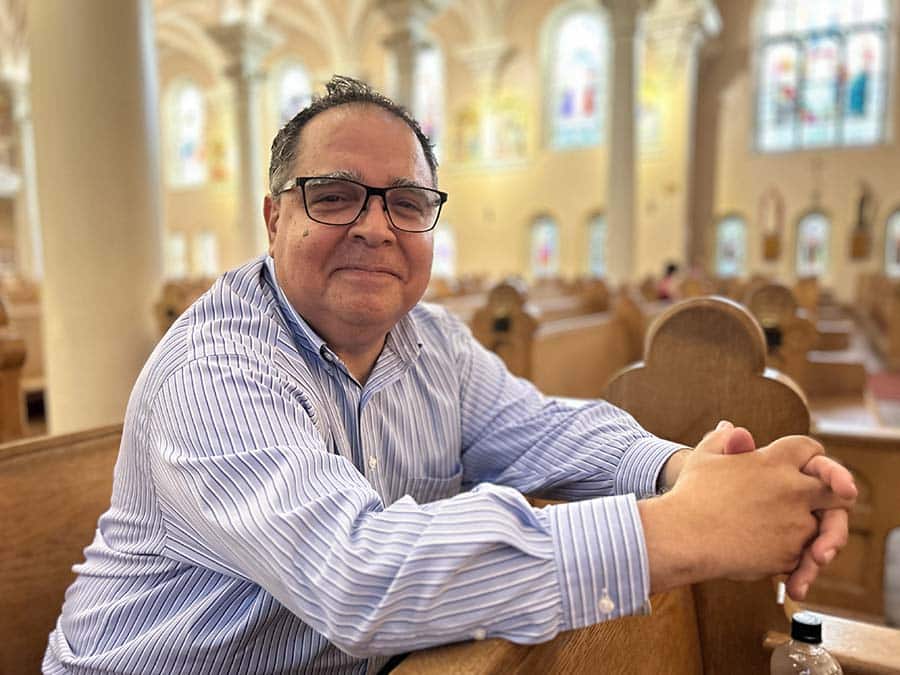
Those efforts are born of a desire to see the body of Christ unified in praise, said Cortez, who in 2016 was named Pastoral Musician of the Year by the National Association of Pastoral Musicians.
Cortez admitted that, amid a polarized society, “we have a little bit of division” in the pews, making for a “difficult time … for finding a way to common ground right now.”
At the same time, he said, “Catholic means ‘universal,'” and the faithful “have to remember and understand that there’s a place for everybody at the table.”
Liturgical music should be approached “with an attitude of Catholicism,” he said.
In particular, he said, “when you at least attempt to have music that’s in bilingual form, at least you are making a reach to include other people.”
That same reach should span the often contentious debates over the artistic styles of liturgical music, allowing faithful of all musical preferences to come together at the same Masses, said Cortez.
“The unfortunate thing is that we have … a big division in having people doing only Masses with Latin chant, or with organ and voice only,” while still other parishes have “the small group of people playing with percussion and guitars,” said Cortez, who serves as director of liturgy and music at Our Lady of Perpetual Help in Scottsdale, Arizona.
As a result, many members of the same parish are “not meeting one another,” he said.
Instead, said Cortez, “it would be ideal if the church would mix up bilingual and multilingual music with traditional chant and with some Latin pieces.”
“It’s not always easy to do,” he admitted. “But with a little bit of preparation, it would be wonderful if we could do that.”
Equally important, Cortez said, is selecting liturgical music that allows for what the Second Vatican Council called the “full and active participation by all the people” in the Mass — “the aim to be considered before all else,” according to the council’s constitution on the sacred liturgy, “Sacrosanctum Concilium.”
“The full participation of the assembly still means a lot to me; more than anything,” Cortez said.
He said the conciliar document, along with the General Instruction of the Roman Missal, which explicates the council’s directives for the Mass, and “Sing to the Lord: Music in Divine Worship,” the U.S. Conference of Catholic Bishops’ official guidelines for pastoral music, have “formed” him.
“In my parish, I’m always paying attention to the music and evaluating and looking — are people trying to sing this? Can they do it? Is it too high? Is it too low? Is it too difficult? Is it too wordy?” he said. “I’m always evaluating: Can this help our people deepen their faith by the experience of their music and participating in the music? … I still give that priority No. 1.”
Parishes can take several practical steps to reach that goal, said Cortez.
“The first thing would be to choose your classical pieces or your Latin pieces very carefully so that they could be done by the assembly,” he advised. “Some parishes have been very successful at that. Some of them are very good at picking two or three or four in the year, and they repeat them many times. Repetition helps; do something to allow people, the assembly, to hear these pieces, repeat them and try them slowly and do them several times in the year.”
He also recommended “explaining to people what we are singing and what is the meaning.”
As a liturgical music director, composer and musician, he said, “I want to be where I’m allowing the music that I pick to allow the assembly to enter into the song, so they can also express their faith and also they can even deepen their faith by the expression of the music, along with other things that are there filling all our senses — with the word (of God), with the sound of silence, with the incense.
“So it’s all very sensory, and it should happen with the music being a vehicle for the expression of the faith of the assembly,” he said, adding, “That’s still, after 37 years, a top priority for me.”
Read More Arts & Culture
Copyright © 2025 OSV News
