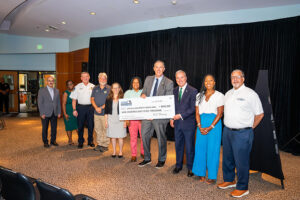
Loyola University Maryland has received nearly $1 million in federal funding to establish a forensic science training center, an investment university and law enforcement leaders say will strengthen forensic science education, expand research opportunities and deepen partnerships that support criminal investigations across the region.
The $965,000 award will allow Loyola to create the training center while investing in advanced technology for research and instruction in areas including DNA analysis, toxicology, digital forensics and pattern analysis, according to a university news release.
The funding will also support the university’s collaborations with local law enforcement agencies, crime laboratories and the City of Baltimore.
University officials announced the award during a ceremony July 9 at Newman Towers on Loyola’s campus, where U.S. Rep. Johnny Olszewski Jr., who represents Maryland’s 2nd Congressional District, formally presented the funding.
“This funding is significant not just for Loyola, but for our entire community,” said Loyola President Terrence M. Sawyer. “It ensures that the university will continue to graduate highly skilled, civic-minded forensic scientists who are ready to serve, while also building upon the mutually beneficial training partnerships Loyola has with local law enforcement agencies and investing in experiential learning opportunities for young people interested in careers in the forensic sciences.”
The new center is expected to expand opportunities for hands-on learning while providing additional resources for faculty and students who work alongside law enforcement professionals on forensic investigations, according to the news release.
Loyola’s forensic science program already partners with local law enforcement agencies and crime laboratories, with students and faculty assisting in cold case investigations and providing forensic analysis in criminal cases.
Olszewski said the investment will have benefits extending beyond the university.
“This investment will prepare students for high-demand careers, give law enforcement better tools to do their jobs, strengthen partnerships across our region, and ultimately make our communities safer,” Olszewski said. “That’s exactly the kind of investment taxpayers deserve and this is exactly what responsible government looks like.”
David Rivers, chair and professor of forensic science at Loyola, said the funding represents a major step forward for the university’s program.
“Our goal is to make Maryland the top place for forensic science education, training and career opportunities, and this funding is a springboard for that,” Rivers said. “I’m especially excited to secure cutting-edge equipment to train our students, equipping them with the tools that put them at the forefront of forensic science, and the forensic science training center, which enables us to advance our curriculum. We are also looking to create a first-of-its-kind forensic science equipment hub to share resources with other agencies and universities.”
The equipment hub would allow agencies and higher education institutions to share access to specialized forensic technology, helping maximize resources while expanding research and training opportunities.
The funding supports Loyola’s ongoing efforts to introduce younger students to careers in forensic science. The university’s Department of Forensic Science partners with the Baltimore Police Department to host the annual Forensic Science Summer Academy, a free, weeklong camp for high school students from Baltimore City and surrounding counties.
Baltimore Police Commissioner Richard Worley said the partnership between the department and Loyola extends well beyond classroom instruction.
“Baltimore Police Department is proud of its partnership with Loyola because it represents much more than two organizations working together,” Worley said. “It represents commitment, education, innovation, science and service to the community. Some of these campers may one day become forensic scientists, investigators, researchers, or public servants who help keep the community safe.”
Loyola’s Department of Forensic Science offers undergraduate major and minor programs as well as a Master of Science in Forensic Pattern Analysis. The graduate program prepares students for careers as latent print examiners, firearms and toolmarks examiners, crime scene investigators and other forensic science professionals.
Read More Colleges



Copyright © 2026 Catholic Review Media
