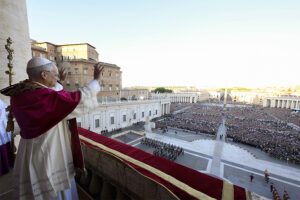
VATICAN CITY (OSV News) — Pope Leo XIV published his landmark encyclical on artificial intelligence “Magnifica Humanitas” May 25, comparing the attempt to build an AI future that excludes God to the “Tower of Babel” and underlining the need to safeguard human dignity as it is “threatened by new forms of dehumanization.”
“The risk of dehumanization — of building a future that excludes God and reduces the other to a means — is an ancient and ever-new temptation that today takes on a technical guise,” Pope Leo wrote in his first encyclical, “Magnifica Humanitas: On Safeguarding the Human Person in the Time of Artificial Intelligence.”
“In the era of artificial intelligence, when human dignity is threatened by new forms of dehumanization, ours is the pressing duty to remain profoundly human. We must lovingly safeguard the grandeur of humanity bestowed upon us and revealed in its fullness in Christ, the splendor of which no machine can ever replace,” he said.
AI misuse compared to ‘Tower of Babel’
Pope Leo opens the first encyclical of his pontificate by saying that humanity today faces a pivotal choice — “either to construct a new Tower of Babel or to build the city in which God and humanity dwell together.” Using the Biblical Genesis narrative, the pope warns against the “‘Babel syndrome,’ namely the idolatry of profit that sacrifices the weak” and the pretense that everything, “including the mystery of the person,” can be translated into “data and performance.”
“Calling for prudence, rigorous evaluation and even, at times, a slower pace in adopting AI does not mean opposing progress; instead, it is an exercise of responsible care for the human family,” Pope Leo wrote.
From cryptocurrency to the ‘Lord of the Rings’

The lengthy papal document is divided into five chapters and touches on wide ranging issues related to AI, including the prospect of massive unemployment, the future of education, the protection of human freedom, excessive screen time for young people, cryptocurrencies, economic disparities, transhumanism, cyberattacks and the application of Catholic social teaching principles.
Pope Leo dedicated the final chapter of the encyclical to AI in warfare and the need for “rigorous ethical constraints” and proactive peacebuilding “to curb the technological arms race.”
The American pope points to Martin Luther King Jr., St. Teresa of Kolkata, Dorothy Day, St. Maximilian Kolbe and others as examples that “history can also change when individuals truly take the dignity of everyone seriously.”
In “Magnifica Humanitas,” Latin for “Magnificent Humanity,” the pope calls on Christians not to be “passive spectators” or “mere commentators on what is crumbling,” but to take a proactive role in building the future by cultivating community and in-person relationships, educating young people to love wisdom, spending time with the poor and the lonely, being a voice for justice, defending objective truth, and treating the digital world as “a new continent to be evangelized.”
“It is not our part to master all the tides of the world, but to do what is in us for the succour of those years wherein we are set, uprooting the evil in the fields that we know, so that those who live after may have clean earth to till,” the pope wrote, quoting J.R.R. Tolkien’s “Lord of the Rings: The Return of the King.” He added that it is “small and steadfast acts of fidelity that serve as a bulwark against dehumanization.”
‘Slowing things down when everything is accelerating’
In the encyclical, Pope Leo says that the idea of a “more moral AI” is not enough if that morality is only determined by a few.
“What is needed is a more active political involvement that is capable of slowing things down when everything is accelerating, and of protecting the opportunities for communities still to be able to participate and ask questions,” he said.
The pope argues that “we cannot consider AI to be morally neutral” and underlines that ethical discernment cannot be limited to “asking whether we are using a system for good or bad purposes,” but must also “examine how that system is designed and what vision of the human person and society is embedded in the data and models that guide it.”
Pope Leo added that data cannot be left solely in private hands and “should not be treated as something to be sold off or entrusted to a select few,” calling for appropriate regulation and creative thinking to “manage data as a common or shared good.”
Unemployment as a ‘grave evil’ and ‘social calamity’
Pope Leo addresses the looming specter of mass unemployment due to the adoption of AI, saying this would be “a true social calamity that especially requires the State to exercise responsibility.” He cites St. John Paul II’s 1981 encyclical on human work “Laborem Exercens,” noting that his predecessor recognized that unemployment is “a grave evil,” with Pope Leo adding that “exposing many to forced inactivity, a lack of responsibility and the absence of daily tasks and stimuli” could lead to “human and cultural impoverishment.”
“The pursuit of greater profits cannot justify choices that systematically sacrifice jobs, because the human person is an end, not a means, and the economic order must remain subordinate to human dignity and the common good,” Pope Leo said.
“Without bold decisions, the prospect of greater poverty and inequality looms large, which would leave many individuals marginalized, stranded and surrounded by the machines and automated systems that have replaced them,” he added.
God created humans for communion, not efficiency
Pope Leo writes that AI promises efficiency but the “new ways” of working are not necessarily better, describing how “contrary to the advertised benefits of AI, current approaches to technology can paradoxically de-skill workers, subject them to automated surveillance and relegate them to rigid and repetitive tasks.”
“When efficiency becomes the ultimate measure of value, human beings are tempted to see themselves as a project to be optimized rather than as persons called to relationship and communion,” Pope Leo said.
A defense of objective truth
Truth is a major theme in the encyclical by the Augustinian pope. He said that in the face of incessant flows of information, opinions, images and sophisticated algorithms that can influence decisions, it is imperative to “cultivate hearts that love the truth, prefer what is right despite the most appealing content and pursue wisdom rather than immediate results.”
“We must always keep before us the truth about God and humanity, just as Christ has revealed them to us. We must lay aside an individualistic and technical view of humanity,” he said.
Quoting Pope Benedict XVI, he added, “Modern man is wrongly convinced that he is the sole author of himself, his life and society. This is a presumption that follows from being selfishly closed in upon himself.”
The pope underlined that “the search for truth is an essential element of democracy,” and that “indifference to the truth leads, slowly but surely, to a descent into totalitarianism.”
He said people must “promote an ecology of communication,” in which public policy establishes norms “so that the decision-making behind content selection and its development becomes more transparent and protects personal data.” On a cultural level, he called for “a strengthening of intermediary organizations, serious journalism and forums for debate,” for families and schools to gain formation in using digital tools, and for universities to strive for the “integration of knowledge.”
“Our first task is neither to demonize nor idolize technological tools, but to utilize them on the basis of a fundamental principle, namely that truth is a common good and not the property of those with power or influence,” he said.
Social control and the ‘digital attention economy’

Pope Leo called for “education in digital sobriety” due to subtle forms of addiction in today’s “digital attention economy,” in which digital platforms that are “designed to capture users’ time and attention” weaken “their inner freedom.”
He warned of the risk of “social control made possible by the massive collection of data and use of algorithmic systems.”
“When every action — movements, purchases, relationships and preferences — leaves a trace, a new form of power emerges, namely the power to profile, predict and influence behavior, often without individuals being fully aware of it,” he said. “If such kinds of data are used to make decisions affecting concrete opportunities — such as access to credit, employment or essential services — there is a risk of undermining freedom and discriminating against the most vulnerable.”
Pope Leo XIII and Catholic social doctrine
Pope Leo XIV places his writing on the age of artificial intelligence within the context of the magisterial tradition of Catholic social doctrine, also known as Catholic social teaching. The first chapter of the encyclical provides an overview of what each pope has contributed to the Church’s social magisterium from Pope Leo XIII to present, highlighting key ideas that are particularly relevant today. The second chapter provides definitions of key principles of Catholic social doctrine from the “common good” to “subsidiarity.” Pope Francis and St. John Paul II are both frequently quoted throughout the encyclical.
Pope Leo XIV signed “Magnifica Humanitas” on May 15, the 135th anniversary of “Rerum Novarum,” Pope Leo XIII’s foundational 1891 social encyclical on labor and capital written during the first Industrial Revolution.
“While new economic and technological networks can generate exclusion, isolation and dependencies, the Church — nourished by the Eucharist — is called to make visible a different paradigm, one that preserves human connections, gives a voice to the invisible and ensures that processes are aimed at respecting people’s dignity,” Pope Leo said.
Read More Vatican News
Copyright © 2026 OSV News
