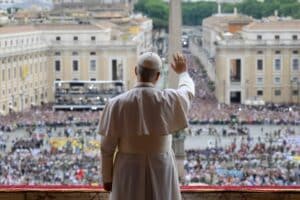
(OSV News) — Pope Leo XIV’s widely anticipated first encyclical on artificial intelligence is here, and it offers a clear path forward to one of the most pressing challenges of our age. But the 42,000-word “Magnifica Humanitas” also serves as a formal launching point for Pope Leo’s vision for contemporary application of Catholic social teaching.
The text provides answers to questions pertaining to the “new things” of our modern age following in the footsteps of Pope Leo XIII’s treatment of the advancements in technology, industry and economics at the turn of the 19th century, which birthed modern Catholic social doctrine. But “Magnifica Humanitas” also reveals some aspects of who Pope Leo is, how he governs, and what he brings to the Petrine office. Reading between the lines, the encyclical can be seen also as a roundup of what has been learned about Pope Leo so far and sheds perspective on what might lie ahead.
A particular word that Pope Leo repeats, as he frequently has even since his first address to the world as the newly elected 266th Successor of Peter, can serve as a key to these latent aspects of “Magnifica Humanitas.” In fact, “to disarm,” Pope Leo says in the encyclical, is an expression “close to my heart” (No. 110). Closer, perhaps, than it might appear at first glance?
A pivotal moment
Pope Leo begins his encyclical in stark terms, arguing that the modern world is at risk of heading down the path of the architects of the Tower of Babel — where the descendents of Noah chose their own glorification over that of God, as recounted in Chapter 11 of Genesis — and facing similar disastrous consequences.
Countering the cautionary tale with an example of a positive path forward, Pope Leo offers Nehemiah’s plan for rebuilding Jerusalem’s walls, as recounted in the first and second chapters of the Book of Nehemiah. Where the inhabitants of Babel attempted to build a single vision for the future — one that put the self and not God at the center — Nehemiah’s vision facilitated progress through collaboration with God and others, bringing together society, with its various talents, to achieve a common purpose. In many ways, “Magnifica Humanitas” serves as Pope Leo’s desire to bring Nehemiah’s vision to the modern world.
This is achieved, Pope Leo proposes, when we disarm our own priorities, plans and projects by choosing to put Jesus Christ at their center rather than ourselves. This message is congruent with the Christocentrism that has pervaded Pope Leo’s words and actions from the earliest moments of his pontificate.
“Whenever humanity is in danger of marring its true identity, we Christians lift our eyes to the Incarnate God, knowing that it is ‘only in the mystery of the Word made flesh that the mystery of humanity truly becomes clear,'” he writes, quoting Vatican II’s “Gaudium et Spes.” “In Jesus Christ, this humanity in its grandeur becomes the Way, the Truth and the Life, opening the path for each of us to grow toward fullness” (No. 1).
Citing his beloved St. Augustine, Pope Leo wants to help humanity understand its innate desire for the happiness found only in God. As he writes, “Like Saint Augustine, we too can say, ‘You have made us for yourself, O Lord, and our heart is restless until it rests in you'” (No. 11).
A call to embrace the Church’s vision
In a world so polarized and ideological, so unable to find a common language, purpose or vision — and too often defined by a growing absence of objective truth and moral relativism — Pope Leo holds up the Church’s social doctrine as a much-needed means to disarm current growing divisions, tensions and threats.
Pope Leo is clear that this time of rapid change in technology, economics and politics warrants revisiting this tradition comprehensively and boldly. Pope Leo’s choice of papal name itself, as he explained to the College of Cardinals just two days after his election, was “mainly” because of how Pope Leo XIII “addressed the social question in the context of the first great industrial revolution” in his groundbreaking 1891 encyclical “Rerum Novarum.”
“In our own day, the Church offers to everyone the treasury of her social teaching in response to another industrial revolution and to developments in the field of artificial intelligence that pose new challenges for the defense of human dignity, justice and labor,” Pope Leo XIV told the cardinals.
“Magnifica Humanitas” is Pope Leo’s magisterial contribution to this tradition — even signed on the 135th anniversary of “Rerum Novarum,” his namesake’s monumental text. It is his invitation for humanity to disarm itself against self-interest. It is a call to step back, see the bigger picture, and work together to overcome collective challenges and plot the course ahead.
Through keen pastoral insights, Pope Leo underscores how the Church possesses the truth that the world needs to address the great social questions of our time; that we hold the blueprint for the way ahead. He argues that “building for the common good requires an evangelical language” and that “we must lovingly safeguard the grandeur of humanity bestowed upon us and revealed in its fullness in Christ, the splendor of which no machine can ever replace.” (No. 14-15).
A call to unity
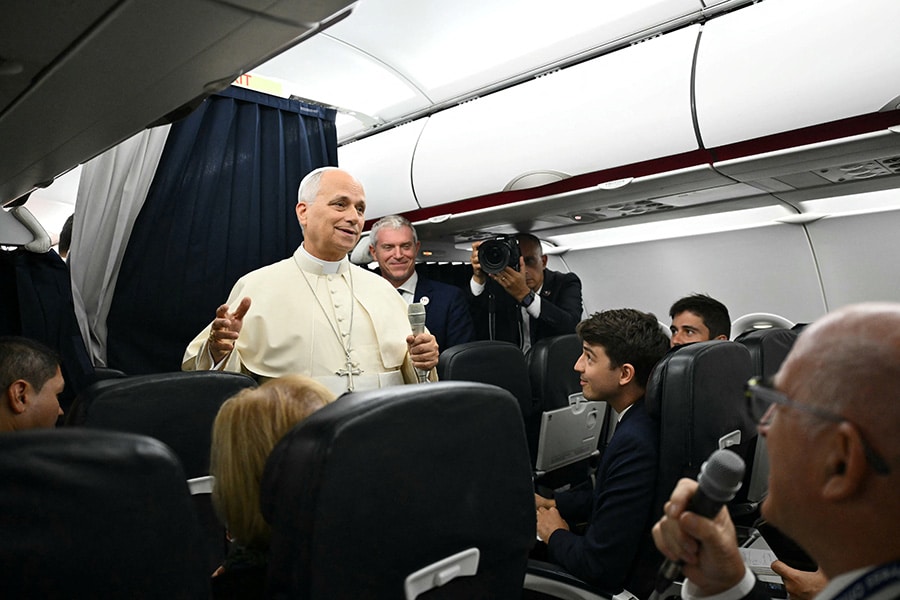
In order for humanity to work toward the peace God wills, Pope Leo stresses the importance of collaboration to advance the common good. The theological and anthropological implications of humanity’s creation in God’s image lies at the heart of human fraternity, communion and unity. Observers of his public schedule will note how available Pope Leo has made himself. Those who meet with him remark what a keen listener he is. Pope Leo promotes the implementation of synodality as a means to foster dialogue and co-responsibility in ecclesial life. He advocates for diplomacy and multilateralism.
Pope Leo’s own episcopal motto — “In Illo uno unum,” which means “In the One, we are one” — is taken from a commentary of St. Augustine on the psalms and stresses unity in Jesus Christ. Echoing Christ’s own call to unity — an innate desire for which is written into human consciousness as made in the image of the Triune God — ought to permeate our answers to social questions.
As we await the fulfillment of the heavenly Jerusalem described by St. John in the Book of Revelation, Pope Leo draws attention to this vision as it serves “as an encouragement, a call to overcome our divisions and to work together, for this is the way of Jesus Christ, yesterday, today, and forever” (No. 242). In essence, Pope Leo teaches that the path of Christ is the way to disarm humanity from that which competes with God’s vision for humanity.
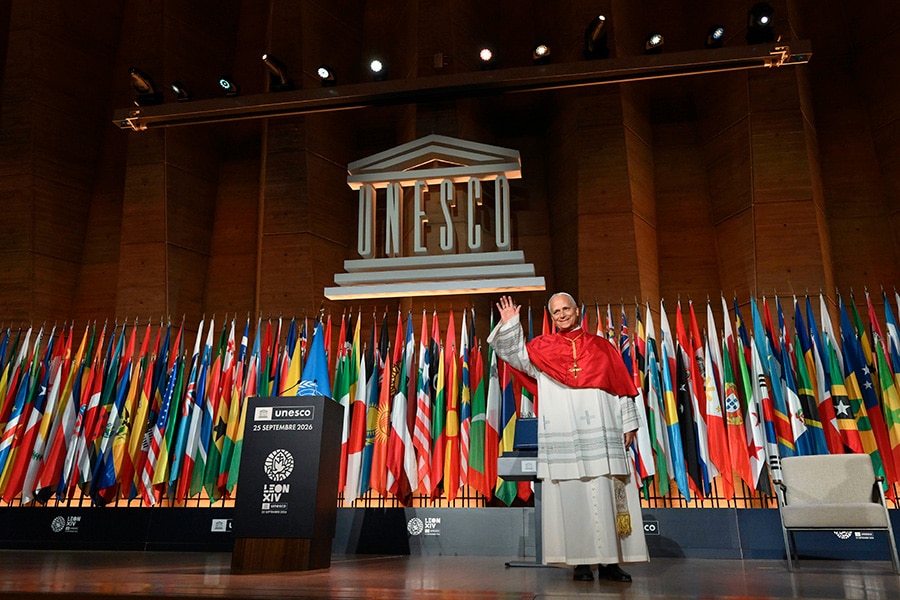
Of course, the Church is not immune from reflecting the divisions, polarization and ideological defects of the wider society. And it is no secret that these realities plague the Church in a host of ways. While these divisions deepened under the pontificate of Pope Francis — and were in some ways exacerbated by him — Pope Leo has been a disarming presence since Day 1. When he chose to wear the traditional red mozetta, or cape, on the loggia after his election, it was a signal of his beginning down the path that comes full circle with this encyclical.
This makes particularly significant Pope Leo’s extensive treatment of many of his papal predecessors’ contributions to Catholic social teaching, beginning with Pope Leo XIII, who reigned as pope from 1878 to 1903. The former Robert Prevost, who grew up in Chicago and became a missionary priest and bishop in Peru, has receded into the Petrine office to such a degree that Pope Leo is who we now see. By his lengthy commentary of what recent popes have contributed to the social questions of their age, Pope Leo situates himself squarely within those confines.
And, through Pope Leo’s generous quoting of Pope Francis, he accomplishes the same for his predecessor, highlighting the best of what Pope Francis contributed to the Church’s magisterium. He has found a way, in “Magnifica Humanitas” and other official texts in his brief pontificate, to position his predecessor’s contributions more securely within the tradition.
With his disarming style — allowing the office and the One he represents to take center stage — Pope Leo is leading the Church into a new age of unity, thereby making room for the Church to find its voice in a world so constantly at odds with its mission.
A shift in priorities?
Naturally, any document of this sort comes with its own limitations. The subjective nature of any kind of teaching document addressing timely issues will naturally lend itself to criticism, especially from those more prone to agendas.
Rather than giving into the temptation of ideology, though, listening to Pope Leo and heeding what he has to say to humanity at this moment would be the wiser path. From what we have seen and heard from Pope Leo, it seems like he is encouraging us to avoid constructing such Babel-like towers in the Church, and instead is offering the vocabulary and blueprint for humanity to collaborate in rebuilding the walls of a fractured world at risk of collapse.
Pope Leo’s life as a priest and bishop put him in contact often with the global poor, a people whose faith greatly shaped his own. Their daily reality dictated that they be less concerned with such internal debates in Church life. Is Pope Leo not encouraging us to actually live Christianity instead of trying to tinker with revelation and trivialize sanctity?
Perhaps that is really the call of “Magnifica Humanitas”: that those of us in the Church disarm ourselves of our own preoccupations and proclivities for nothing short of the life of the world.
Also see

Copyright © 2026 OSV News
