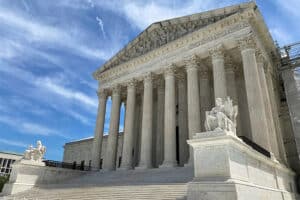
In a momentous decision that has far-reaching implications for the future of public education and religious liberty in the United States, the U.S. Supreme Court ruled in Mahmoud v. Taylor that parents, not the state, hold the primary right to direct the upbringing and education of their children.
Although the case centered primarily on a dispute involving a public school’s curriculum and a Muslim family’s objection to certain classroom content and their ability to opt out of that portion of the curriculum (the court ruled that they could opt out, based on the coercive pedagogical methods related to the content), its implications affect every family concerned about the moral and spiritual formation of their children — including Catholic parents.
At the heart of the ruling was a clear rejection of the notion that a child is, as one justice put it, a mere “creature of the state” to be indoctrinated at will. The court reaffirmed a fundamental truth that resonates deeply with our Catholic faith: Children are entrusted to their parents, and it is the family — not the government — that is the primary school of virtue, identity and faith.
This decision is consistent with the church’s long-standing teaching, beautifully articulated in the Second Vatican Council’s declaration “Gravissimum Educationis,” which affirms that “since parents have given life to their children, they are bound by the most serious obligation to educate their offspring and therefore must be recognized as the primary and principal educators.”
And as the Catechism of the Catholic Church states: “The right and duty of parents to educate their children are primordial and inalienable.”
Schools, whether public or private, serve an important role in supporting that mission, but they do not replace it. The Mahmoud decision brings this principle more fully into the legal consciousness of our nation, reminding us that state-run schools must operate in partnership with families — not in opposition to them.
In recent years, many Catholic parents have grown increasingly concerned about ideological content creeping into public school curricula — content that often runs counter to church teaching on human dignity, sexuality, the family and the nature of the human person. While some families can choose Catholic education or homeschooling as an alternative, many others rely on the public school system and expect, at minimum, a baseline respect for their religious and moral convictions.
Mahmoud v. Taylor represents a significant blow against the progressive overreach that has too often characterized public education in recent years. In reaffirming that the state has no right to impose a singular worldview upon all children, the court has created space for genuine pluralism, where families of diverse beliefs can coexist and collaborate in the public square without being coerced into ideological conformity.
This ruling should serve as both encouragement and a challenge to Catholic parents. It is a reminder that we are not powerless in the face of cultural forces. Legal precedent is now on the side of families who speak up when public education drifts into indoctrination rather than instruction.
But the decision also calls for renewed vigilance. The decision does not allow parents to shield their child completely from all sensitive topics or alternative viewpoints than their own; rather, it ensures that schools cannot impose ideological conformity around certain viewpoints. Therefore, it will require parents to exercise their responsibilities if they wish to have their legitimate rights protected.
If you send your child to a public school, do you know what he or she is being taught? Have you spoken with teachers or administrators about your concerns? Are you involved in school board elections or curriculum reviews?
Increasingly, Catholic parents must be active participants in their children’s education, advocating for transparency, balance and respect for faith and reality-based perspectives. Mahmoud offers a path forward for dialogue between parents and schools, which should be a dialogue grounded not in confrontation, but in the shared goal of forming well-rounded, morally grounded citizens.
The decision also invites Catholic school leaders to reflect on their mission. In a time when public schools often stray from the basics, our Catholic schools must continue to model an education rooted in truth, beauty and goodness — faithful to the church’s teaching and supportive of parental authority. Catholic education should never mirror the confusion of the culture; it must be a refuge of clarity and charity, forming students in both intellectual excellence and moral virtue.
As Catholics, let us give thanks for this victory. But let us also rise to the occasion it presents. The U.S. Supreme Court has drawn a line in the sand; it is now up to us to walk forward — faithfully, courageously and always in defense of the dignity of every child and the prerogatives of the family.
Read More Commentary

Copyright © 2025 OSV News
